| ne Design Division | ||||||||||||||||||||||||||||
| GOLD Fleet | ||||||||||||||||||||||||||||
| 1. | ![]() |
USA 2 | Helly Hansen | Tim Healy | 2 | 2 | 2 | 1 | 3 | 2 | 1 | 1 | 13 | 4 | 8 | 2 | [13] | 28.0 | ||||||||||
| 2. | ![]() |
USA 187 | Catapult | Joel Ronning | 1 | 1 | 1 | 4 | 8 | 1 | 2 | 14 | 10 | 1 | 4 | 6 | [14] | 39.0 | ||||||||||
| 3. | ![]() |
USA 96 | Savasana | Brian Keane | 1 | 3 | 3 | 2 | 11 | 16 | 9 | 11 | 1 | 3 | 25 | 1 | [25] | 61.0 | ||||||||||
| 4. | ![]() |
USA 246 | New Wave | Martin Kullman | 6 | 24 | 6 | 3 | 2 | 3 | 7 | 28 | 4 | 13 | 1 | 14 | [28] | 83.0 | ||||||||||
| 5. | ![]() |
USA 95 | MUSE | Heather/Joe Gregg Earl/Bardenheier | 23 | 13 | 9 | 11 | 13 | 5 | 4 | 3 | 2 | 7 | 11 | 5 | [23] | 83.0 | ||||||||||
| 6. | ![]() |
USA 86 | Stampede//Pour Judgement Racing | Patrick Wilson | 7 | 12 | 13 | 5 | 14 | 15 | 3 | 6 | 19 | 11 | 6 | 4 | [19] | 96.0 | ||||||||||
| 7. | ![]() |
USA 55 | Joust | Tim Molony | 16 | 2 | 6 | 2 | 37 | 7 | 6 | 20 | 11 | 12 | 20 | 3 | [37] | 105.0 | ||||||||||
| 8. | ![]() |
BRA 403 | Bruschetta | Mauricio Santa Cruz | 5 | 6 | 4 | 3 | 1 | 25 | 31 | 24 | 17 | 19 | 15 | 10 | [31] | 129.0 | ||||||||||
| 9. | ![]() |
USA 179 | Africa | Jud Smith | 14 | 10 | 14 | 20 | 1 | 10 | 19 | 4 | 3 | 22 | 14 | 35 | [35] | 131.0 | ||||||||||
| 10. | ![]() |
NED 69 | Bliksem | Pieter Taselaar | 8 | 14 | 33 | 15 | 2 | 9 | 18 | 2 | 26 | 15 | 16 | 7 | [33] | 132.0 | ||||||||||
| 11. | ![]() |
USA 353 | Heartbreaker | Robert Hughes | 7 | 20 | 5 | 14 | 3 | 4 | 16 | 18 | 9 | 10 | 36 | 33 | [36] | 139.0 | ||||||||||
| 12. | ![]() |
USA 45 | Wild Child | Henry Filter | 17/SCP | 1 | 7/SCP | 6 | 4 | 19 | 27 | 9 | 14 | 24 | 39 | 18 | [39] | 146.0 | ||||||||||
| 13. | ![]() |
USA 85 | Dazzler | Allan Terhune, Jr | 28 | 35 | 2 | 12 | 7 | 6 | 11 | 10 | 29 | 20 | 10 | 11 | [35] | 146.0 | ||||||||||
| 14. | ![]() |
USA 209 | Trouble | Peter McChesney | 5 | 29 | 18 | 9 | 4 | 33 | 22 | 16 | 8 | 14 | 9 | 17 | [33] | 151.0 | ||||||||||
| 15. | ![]() |
USA 217 | Joint Custody | Jenn & Ray Wulff | 6 | 5 | 12 | 10 | 17 | 12 | 36 | 33 | 5 | 9 | 28 | 20 | [36] | 157.0 | ||||||||||
| 16. | ![]() |
GBR 123 | Team RAFBF Spitfire | Simon Ling | 2 | 10 | 11 | 7 | 7 | 20 | 28 | 39 | 6 | 16 | 35 | 25 | [39] | 167.0 | ||||||||||
| 17. | ![]() |
USA 482 | X | Dan Cheresh | 4 | 17 | 27 | 6 | 28 | 35 | 17 | 35 | 20 | 6 | 2 | 8 | [35] | 170.0 | ||||||||||
| 18. | ![]() |
USA 69 | USA 69 | Joseph Colling / Lee Sackett | 3 | 21 | 4 | 20 | 12 | 8 | 32 | 13 | 34 | 17 | 23 | 19 | [34] | 172.0 | ||||||||||
| 19. | ![]() |
USA 326 | Aquaholiks | Martin Johnsson | 28 | 12 | 11 | 13 | 9 | 17 | 10 | 5 | 21 | 21 | 41 | 26 | [41] | 173.0 | ||||||||||
| 20. | ![]() |
USA 94 | Lifted | Jim Cunningham | 10 | 4 | 1 | 11 | 15 | 22 | 33/SCP | 12 | 43 | 23 | 37 | 22/ZFP | [43] | 190.0 | ||||||||||
| 21. | ![]() |
USA 49 | Relative Obscurity | Peter Duncan | 25 | 8 | 17 | 8 | 11 | 38 | 33 | 7 | 37 | 8 | 29 | 9 | [38] | 192.0 | ||||||||||
| 22. | ![]() |
USA 48 | Rascal | Will Welles | 3 | 14 | 19 | 33 | 40 | 24 | 5 | 8 | 31 | 29 | 13 | 16 | [40] | 195.0 | ||||||||||
| 23. | ![]() |
USA 34 | Perseverance | Bennet Greenwald | 24 | 9 | 13 | 22 | 38 | 14 | 14 | 15 | 24 | 2 | 43 | 23 | [43] | 198.0 | ||||||||||
| 24. | ![]() |
USA 390 | 20/20 | John Arendshorst | 12 | 7 | 5 | 1 | 30 | 43 | 15 | 36 | 25 | 36 | 12 | 28 | [43] | 207.0 | ||||||||||
| 25. | ![]() |
GBR 557 | Boats.com | Ian Atkins | 4 | 23 | 3 | 5 | 24 | 32 | 40 | 23 | 16 | 25 | 31 | 22 | [40] | 208.0 | ||||||||||
| 26. | ![]() |
USA 51 | Black River Racing | Doug Strebel | 9 | 42/ZFP | 26 | 15 | 6 | 23 | 12 | 44/OCS | 18 | 5 | 24 | 31 | [44] | 211.0 | ||||||||||
| 27. | ![]() |
USA 171 | Running Wild | Peter Vessella | 13 | 3 | 23 | 24 | 20 | 13 | 13 | 30 | 12 | 31 | 42 | 39 | [42] | 221.0 | ||||||||||
| 28. | ![]() |
CHI 680 | Flecha | Felipe Robles | 26 | 8 | 14 | 25 | 10 | 26 | 34 | 17 | 36 | 32 | 3 | 27 | [36] | 222.0 | ||||||||||
| 29. | ![]() |
USA 157 | Spring | Dave Franzel | 15 | 7 | 12 | 12 | 9 | 29 | 42 | 34 | 30 | 30 | 32 | 12 | [42] | 222.0 | ||||||||||
| 30. | ![]() |
USA 375 | Lickity Split | Stanley Edwards | 8 | 18 | 27 | 10 | 26 | 21 | 26 | 29 | 38 | 27 | 5 | 29 | [38] | 226.0 | ||||||||||
| 31. | ![]() |
MEX 690 | Vincitore | Erik Brockmann | 18 | 16 | 7 | 17 | 6 | 36 | 21 | 38 | 15 | 35 | 40 | 24 | [40] | 233.0 | ||||||||||
| 32. | ![]() |
USA 340 | Rimette | John Brim | 22 | 15 | 8 | 25 | 22 | 27 | 8 | 41 | 22 | 18 | 33 | 38 | [41] | 238.0 | ||||||||||
| 33. | ![]() |
USA 40 | B Squared | Bryan Cameron & Brian Elliott | 12 | 5 | 20 | 24 | 22 | 28 | 25 | 26 | 23 | 40 | 17 | 40 | [40] | 242.0 | ||||||||||
| 34. | ![]() |
USA 397 | Hot Mess | Rob Britts | 13 | 11 | 24 | 13 | 15 | 34 | 30 | 19 | 42 | 38 | 7 | 41 | [42] | 245.0 | ||||||||||
| 35. | ![]() |
USA 167 | Kraken | Gary Tisdale / Adam Burns | 20 | 31 | 9 | 22 | 5 | 30 | 39 | 22 | 28 | 26 | 22 | 34 | [39] | 249.0 | ||||||||||
| 36. | ![]() |
USA 11 | Menace | Kerry Klingler | 11 | 44/ZFP | 36 | 14 | 10 | 11 | 20 | 37 | 35 | 34 | 26 | 15 | [44] | 249.0 | ||||||||||
| 37. | ![]() |
SWE 601 | Rocad Racing | Mikael Lindqvist | 26 | 4 | 7 | 4 | 28 | 39 | 29 | 32 | 40 | 28 | 27 | 30 | [40] | 254.0 | ||||||||||
| 38. | ![]() |
USA 26 | Jungleland | Chris and Carolyn Groobey | 17 | 11 | 10 | 17 | 12 | 18 | 38 | 27 | 33 | 42 | 34 | 44/SCP | [44] | 259.0 | ||||||||||
| 39. | ![]() |
USA 159 | Torqeedo | Chris Carroll | 16 | 24 | 16 | 16 | 16 | 37 | 43 | 21 | 7 | 39 | 38 | 36 | [43] | 266.0 | ||||||||||
| 40. | ![]() |
USA 389 | Hooligan: Flat Stanley Racing | Trey Sheehan | 11 | 34 | 8 | 9 | 36 | 41 | 23 | 31 | 39 | 33 | 21 | 37 | [41] | 282.0 | ||||||||||
| 41. | ![]() |
CHI 687 | Windmade | Juan Reid | 17 | 6 | 16 | 30 | 30 | 31 | 37 | 25 | 41 | 41 | 18 | 32 | [41] | 283.0 | ||||||||||
| 42. | ![]() |
MEX 526 | Lampuga | Roberto Escalante | 14 | 35/ZFP | 10 | 29 | 18 | 42 | 41 | 42 | 27 | 43 | 19 | 21 | [43] | 298.0 | ||||||||||
Snipe 2014 Western Hemispheres Regatta Report & Results

Rios steals championship with a single point
By Airwaves writer Katelyn Montero
When sailors talk about a close competition, it’s hard to imagine one that came closer than the Snipe Western Hemisphere and Orient Championship. Forty-three teams from 12 different countries competed in the biennial event hosted by the San Diego Yacht Club, and in the end it all came down to a single point.
Puerto Rican skipper Raul Rios and his crew Fernando Monllor were one of three teams going into the final day of the regatta with a shot at first. By the end of the day, they won the championship by a single point.

The California regatta featured two different courses: one inside of South Bay San Diego and the other out on the Pacific Ocean. Each location was meant to showcase a different skill set for Snipe sailors, and the two courses proved essential in differentiating the top pack of the fleet from the rest of the scoreboard.
The majority of competitors came into the regatta with more experience in bay sailing, and the relatively flat waters on both bay days made speed a top priority. With more chop and slightly bigger breezes, the ocean course required smart, tactical handling in order for boats to get the top scores.

In order to do well in this regatta, competitors needed to demonstrate mastery on both courses, as well as extremely consistent scores across the board. Champions Raul Rios and Fernando Monllor, the sole entrants from Puerto Rico, knew that coming away with first place wouldn’t be easy.
“We knew it was going to be a tough day, but we just had to focus on one boat at a time, one leg at a time,” said Rios. The skipper knew the boat to watch would be the Argentina team of Luis Soubie and his crew Diego Mini Lipszyc. After a poor performance on day four, Rios lost his top spot and fell down to third place. Soubie and Lipszyc held the lead going into day five, but couldn’t hold on to No. 1 during the last two races of the regatta.

“Today was a disaster,” Soubie said of Race 9 and Race 10. “We ended the day feeling like we didn’t do much racing at all today. We were constantly in an emergency or getting away from trouble.” Both races ended up being throw out scores, but Soubie’s consistent campaign in the first four race days left them well poised for a podium finished.
No surprise to the podium’s third place spot was the Brazilian team of Breno Bianchi and Flavio de Castro. While the top two teams each had their own bad day, the Brazilians sailed evenly across the five-day regatta, with their throw-out scores just barely making double digits.

This regatta also functioned as a qualifier for Toronto’s Pan American games in 2015. Many coaches made the far trek across international waters to insure that their country could qualify in time to compete in PanAms to be held in Canada. Puerto Rico, USA, Cuba, Ecuador and Colombia have all qualified during this regatta, while the Bahamas and Mexico remain unqualified.

At the end of the day, Soubie decided that if he was going to lose to anyone, he was happy it was Raul Rios. “He’s the future of the Snipe Class,” Soubie said. “He’s only 20 years old. He’s going to make this class proud.”
Snipe (43 boats) (top)
|
||||
2014 Viper 640 North American Championship Final Results
Brad Boston (Sarnia, Ont.), sailing with Curtis Florence (Cleveland, OH) and Chad Corning (New Rochelle, NY) sat in third place after 11 races over three days of sailing from Alamitos Bay Yacht Club. That trio executed a classic come-from-behind finish on the fourth and final day to claim the 2014 Viper 640 North American Championship. Boston presided over a sailmakers’ boat handling seminar Friday night and was overheard commenting how it was unusual for him to be only four points off the lead without having won any of the 11 races sailed over the first three days. That quickly changed as the fleet of 35 Viper 640s headed out through the breakwater for the final day of racing.
ABYC PRO Steve Kuritz wrapped-up his successful regatta with the following overview: “In the end, it was four great days of racing, and it was really interesting to see how the positions of the top six boats changed from race to race. In the end, Brad Boston “thanked” me for calling him OCS on the day’s first start as it allowed him to quickly restart at the favored boat end and take off to the right side and win his first race.”
Boston’s middle crew, Chad Corning, commented that “It was good going into today with only four points separating the top three boats. We were able to play the favored right side all day and it paid off (line scores 1-1-3). In the end, Brad showed how he can be cool under pressure, keeping the mood on the boat light, and we made our moves to put us into the lead after today’s first race. From there, as the wind continued to build, we just tried to sail in the same neighborhood as Kevin Taugher and Jeff Grange.”
After the third day, Taugher and Boston were tied at 30 points just four points behind Grange who had lead in the scoring from the very first race. In the end, however, it was Taugher who finished second and Grange in third.
This year’s win is Boston’s fourth North American Championship (’09, ’10, ’11) and Corning was the middle crew for Jason Carroll’s NA victory last year in Houston.
The members and staff of the Alamitos Bay Yacht Club put on a spectacular four days of racing and shore-side hospitality. Tim Carter, ABYC Event Chairman, said “I’m glad it’s over…from an event task perspective; but I’m sorry to see all these great competitors leaving ABYC for their home ports across the country and across oceans, too.” All the competitors expressed their gratitude and appreciation for “Timbo’s” as, without all his efforts, the Championship would not have been such a glowing success.
Results of the Championship can be found at: http://www.abyc.org/upload/2014_Viper_NA3.htm. Photos from Bronny Daniels and Peter Howson are available to view at www.joysailing.com and www.yachtracing.us, respectively.
Next year’s Viper 640 North American Championship will be hosted by Larchmont (NY) Yacht Club in October 2015. Final results can be found on the ABYC website.
The Viper 640 North American Championship is a qualifier regatta for the EFG Viper Pan-American Championship. Also helping make this regatta a success are Ullman Sails, Doyle Sailmakers, North Sails, Quantum Sails, Goslings Rum, the Belmont Brewing Company, Rondar Sailboats USA, Sailing Pro Shop, and Rooster.
Final Results: http://www.abyc.org/upload/2014_Viper_NA7.htm
Lido 14: A Class of its Own
By Airwaves writer Tyler Colvin 
Hand building boats is an art overlooked by many. Many of today’s sailing dinghies were originally hand crafted in garages, barns and basements before they hit high volume assembly lines. The Lido 14 is no exception. Originally built by legendary boat builder Bill Schock, the Lido 14 came to life out of his Newport Beach shop in early 1958. A year later, over 600 hulls had been cast and the one design class, as we know it today, started. There are currently over 6000 hulls with more on the way.
The Boat: A Local Legend
There are many boats who’s popularity is solely location based. How many Cape Cod Mercuries do you suppose are sailing around Penobscot Bay? Likewise, the intensely Southern California concentration of Lido 14s is most likely due to the locality of the designer and boat yard, Newport Beach.
The Lido 14 stands a stately 14’ long with a 6’ beam at the widest point. Dry hull weight is 310lbs, making it downright portly compared to the C420 or CFJ. Not designed as a racing boat, the Lido 14 gained popularity amongst racers in California, Oregon and Washington State as well as several other smaller groups spread across the country. It has a total sail area of 111 square feet between main and jib.
Designed for cruising, the Lido 14 comfortably sits 6 on its wide bench seats in a roomy cockpit. Races are a two person affair however, similar to many other small sailing dinghies of its size and vintage. Beamy and very difficult to capsize, it cruises comfortably and is very easy to set up.

In 1995 the Lido 14 was updated to reflect the progress in technology and update the pre-1960s hardware. These new Lidos, referred to as the 6000 series boats (as to that date, approximately 6000 hulls had been cast), were designed to be as similar as possible to the now “Classic Lido” with only updates to the construction and hardware on the boat. Because of the effort to keep the boats as similar as possible, both Classic and 6000 series boats are still very competitive on the racecourse. In fact, one of the first of the Classic Lido hulls won Lido 14 Nationals in 2014 (hull #2506, Cal State Long Beach Sailing Team standout Mark Ryan and crew Sarah Shaupeter).
Set Up and Sailing
The set up is straightforward and intentionally easy on the Lido 14. Designed to span many age groups and abilities, it comes together quickly and can either be disassembled after use or stored on a dock, mooring, or cradle. The deck-stepped mast is easily erected and stayed into place by two or more people. On Classic Lidos, the boom slides into a track on the mast and should be fixed in place by either a stopper inside the mast track, or a pin through the front of the mast. 6000 series boats have a fixed gooseneck that is fairly straightforward.
Tuning the Lido is also not complicated. Mast rake is the most easily adjusted mechanism and controls the power and helm of the boat. A reliable tuning guide from Ullman Sails can be found here (http://www.lido14.org/). Once your rig is set to the proper settings, the boat can be launched, sails raised and centerboard lowered.
Sailing upwind the Lido 14 has what is known as “weather helm”. Weather helm refers to the phenomenon where when sailing in a straight line on close-hauled, the tiller will tend to want to pull down and boat to head up. This is completely normal for many boats including the J24. As breeze increases however, this weather helm may become too strong and the boat should be depowered to decrease this pull.

Downwind the Lido 14 is sailed wing on wing when breeze allows. In racing conditions the centerboard can be raised slightly to help reduce drag on the hull. The jib is put on a whisker pole to allow it to fly out and catch more wind like a spinnaker would in the same situation. It is fast to heel the boat to windward slightly in order to rotate the main up higher and power up more.
Class Association
The Lido 14 class association (http://www.lido14.com) is an organized and helpful organization for such a relatively small racing community. Class championships are popular and provide a mix of Classic and 6000 series boats, as well as sailors young and old. The current Lido 14 National Champions, Mark Ryan and Sarah Shaupeter are perfect examples of a Classic boat with a young crew. Mark and Sarah sailed the oldest boat in the fleet #2506, previously owned by their grandfather. A recent graduate and Cal State Long Beach Sailing Team standout, Mark has a passion for Lidos and it is great to see a young skipper taking such interest in an older boat.
Why Sail?
Young, old, new or veteran, the Lido 14 has possessed the ability to maintain its status as one of the classic small dinghies in the United States. Competitive fleets on the West Coast keep racing alive; while countless others are cruised on lakes, rivers and ponds across the Midwest. Easily set up and easily sailed, the Lido 14 offers accessible sailing to many ability levels and age groups all over the country.
Viper 640 North Americans Day 1 Report

Jeff Grange Takes Control of Viper 640 North Americans After First Day
September 3, 2014 Long Beach, CA – Some championship regattas fall into the trope of “it’s never like this here.” In Long Beach, California, this was not true thankfully for the Viper 640 fleet. Despite dire forecasts, several days of light winds during practice, and an hour on-shore postponement, the Viper 640 North American Championship enjoyed Chamber of Commerce conditions with a classic Long Beach seabreeze for the 34 boats in attendance. Sailing the inside course, the fleet sailed briskly through the relatively flat seas where hard hiking proved key for the day.

In the first race, the fleet split evenly going upwind with both sides of the fleet converging at the first mark. Blasting downwind the boats were hitting speeds in the low teens as boathandling proved a critical asset. In the end, Jeff Grange (Santa Barbara, CA) was first across the line. That statistic would repeat itself. Grange would go on to win all four races on the day, returning to shore with an eight-point lead over 3-time North American champion Brad Boston (Sarnia, ON), who holds a slim, one-point lead over local Kevin Taugher. “Everything was perfect here today,” said Boston. “The yellow boat just sailed better through the water than us today.”
ABYC PRO Steve Kuritz commented “The caliber of the racing among the Viper 640s today was as competitive as any racing I’ve ever been part of. The boats are so quick and responsive that watching the competitors race these sport boats was a thrill. We’re expecting the next three days to provide the same ideal racing conditions.”

Event Chairman, Tim Carter, was on the water racing his Viper after having organized a world-class regatta. The previous night, after the Viper 640’s Annual General Meeting, Carter arranged for gourmet food trucks to feed and entertain the sailors. “It was a load of fun with everyone milling around the food trucks and eating on the decks of the boats on their trailers.” At the AGM, the class elected new officers, with local sailor Jim Sears assuming the role of Class President.
This is the first Viper North Americans sailed on the west coast. Thursday’s racing is scheduled to be in the ocean outside the Long Beach breakwater, with the first warning at 1155 with a sea breeze forecast to be from the southwest in the 12-15 knot range, building throughout the day.

The Viper 640 North American Championship is a qualifier regatta for the EFG Viper Pan-American Championship. Also helping make this regatta a success are Ullman Sails, Doyle Sailmakers, North Sails, Quantum Sails, Goslings Rum, the Belmont Brewing Company, Rondar Sailboats USA, Sailing Pro Shop, and Rooster. Event website: http://www.regattanetwork.com/event/6130
Lessons From the Sting of Defeat: The 34th America’s Cup from the Kiwi Perspective
Editors Note: Ahh, sailboat racing. No matter how talented, prepared, and invested you are into any particular boat or regatta, this sport, it seems more than most, can offer up bitter and cruel defeats. I personally have had my share of those, losing a major regatta by 1/4 of a point (back when 1st place was 3/4 of a point!), winning 3 of 4 races in a 70-boat J/24 regatta, then learning one was a dreaded OCS, and more. It can be hard to take, and much credit should go to those that keep at it, letting bad things go, and savoring the great moments. Someone once said “I never lose, I either win or get better.” This attitude, or some similar form of it, is what drives the best to the pinnacle. For example, Mike Holt has been at 505 sailing now for 30 years, and just won his first World Championship.
I must be getting old, but the old ABC Sports television intro comes to mind:
At what some see as the pinnacle of our sport, the sailing world watched one of the greatest, or one of the worst, dramas unfold in San Francisco at the 34th America’s Cup. The most improbable of all comebacks, or thrilling victories, and also one of the the most agonizing of all defeats, played out on the waters of SF Bay, narrated by American commentators, triumphal at the end, and Kiwi analysts, shocked at the crushing defeat. Our New Zealand correspondent, Sara Morgan Watters, got a chance to catch up with Peter Montgomery, the voice of NZL Yachting, and get his thoughts on what happened, and why.
By Airwaves Kiwi Correspondent, Sara Morgan Watters
Race 8 is what Peter Montgomery, New Zealand’s voice of yachting, will most remember of the 34th America’s Cup. Known by most as PJ, avid sports fans remember him best for his iconic call in 1995 “America’s Cup is now New Zealand’s Cup!” But broadcasting in 2013, those words, for a brief moment were only sweet memories for fans watching, during what became one of sport’s greatest comebacks.

Although PJ wasn’t able to repeat those famous words during his coverage in San Francisco, he did get an insiders view of the Cup that he recently shared at an evening presentation I attended at the Royal Port Nicholson Yacht Club in Wellington. In an attempt to better understand how Emirates Team New Zealand lost their lead to go on to lose the Cup, PJ broke it down into three main mistakes, holding ETNZ players both on and off the water responsible.
1. Kiwis made a mistake on the water
According to PJ, the beginning of the end was in Race 8 when Team New Zealand nearly capsized, after a last minute decision to tack because of a questionable port/starboard crossing. Problems with the hydraulics during the tack caused the one hull to lift out of the water, making the boat heel to a 44.8 degree angle. Only .2 degrees away from capsizing, at the time it was a victory that the team managed to recover with out any damage, but according to PJ, this was the first of three costly mistakes that lead to their defeat.
Eager to gain some insider knowledge and a better understanding of how this important crossing unfolded, PJ re-played this painful moment to the audience. I could feel the tension in the room rise as the footage revealed that in fact the Kiwis would have crossed on port cleanly with on-board audio between Oracle’s Ben Ainslie and skipper Jimmy Spithill confirming this as they discussed having to sail behind the Kiwi team. Instead, in a moment of hesitation, the Kiwis decided to tack, causing a near disaster. The icing on the cake was the American announcers, Gary Jobson and Ken Read (broadcasters that didn’t appear on Kiwi coverage) saying “airplane tickets are being changed from Monday to Tuesday”, as Team Oracle took the lead to go on and win the race and prolong the series.

2. The Kiwis made a mistake off the water
According to PJ, the second mistake came on Friday 13th, when Team New Zealand officially decided they didn’t need to use the reserve day and that the team would be better off resting. This extra day gave Oracle time to go out on the water and practice, exactly what they needed, according to PJ. In addition to Team New Zealand giving up their momentum, Oracle was able to work on their speed, angles sailing upwind, and foiling through jibes and tacks. This extra practice gave Oracle the speed they needed to be more competitive.
PJ wasn’t shy to attribute the decision to take the lay-day to rest as a political error in judgment. Waving paper up in the air in front of the audience, PJ explained that they were copies of the email from Grant Dalton explaining to race organizers the team’s decision to take the day off the water, when in fact it was really only the team owner’s choice.
3. Kiwis didn’t play the mental game
Although PJ never suggested anyone cheated, his third point was that the Kiwis missed the opportunity to pursue clarification with the rules on how the hydraulic system should work. From his point of view, it was clear the hydraulic system that controlled the foils was simplified on the Team USA boat, making it easier to use.

Having watched sailors prepare for major events like the Olympics and other high stress world championships, PJ recognized the importance of understanding and playing the mental game of sailing and he felt there was a missed opportunity to play the game. The mistake being that, the Kiwis should have addressed this issue earlier, so to distract Oracle away from the racing.
The theme of the evening presentation certainly wasn’t how Team USA won the America’s Cup, but rather how Team New Zealand lost it. The speech directed neither negativity nor cause for defeat towards Team USA, but instead focused on the mistakes the Kiwis made that eventually led to their loss.
When asked his thoughts on the event, Wellington Ocean Sports Project Manager, organizer of the evening’s event, and local Kiwi, Matt Wood gave his own perspective on the matter…
“Although in the end Oracle clearly was the fastest boat in the 34th Americas Cup, it will go down as New Zealand’s biggest missed opportunity to win. After initial dominance there was a period of several days where the Cup was within our grasp, but lost due to some basic errors. Given everything Team New Zealand had in its favour heading into the regatta against Oracle (a jump on foiling and a significant speed advantage) it begs the question, can this team in its current configuration actually win? We can only hope this result has strengthened the teams resolve to solve the Americas Cup equation.”

As the speech was coming to a finish, the audience longing for those iconic words declared 18 years ago only to be cast as hallow echoes in 2013, PJ gave them the bitter sweet satisfaction of ending the night by reenacting those famous words one last time. And so the audience was left that evening with the memory of what could have been met alongside with slight optimism for what the future could hold.
2014 505 World Championships Report & Results
Six teams Vie for Title on final Day of Racing By Airwaves writer Katelyn Montero
All photos courtesy of: SAP 505 Worlds 2014/ Christophe Favreau
Kiel, Germany- The SAP 505 World Championship had 173 entries competing in Kiel, Germany this past week, making it the third largest world championship for the class in the past 60 years of racing. The regatta concluded on August 22 when two-time runner up Mike Holt finally completed his nearly 30 year quest to conquer a World Championship. The high number of entrants did not disappoint, as the racing was some of the most competitive that the class has ever seen. This regatta was also a prime example of just how popular the 505 class is in international competition, with competitors from 16 different countries gathering in Kiel to compete in the trapeze dinghies.

“I don’t think we’ve ever had anything like this,” said Holt before the final day of racing. “Six teams gunning for the title says how competitive it has been this year.” Holt and his crew Rob Woelfel were one of those six hopefuls, and after a fierce day of sailing they were finally able to snatch the coveted title of 505 World Champions.
Going into the final day of racing, Holt and Woelfel had only a marginal lead of two points over the Great Britain pair of Andy Smith and Tim Needham. It was early starts out of the gate that allowed Holt and Woelfel to hang on to their first place lead throughout the final competition. Smith and Needham fell to a final place finish of fourth, with the Australian duo Peter Nichols and Luke Payne taking second and German pair Dr. Wolfgang Hunger and Julien Kleiner eclipsing them for third.
Just now in their mid-20s, the Aussies were very pleased with their second place finish. Payne says that going into the regatta, their personal goal was for a top 10 finish. As the runner-ups, Payne and Nichols are setting their future sights on a world title.
The podium was nothing new to third-place finisher Hunger, who has accumulated a total of five World Champion titles in the 505 class. He and Kleiner were able to utilize their legendary speed sailing downwind to make it into the top three.
Rounding out the top five teams was another German duo, skipper Stefan Böhm and crew Gerald Roos.

The 505 World Championships was not just about cutting down race times, but also integrating cutting edge technology into the sport of sailing. Sponsor title SAP provided the race committee with a state of the art app as well as broadcasting live streaming of race updates so that families, friends and fans around the world could stay up-to-date on what was happening out on the course.
The technology used in the 505 World Championships is among other apps and mobile tracking integration that sailing regattas are beginning to test out and introduce. A longstanding challenge of the sport is how to bring the action onto the shore, and now with updates and breakthroughs in technology, the world of sailing is becoming more accessible than ever.
http://sap505worlds.com/
A Life in One Day: What's it's Like to be a College Sailing Coach
By Airwaves writer John Storck

Late August has always been a time of the year that I really enjoyed. Summer seems to ease off the throttle a bit. The temperature ceases to have me sweating in the shade. And everyone just tries to relax and enjoy what is left of another summer gone by. Of course it has also always meant “back to school” is right around the corner. Having recently retired from the ranks of college sailing coaching, at 31- I am not going “back to school” for the first time in my life. However, many of my peers are, and I want to wish them well.
The life of a college sailing coach was once described wisely as a “binge-work lifestyle.” It’s easy to look at the flexibility that a college coach has during the summer and be envious, but you may reconsider when you see them on the road for the entire weekend, for the seventh straight weekend of the fall. Yes, like any job it has it’s pros and cons. For those in the game, they know what’s around the corner. But for the rest of you, here’s a sampling of just some of the things that these coaches are going to work through in the next three months.
Roster Challenges
Uhoh… we have more skippers than crews this year. How are we going to keep all these people happy? Seriously, think about it…
Injuries
The truth is, college sailing is a lot different than it was 20 years ago. One of the biggest changes is how good everyone is at boathandling. That said, the manner in which the boathandling is performed these days can be taxing on the body. At some point, every coach will have to deal with a top player not being able to sail due to an injury. How to fill that player’s role (temporarily) without disturbing good vibes within the team is a huge challenge.

Sickness
Eventually, every coach will have to deal with this as well. The challenge of filling that player’s role is the same as the injury problem. However, what if he/she gets more of the team sick? Things can get ugly quick!

They’re College Kids, After All
Did you ever make a mistake in college? Well, chances are good that if you made the same mistake today, the consequences would be far greater. I’m not making any statements about whether that’s right or wrong, but it is reality. Every team will have at least one person deal with a disciplinary issue this season. Every coach just hopes it isn’t the whole team.
Travel Logistics
When you stay in as many hotel rooms and rent as many cars as a college sailing team does during a season, the odds of nothing going wrong become worse and worse. Over time, every college coach leans to just take these things in stride “Oh, they’ve never heard of us at the hotel you guys are trying to check into, even though I’m looking at the reservation in my email right now?…awesome!”
Facilities and Boats
At some point, a toilet is going to explode. Or maybe there will be a rodent infestation. Another great part of owning a large fleet of boats that are all the same vintage is that if one thing fails due to “normal wear and tear”: get ready because every boat is about to have the same problem. You just hope that these things don’t happen right before your big home event.

Team Drama
Probably the worst part of the job, but a certain inevitability. Everything might be going great for weeks, and then something happens within the squad that is totally out of your control, and now three people can’t stand to be within 30 feet of each other, and most likely two of them had been sailing together. Now what?
Individual Challenges
Now this is probably the most rewarding part of the job, but it can be incredibly painful to work through as well. When you have anywhere from 24 to 48 kids on a team, chances are more than good that you’re going to have some individuals who need to work on some non-sailing related things. Meeting expectations, working as a good teammate, becoming a leader, don’t come naturally to everyone. And for some, there are real growing pains through the process and it can be taxing on the coaching staff.
Now all that said, when the dust settles on top of the leaves in late November, nearly every coach will have something truly rewarding to look back on. Perhaps its a championship. Perhaps its a few big victories along the way. But more than likely, it’s some less tangible things. Maybe one of those individuals that has been tough made some real strides this season. Maybe one of your players had to deal with something tragic, and you and your team carried them through it. Whatever the case, there can be sources of tremendous pride at the end of each long, hard season.

So to all of my former colleagues, I wish you well heading back to campus. I hope your list of challenges is on the shorter side this season, and that they don’t hit at the worst possible time. But mostly, I hope you can sit down with your families at Thanksgiving and be proud of the accomplishments behind you, both on and off the water.
Good luck, old friends.
Sail1Design invites you to share your memorable coaching experience(s) below!
One Design Spotlight: Club Flying Junior
Club FJ (Flying Junior): Youth Trainer Extraordinaire, by Airwaves writer Tyler Colvin
![]()
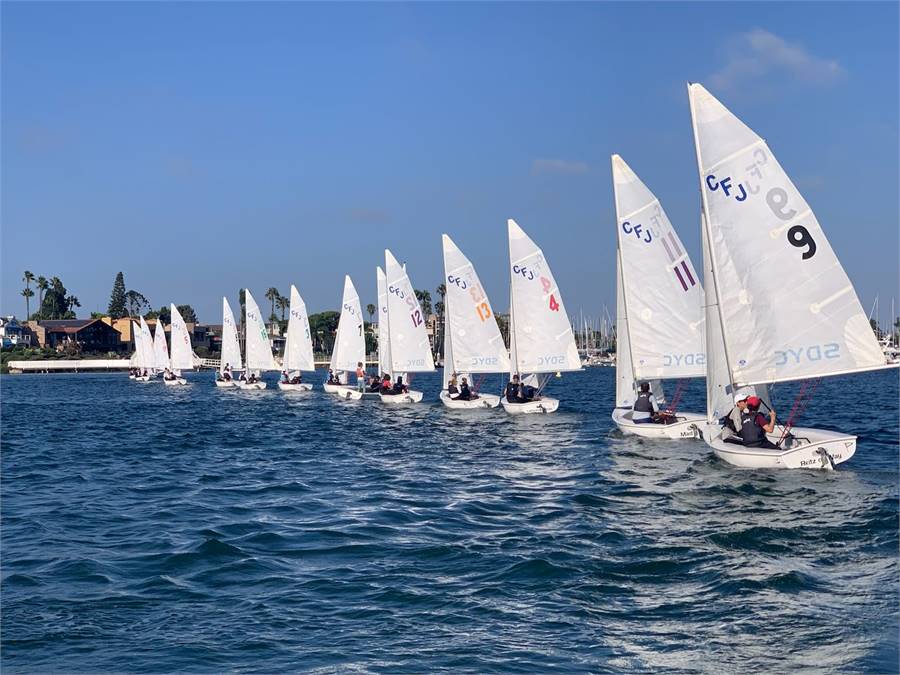
Recognizable to many youth sailors who grew up on lakes, ponds, or on the west coast, the Club Flying Junior (CFJ) is often used instead of C420s in youth sailing and collegiate programs. Originating in the mid 20th century in the Netherlands, it has spread to many clubs across the United States. The CFJ’s characteristics have made it a very popular on the west coast and on inland sailing venues.
The Boat: CFJ, Light Air Machine
The CFJ is a light, maneuverable boat at 13 feet long, 4 feet wide and weighing in around 220 lbs. Slightly shorter, narrower and lighter than the C420, the CFJ is designed to go upwind, fast. Narrow bow entry and a more rounded hull shape than the C420 means better upwind feel at the sacrifice of the ease of planing. A three-sail boat, the CFJ has a smaller main, larger jib and smaller spinnaker than the C420. The main sail is trimmed from the traveler bar in the cockpit and instead of having a mainsheet bridle to change trim angle, there is a traveler, which can be slid to windward or leeward. Additionally, jib trim angle can be adjusted from sliding jib block cars.

With only several thousand hulls in the water (as opposed to the nearly 8000 C420) internationally, the 2014 US National Championship saw a 53-boat fleet from mostly California based programs. In 2013, the World Championships in Germany had 57 boats from European countries.

Set Up and Sailing: Upwind Groove
While not nearly as much data exists for CFJ tuning as does for the C420, reliable tuning guides can be found from several sources (https://sail1design.com/wp-content/uploads/2014/08/NorthSails_FJTuningGuide.pdf) and here (https://sail1design.com/wp-content/uploads/2014/08/FJTuningGuide.pdf). Similar to the C420, mast rake and tension affects power in the rig and is adjusted from the chain plates and jib halyard tension respectively. Mast butt position is adjusted slightly to help the mast tip get forward or back.
Upwind the CFJ is lively and quick. It likes to point and drives off the large jib much more so than the C420. Traveler should be adjusted so that when the main is centerline, the top batten is parallel, or as close as possible, to the boom. This means traveler up in light air and back down towards the center as the wind increases. Jib trim is a very dynamic process in the CFJ. Car position should be adjusted so that the telltales both break evenly.
Because of its weight and hull shape, the CFJ responds well to boat handling and smooth maneuvers. It is very susceptible to side slip if not kept flat, which puts a premium on crew position. Because of the relatively wide transom, getting combined weight forward in lighter conditions is very important to break the suction that can occur. Driving the CFJ requires a light hand and a willingness to point to keep it in the optimum upwind “groove”.
Off the wind the CFJ will plane on main and jib alone, however for deep downwind sailing the spinnaker is used. Similar to the C420, the CFJ spinnaker is launched from a bow basket and flown by the crew. It is very important to keep the spinnaker round and full in order to maximize the sail shape.

Class Association: International Recognition
The CFJ class would be shortchanged if recognition of its international status was denied. The International Flying Junior Class Association (http://ifjo.org/) services the needs of this internationally raced one design class. Coordinating national, regional, continental and world championships, the class association has its hands full with the litany of participants from all of the major European countries as well as the United States and several others.
All one-design classes do not necessarily enjoy international class status. The C420 is not an international class, owing that honor to its close relative the International 420 (I420). International appeal means events can have a wide range of sailors from all over the world. It also means that events can require a bit of travel. Having a relatively small number of hulls (compared to the C420, Optimist, or Laser) in a large number of places can mean travel headaches for some wishing to compete on the regional or world stages.

Why the CFJ?
Talk to many collegiate sailors and they may tell you that they prefer racing the CFJ to the Collegiate 420. Talk to many west coast and European sailors and they won’t know anything else. Either way, the point is that the CFJ provides fast, exhilarating sailing in a responsive and nimble dingy unlike anything else its size. From junior sailors to college All-Americans, something must be right about the boat to keep them coming back for more.
To learn more about the c420, read our class profile!
The Dinghy Shop Fall Optimist Series: Can't Get Better Than This
Sailing Continues!
Want to keep sailing? Junior sailing ends in August, but that doesn’t mean that you have to stop. There’s a lot of great racing ahead at the Dinghy Shop in Amityville, NY.


Beginning September 7th, the Dinghy Shop will again open its beach to host the largest youth sailing series in the nation: The Dinghy Shop Fall Series. For seven consecutive weekends kids from all over the Northeast will come to race on the Great South Bay. Whether they are seasoned Red fleeters or just started this summer, the series is open to all and has tons of opportunities. If you want to keep going, come out and sail the 17th Fall Series. Instead of raking leaves, rake masts!

The Dinghy Shop Fall Optimist Series, now in its 17th year, starts Sunday September 7th through October 19th, with harbor start at 1 pm. Optimist skills clinics are available each Saturday from 10 am-4 pm. Preregistered sailor can leave their hull at the center. You can register online at www.dinghyshop.com. Preregistration ends 8/31/14.
REGISTRATION PAGE
Laser sailors race every Saturday. The Laser Fall Series starts September 13 and runs through October 18. Harbor start is 12:00.
Dinghy Shop Inc / 334 S. Bayview Ave / Amityville NY 11701 / www.dinghyshop.com / Tel: 631-264-0005


Meet the US Sailing Team Sperry Top-Sider – Team Haeger/Provancha

By Airwaves writer Martha Pitt
Do you know who is representing the USA in the Olympic sailing classes? You should! Meet the US Sailing Team Sperry Top-Sider, the 43 athletes who have dedicated much of their time, energy, money and lives to compete at the elite level and campaign to go to the Olympic and Paralympic Games in 2016 in Rio de Janeiro.
Bronze Medals at SWC Hyeres (c)US Sailing Team Sperry Top-Sider/Will Ricketson

Featured this month: Annie Haeger and Briana Provancha, #1 ranked US Women’s 470
Annie Haeger (East Troy, Wisco.) and Briana Provancha (San Diego, Calif.) began their 470 campaign while they were at Boston College together, and after graduating in 2012 committed to their Olympic goals full time. Since then they have been climbing the international rankings, peaking at #1 in 2013 and currently ranked #4 in the world. The duo have been training hard both domestically and around the world with US coaches and foreign training partners, and have been tearing it up at international competition. Their 2014 competition schedule peaks in September at the Olympic Class Combined Worlds in Santander, Spain where they hope to qualify the USA in the Women’s 470 class for the 2016 Olympics.
I was able to talk to them for a bit about their campaign, their experiences that have gotten them to this point, and what it means to them to be a part of the US Sailing Team.
Sail1Design: What made you two decide to campaign together?
Annie Haeger: Briana and I meet during a youth worlds in 2007 while both on the podium. Briana won Gold for the US in the 29er while I received the silver in the radial. I knew how driven and talented she was as a sailor and it seemed fate that we ended up at [Boston College] together! After she chased her dream of becoming an Olympian her Junior year sailing in a 470 for a couple months, I knew I wanted to follow her and do the same. I had always had laser radial dreams, but came to the realization that the 470 was a better fit. The rest is history!
Briana Provancha: We went to BC together and each had Olympic aspirations. We were great friends in college and it seemed like an awesome fit with each of our roles in the boat.
S1D: What does it mean to you to be on the US Sailing Team Sperry Top-Sider?
BP: I am proud to be American and to be able to represent my country all over the world doing what I love; it is such a special thing to be a part of.
AH: Having the American Flags and US Sailing Team stickers on our sails is an indescribable feeling. I am so proud to be representing our country on the international scale and to have the support system of the team itself!

S1D: What are some of your favorite things about being on the USST STS, and how has being on the team changed you as a sailor?
AH: I think the collaboration and support that the team gives you are some of my favorite things about US Sailing Team Sperry Top-Sider. During team camps, great minds in our sport come together in one room giving advice and sharing all of their knowledge. Open floor forums allow for information sharing and accelerated learning for all teams! I think being on the US Sailing Team has changed my perspective about not only representing Team Haeger/Provancha, but also the United States. I feel honored to be a part of something bigger than me, representing our country internationally and hopefully at the Olympic Games.
BP: As each year goes by, I learn more about myself and continue to grow as a person and I am proud of the person I am becoming while being a part of this team. Plus, I love messing with [Communications Manager] Will Ricketson!

S1D: What has been the most challenging aspect about campaigning and/or your campaign?
AH: Probably the most challenging aspect would be the amount of travel and fundraising required. During competition months during the summer, Briana and I are constantly living out of our suitcases often not settling down in one spot for more than two weeks. Though we are extremely lucky to be able to travel to many amazing spots abroad, being nomads takes a toll on relationships and energy levels!
BP: When someone asks me where “home” is, I say, “Well, I get my mail sent to San Diego, so there I guess”. Living out of a suitcase and always being on the go is definitely a lifestyle to get used to and is one of the most challenging parts for me.

S1D: Who have been the most influential people in your sailing career?
AH: My father has been by far the most influential person in my career. He not only introduced me to the sport but also has been my biggest support system throughout mine and Briana’s campaign so far. Whenever I need to bounce an idea off of someone, I know he will be all ears and steer me in the proper direction!
BP: [Boston College Sailing Coach] Greg Wilkinson and Boston College Athletics. They taught me how to be an athlete and not just a sailor.
S1D: Who are your favorite teams to sail against?
AH: The best teams to sail against are those who are competitive on the water but are still respectable and friendly off the water. Briana and I have made a good connection on and off the water with the Dutch team. It is always nice to be able to grab dinner with a team that you have just been competing at such a high level against.
BP: The 470 Women’s fleet overall is surprisingly very friendly off the water, which makes the racing more fun. On the water though, it is always a fight and I love the battle. I enjoy racing teams who are going to bring their A game.
S1D: What advice would you give other sailors who are interested in Olympic sailing?
BP: Learn to overcome the fear of being unsuccessful.
AH: Have something on the side of sailing that you enjoy! The first year of the campaign I often found myself thinking about sailing at most points during the day which lead to burn out. Having something off the water where you are able to put your energy post training or event will ensure that you are able to give it your all on the water.

S1D: So what do you like to do when you aren’t sailing the 470?
AH: I am super arts and crafty! Right now I am actually working on a scrap book from our travels.
BP: I enjoy cooking, spending time with my family and I’d be lying if I didn’t say keeping up with the Kardashians.
S1D: Do you have any rituals or superstitions relating to your sailing?
AH: The one ritual that I can think off the top of my head is our Parajos. We acquired our self-nicknamed Parajos during our first Palma last year in 2013. The morning that we arrived into the port from the ferry from Barcelona many members of the USST STS decided to stop and grab some breakfast before our housing was available. While we were sitting down in this cafe, an older gentleman (around 75) took great interest to our English and began speaking about us in Spanish to his friends. Growing up in San Diego and taking Spanish for many years, Briana was able to easily communicate with Miguel (as we later found out his name was) and I could see him falling in love. Miguel decided to sit at our table for about an hour speaking only with Briana making fun of the rest of us around the table. While we were winding up breakfast, Miguel asked us to wait for a second as he ran out to his car. He grabbed a painting that he had made the week before depicting two birds sitting in a tree and gave it to Briana as a gift. He asked us to come back and visit him at the cafe, which we did two more times before we had to get into what we call “regatta mode”. The Parajos have now become our good luck charm traveling with us to every venue! The one time we left them inside our car before an event, our car almost got towed. From that point, our ritual was as soon as we are settled into our housing Briana picks out the Parajos perch where they stay for the entire event.

S1D: Does your boat have a name?
AH: We have two boats at the moment both having meaningful names to Briana and me. “No Gucci” lives in the US and was our first boat on the 470 circuit! The name reminds us that we need to first learn how to sail the boat before dealing with all the fine-tune details of the 470. It is easy for some sailors to get sucked into boat work and tweaking that may not be as important as going out and actually sailing! Our boat that is our competition boat in Europe is named “10%”. This name is derived from an old saying for our Boston College Sailing Team that 90% of sailing is looking good. Though the name comes from an inside joke, it also reminds us that we needed to start the technical details of the 470.
S1D: What do you guys talk about on the boat when you aren’t talking about sailing?
AH: Sometimes during postponements, we will pick animals and see which ones would win in a fight… For example, who would win in a battle? Camel or donkey? I don’t know how this speaks to our maturity level, but it keeps us entertained for HOURS.
BP: [Another battle example:] A hippo or an eagle? Sometimes when we train, we talk in accents to each other. British, Red Neck and Asian are a few of our favorites.
S1D: If you were to reincarnate as an animal in your next life, what do you think it would be and why?
AH: 100% an eagle. I may be slightly biased because of the whole Boston College thing, but they are such amazing animals! They are a symbol of the US, seem very regale and are just boss animals. Not that I have thought about this question a lot before…
BP: Definitely something in the ocean, probably a dolphin. They are smart, good communicators and spend their day jumping through waves!

S1D: If there was one thing that you would like the readers of this article to know about you (that they don’t already know), what would it be?
AH: I am dyslexic which makes on-boat communication more difficult for Briana! The poor thing cannot depict what is happening in terms of right and left since I am not able to tell the difference between the two, in high pressure situations.
BP: I was my high school class Valedictorian.
S1D: What has been your favorite place to sail in international competition? Similarly, what has been your favorite place to travel to or visit?
AH: My favorite place to compete thus far is Lake Garda, Italy. I sailed there a couple of times way back when I was competing in my opti and would LOVE to go back and show Briana the area. The venue is a glacial lake which enables you to sail up directly to the massive cliffs! The hiking and biking around the area is spectacular which is right up my alley. Breeze works like clockwork there, coming in strong late in the afternoon. What can you ask for a better venue than great sightseeing, breeze and food??
BP: My favorite place to compete is Palma de Mallorca, Spain, minus the sand. We also got to spend a day in Rome. That was amazing!
S1D: What is your game plan for the next 2 years leading up to Rio?
AH: Our game-plan is to keep checking boxes off our list. The 470 is such a technical boat with many combinations of gear changes that seems quite daunting when starting out. Taking each day step by step and goal setting to be efficient as possible will hopefully lead us to our goal!
BP: We are working closely with Dave Ullman, our new coach and we are taking it one step at a time. Rio is still a long way away and we plan to focus on short-term goals, while still keeping the big picture in mind.
For more information on Team Haeger/Provancha, visit their webpage www.teamhp470.com
Follow the US Sailing Team Sperry Top-Sider on Facebook, Twitter, and Instagram through the USST Social Media Hub, where you can also sign up for the team’s newsletter The Medalist http://ussailingteam.uberflip.com/h/
About the US Sailing Team Sperry Top-Sider
The US Sailing Team Sperry Top-Sider is managed by the United States Sailing Association (US Sailing), the national governing body for the sport of sailing and sailboat racing. The top boats in each Olympic and Paralympic class are selected annually to be members of the US Sailing Team Sperry Top-Sider. US Sailing helps these elite athletes with with financial, logistical, coaching, technical, fitness, marketing and communications support. The title sponsor of the team is Sperry Top-Sider; other sponsors include Harken and Team McLube. Yale Cordage is a team supplier. The US Sailing Center Miami is an Olympic training site. Oakcliff Sailing and Clearwater Community Sailing Center are US Sailing Team Sperry Top-Sider training centers. Chubb Personal Insurance sponsors US Sailing’s National Team Tour, a nationwide presentation program for US Sailing Team Sperry Top-Sider athletes.
The United States Sailing Association (US Sailing), the national governing body for sailing, provides leadership, integrity, and growth for the sport in the United States. Founded in 1897 and headquartered in Portsmouth, Rhode Island, US Sailing is a 501(c) (3) non-profit organization. US Sailing offers training and education programs for instructors and race officials, supports a wide range of sailing organizations and communities, issues offshore rating certificates, and provides administration and oversight of competitive sailing across the country, including National Championships and the US Sailing Team Sperry Top-Sider. For more information, please visit www.ussailing.org/olympics.
Photo credits:
Hanging in the boat park (c)US Sailing Team Sperry Top-Sider/Will Ricketson
Sailing World Cup Hyeres, France (c)US Sailing Team Sperry Top-Sider/Amory Ross
Team HP at the Princess Sofia Trophy (c)US Sailing Team Sperry Top-Sider/Mick Anderson
Looking Up at College Sailing: What's it Really Like?
GETTING BEHIND THE BROCHURES…
By Airwaves writer Emma White
Over the past few years I attended several talks during clinics and regattas in which college coaches discuss and answer questions on collegiate sailing. Although I appreciate and learn from these informative sessions, I often wondered about the experiences and perspectives of the collegiate freshmen on the coaches’teams. What do they think? Are their experiences consistent with the coaches’comments? So, to learn more, I surveyed a number of rising collegiate sophomores who sail on top 20 teams to ask about their freshmen college experience.

What I found most interesting was the rigor of their weekly schedule. Here are some other findings you may find intriguing:
Most college freshman practiced 3-4 times a week, and studied 4 hours each day. No one studied more than five hours and no one studied less than one hour each day. Most sailed in more than 6 regattas their freshman fall and spring sailing seasons.
My survey also probed some deeper areas to draw out more about the freshman experience. For example, despite the close relationships high school and junior sailors may form with their teammates, most college freshmen sailors found their college team much closer and tightly knit. They reported that college teammates work well together and everyone is collaborative. Teams are often described as a family and within that family, each class is especially close. One sailor mentioned that while practices are competitive, meetings off the water focus on team dynamic and collaboration of the team. An example of team collaboration is upperclassmen reaching out to underclassmen to help them improve. These comments confirm the college coaches’emphasis on team chemistry often mentioned during the college panel discussions. Another interesting difference the sailors suggested is the competitive college team atmosphere on the water helps everyone improve, and while tensions may rise on the water, they immediately disperse off the water. In comparison, in high school sailing tensions that are high on the water tend to loom over the team off the water as well.
Thinking back to the college coaches’panels and different coach styles and presentations, I asked the sailors to share the most important thing learned from their college coach during freshman year. The responses spanned a wide range, but all underscore the important and lasting impact of a college coach:
- “The importance of team over the individual”
- Improve something everyday, you should always have a goal for practice
- One student was sick both semesters, and this individual learned the importance of taking care of one’s health before sailing
- Making the transition from junior sailing, with many boats competing at a time and long courses, to college sailing with 18 boats competing at a time and short courses is difficult. College coaches help sailors smoothly make that transition and adjust tactics and strategy.
- Each practice is precious time on the water and you should be pushing yourself (and other teammates)
- Life is split into three categories: sailing, social, and academics…you can only choose two

I also asked about the transition for high school to college, and the challenges of sailing with a new talented team. Some sailors found it hard to not start in all of the regattas, they had to learn to appreciate the virtue of patience before competing. Acknowledging the bigger picture of the team’s success is more important. As expected, the fleet is much more competitive than at the high school or junior sailing level. Circling back to the ⅔rule on sailor mentioned in the previous question, other sailors offered their similar input by mentioning the difficulties of managing school and a social life around a time demanding sailing schedule. However, some sailors mastered “maintaining a healthy balance of sailing, school, and activities outside of sailing”which led them to feel more satisfied with their college experience because they also enjoyed campus life. Finally, sailors felt pressure of representing their team and college with dignity.
Last, I asked the freshman sailors what tips and advice they would offer this year’s incoming college freshman sailors:
- Learn as much as possible from the upperclassmen (specifically seniors)
- Time management is critical
- Tough days are inevitable, so you have to remain positive and look forward to good days ahead
- Be as open minded as possible and prepared to adjust to a new level of racing
- Some teammates might underestimate you because you’re a freshmen, but remember that you’re still an integral part of the team
- Become as close as possible to your teammates, especially the seniors
- Be a leader and work hard
- In terms of exercise, focus on endurance training for all muscle groups and core workouts that pinpoint hiking muscles
I hope you found the college freshman perspectives as interesting and informative as I. Thank you to all the rising sophomores who completed the survey, good luck next year at school!