On January 20th, 108 sailors from eleven different countries still had no idea where in the Western United states they would race the 2017 DN World Championship, set to begin in two days.
“Welcome to Iceboat racing!”
An unseasonably warm weather pattern overtook the Midwest and turned most of the frozen lakes in the region to mush a week before the event was set to begin. Most iceboaters pray for a late January rain, we call it the Great Zamboni, but nobody likes to see three days of rain and seven days of temperatures in the mid-forties before a big event. Warm rainwater creates huge holes in the ice and turns the surface into a slushy, wet mess. It’s the equivalent of racing F1 cars on sandy track littered with potholes big enough to pull off tires. DNs thrive in a frictionless environment, but when pushing through soft ice, things get real slow, real quick.
By the 20th, competitors recognized that the most probable location for the regatta would be near Madison, Wisconsin but could be as far north as Lake Superior. Sailors on the Eastern Side of the United States started their drive West while competitors flying in from other countries waited for news in their stateside hotel rooms. Regionally, dozens of sailors were frantically test sailing all the lakes in the region looking for any sheet of ice that could accommodate 50 boats flying around a one mile long course at 50 mph. The temperature was still pretty warm so event coordinators pushed the first day of racing back 24 hours. The hope was that a forecast below freezing that night could harden up what ice there was. By noon the 21st, event coordinators called the event on for Lake Kegonsa, just south of Madison. The fleet was on the move!
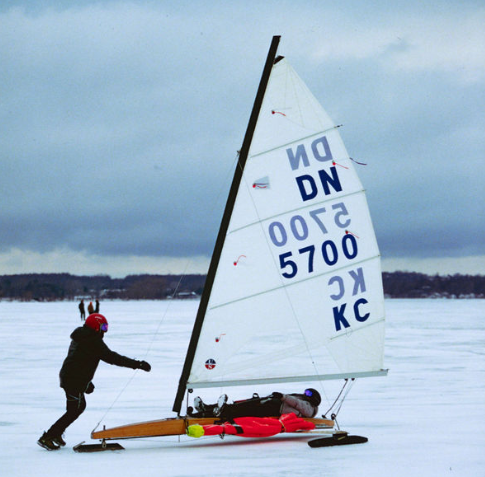
If you find yourself unfamiliar with the humble little DN (Detroit News), don’t worry. Most of the sailing community hangs up their sails for the winter and finds something warmer to do. For those of us that iceboat, we often find ourselves referring to summer racing as a way to pass time until we can get to ‘real’ sailing. The DN is a wooden, 12ft long, 100-150lb, DIY developmental class designed to hurtle a sailor around the ice at speeds up to 60mph (2-4 times the average windspeed). This community of competitors is filled with some of the most technically minded sailors in our sport. Names like Harken, Struble and Gougeon (West System Epoxy) permeate the sport’s history. Each home-built boat has its owner’s unique interpretation of go-fast techniques much like the Moth, 505 or A-class cat fleets. Sailors spend hours honing the runners (skates) to achieve optimum profile for the ever-changing ice condition. They constantly adjust settings to make the boat bend and respond to changing conditions. Unlike soft-water boats, where you can adjust most settings on the fly, DN racers only have a mainsheet and tiller once they leave the starting blocks. If the boat is set up too stiff it can be a wild ride, if you play it safe and sail the boat loose, you find yourself lacking enough power to keep up. It is without question the development-based culture of this design and thrill of the speeds that keeps sailors coming back year after year. Why else would somebody travel thousands of miles (from as far as Russia) to freeze their butts off on a frozen lake for a chance, and I stress the word chance, to get a couple races in?
The night of the 21st, sailors collected at a local DN racer’s business for a meet and greet, skippers meeting and the ceremonial singing of National Anthems. Sailors laughed and cheered as competitors sang their hearts out in a show of pride and community. It was refreshing to see such camaraderie between sailors from such vastly different cultures and communities.
The morning of the racing brought a flurry of commotion while competitors prepped for the day’s events. Some were still arriving from their travels while others were frantically testing their equipment for that last ounce of speed. Some sailors dragged multiple sets of runners and sails out to the course, others ran as simple a program as they could. The Ice had hardened significantly from the day before but 30% of the course was still covered by sticky patches of slush and there were marked holes everywhere. The breeze wasn’t forecasted to breach seven knots and after some laps around the course it became clear that this was to be a tough regatta.
The first three races of the day were qualifiers for Gold, Silver and Bronze fleets. Those whi have a lower international rank have to sail hard to qualify for Gold fleet. After everyone is seeded the race officials initiate scored racing. The regatta is considered complete at three Gold races with no more than seven races per fleet to be sailed during the event. A forecast of light air and potential snow over the next three days meant that there was little time to fix boatspeed problem. Each sailor knew the winners could very well be decided by the end of the day.
The first race of the day was sailed in sub-optimal conditions for high speeds. In six knots of breeze the Gold fleet left the line for a three lap race in intense, challenging conditions. Those that spent the extra time with their alignment and runner selection immediately showed speed. Sailors that were able to sail around the slush (much like big waves) and keep the boat going were able to stretch their legs and extend. The rest of the fleet piled into the first mark as best they could but a huge, soggy patch at the windward mark made transitions to the downwind challenging. Boats that could carry speed through the turn would make gains on the downwind, those that tacked short of the layline paid a terrible price. Carol Jablonski, from Poland, was first around the windward mark and he never looked back. The ten time world champion put together the perfect picket fence and ended the day with a four point lead on Matt Struble. Silver fleet sailed in similar conditions, but the top sailors in each race swapped a significant amount more than was usual. A local sailor, Tim Sugar, was able to string together two wins in race three and four ending the day tied for first. Bronze fleet sailed most of their races in the lightest winds of the day splitting the fleet into those who could get top ten finishes and those who couldn’t. By the end of the third race, Chad Coberly held a three point lead on second place before the sun got too low to continue racing.
The second day of the event was forecasted to be quite light and in a rare show of skill, the weathermen were right. Sailors walked their boats out to the starting line and waited for any sniff of breeze to try new settings. A sucker puff would show up every hour or so and cause a flurry of movement, but by 3:30pm it became clear sunset was going to be the only event of the day. Sailors packed up and made the long walk back to the staging area, pushing or pulling their boats along. The fleet derigged in the pits and sailors walked around sharing beers and jokes. You can’t bring this fleet down.
The forecast for day three was punctuated by a thick coat of rain and snow, followed by more light air. During the night, Madison saw 4-6 inches of heavy snow as the fat lady belted out her best. There would be no suitable lake in the Madison area and little possibility of race-worthy ice in the greater Midwest. Event organizers sent racers to several different lakes on the outskirts of the weather system to test sail whatever they could find. Meanwhile, competitors packed up and traded stories at a local bar that became the event’s unofficial home base. By mid-day, it was clear that no lake within one day of travel was suitable for further racing and it was announced that the 2017 DN World Championships was concluded. Not one person expressed dissatisfaction and you could see, it was smiles all around. The heart of an iceboater hopes for the best but accepts the worst. Each race sailed was fair and well-run; the fleet was happy.
Congratulations to Carol Jablonski for winning Gold Fleet for the 11th Time, Tim Sugar for 1st place in Silver fleet and Chad Coberly for a convincing win in Bronze Fleet. Full results HERE

Two days later the same fleet of sailors, including most of the international competitors, descended on Peshtigo, Wisconsin to do it all again for the 2017 DN North American’s. Nothing can crush the spirits of these sailors. The ride is too good, the community is too strong and there is always better ice around the corner.
Results, pictures, video and more information on the Class or event can be found on the DN North America website NA.IDNIYRA.org
Club Profile: James Island Yacht Club
By Airwaves writer Taylor Penwell Brought to you by: SELDEN & KO SAILING
The James Island Yacht Club sits just outside the beautiful and historic city of Charleston, South Carolina. Located on an amazing spot with stunning views of the Ravenel Bridge, Fort Sumter, The Yorktown, Castle Pinkney and everything else in the Charleston Harbor. The family oriented club sets itself apart by its affordability, down to earth feel, and volunteerism.
The club started as part of an agriculture society in 1895 and raced their sailboats against other surrounding islands in the Charleston area. The club was officially incorporated in 1905. The club has an equal share of sailors, powerboat enthusiasts and fishermen. With Charleston becoming such a popular moving destination the JIYC has seen a large influx of membership applications, which is always a good sign for a club.
The many great activities at the JIYC include fantastic sailing with regular year round racing, a summer junior sailing program, fishing clubs and tournaments, and community charities. There is a playground for children, mutual use grills, small beach area for relaxing and launching boats, and of course a bar that is open year round.
The sailing race scene is competitive with many highly awarded sailors calling the club their home. Racing includes PHRF, a frostbite series for Laser, a summer Sunfish series every Tuesday that can get 20-30 boats, along with Lightings and Thistles. The club has one of the biggest groups of foiling Moth sailors in the country. The Moth class association has held their North Americans, Nationals and other large events at the JIYC. In 2014, member Ned Goss set the world Moth speed record at 35.9 knots. Award winning club members consist of a three time Sunfish World Champion, a sailor with 28 National and World titles in five different boats, and other
sailors who have been winning events in the J70, J24, Thistle and Lighting classes. The club also has a great relationship with the College of Charleston’s Sailing Team. Kiteboarding has become a popular activity in Charleston and the JIYC included them in the Fort 2 Battery Race.
The JIYC junior sailing program has been around for years but about ten years ago the club decided to build up the program. A group of active sailors, Chris Hamilton, Ryan Hamm, Ned Goss, and Kurt Oberle and others made a concerted effort to shake things up and increase the size of the Optimist, 420, Sunfish, Laser, and Open Bic’s. Ten years ago the clubs junior sail program saw 25 kids go through the summer’s program and now its up to 120. The club wants to keep its junior sailing program growing and help sailors move from the summer program into the high school programs and college sailing.
Click here more information of the James Island Yacht Club,
http://www.jiyc.org/
A special thanks to James Island Yacht Club member and friend Ryan Hamm for supplying information on this great club.
Hudson River Community Sailing is Hiring
Founded in 2007 to serve the urban community, Hudson River Community Sailing partners with public schools to offer credit-bearing academic programs, internships, mentoring, and college readiness. Our youth development platform uses sailing, boat operation, and boat building to further academic skills and instill the qualities of character necessary for college and career success. We also serve the broader community through affordable marine education and recreation for individuals, groups, schools, businesses, and families.
Hudson River Community Sailing develops leadership and academic success in underserved New York City youth through sailing education and provides maritime education and recreation to the community at large.
Hudson River Community Sailing is hiring an Adult Sailing Instructor.
Adult sailing instructors teach sailing to adults aboard our J24 sailboats in New York Harbor. There is a lot of boat traffic and fast currents. The stress is on student participation and student-focused learning. All of our sails are hands-on, and the typical student has zero sailing experience. Your interpersonal skills will be as valuable as your sailing skills.
Club Profile: Severn Sailing Association Jr. Program
SSA Summer Junior Programs – Growing Lifelong Sailors
Severn Sailing Association (Annapolis, Maryland) has a long history of training youth sailors, whether they are just starting out in the Harbor Rookies class or competing at the highest levels of pre-collegiate racing. Thousands got their start at SSA, including alumni who have claimed regional, national, and international titles and awards such as Rolex Yachtsman of the Year.
At SSA, we believe sailing is more than just sport; it is a unique life-long activity promoting self-reliance, respect for nature, and teamwork . Our philosophy is to build sailing skills at all levels to ensure competency and comfort so that students will remain sailors for life.
SSA’s 2017 coaching lineup is one of the best ever assembled, consisting of talented men and women whose racing resumes and team affiliations speak for themselves. SSA coaches have years of experience and demonstrated character.
The 2017 coaching staff has an accumulated 55 years in experience coaching and instructing. They have sailed and/or coached in college and have competed in numerous national, international, world championship, and even Olympic regattas.
The majority of SSA summer sailors will be newcomers, and our coaching staff is prepared to deliver the right balance of fun, classroom, and on-water training needed to enjoy the sport and learn fundamental skills. For the more than 300 students, the instructor to sailor ratios are among the best in the region—all 1 to 8 or better.
For the more elite racers, three outstanding coaches were hired for Opti, 420, and Laser travel teams:
- Sam MacKay from New Zealand, a multiple-class champion and member of the Nations Cup-winning team at the 2007 Opti Worlds. For the past seven years, Sam coached Opti sailors to competitive success in Australia, New Zealand, and the United States.
- Carl Evans represented New Zealand at the 2008 Beijing Olympics in the 470 Class and won the 420 World Championship twice, so his credentials for coaching SSA’s 420 Travel Team are superb.
- Conner Blouin, assistant varsity sailing coach at St. Mary’s College and recent Pan Am Games athlete representing the United States in the Sunfish class. Conner has also campaigned his Laser Radial to podium success in recent CORK Olympic Classes regattas, so he will bring relevant and recognized expertise to the Lasers at SSA.
Check out SSA’s 2017 full coaching team line-up.
Whether your child is looking for fun as an adventure sailor or aspiring to be a national champion, come visit SSA and get to know us better.
Because our club is focused on developing sailors, we offer pricing that can work within your budget. Consider joining SSA as a member and receive a 25% discount on program fees, as well as many other benefits.
Click for more information and/or to register before classes fill up.
Profiles in Pro Sailing: John MacCausland
By Airwaves Writer Taylor Penwell
John MacCausland is one of the best US Star sailors, crewmember aboard Dennis Connors famous Stars and Stripes Americas Cup team, lifelong Laser sailor and part owner of the Moorhouse-MacCausland Sailing based in New Jersey. John was kind enough to take on a Q&A for Sail1Design Airwaves and here is what he had to say. Enjoy!
Who is John MacCausland
Q: Where did you grow up?
A: Cherry Hill, NJ.
Q: What made you want to get into sailing?
A: My father was a sailor and it was fun to race with him.
Q: What boats did you sail as a junior sailor?
A: I sailed Penguins, Moths, and Lasers.
Q: What drew you to racing?
A: I liked the competition.
Star Sailing
Q: How did you get involved in Star sailing?
A: My father raced a Star and would crew for him at times.
Q: How many years did you chase the World Championship before winning it in 2013?
A: I sailed my first Star Worlds in 1981 with my father as my crew.
Q: What keeps you in Star sailing? A lot of new faster boats being sailed now.
A: It’s in my blood, even with all the years I have sailed the Star I learn something new each time I go sailing my Star. It is a wonderful class and I have many lifelong friends that I enjoy racing against.
Q: What do you like most about the Star Class?
A: I enjoy the challenge of making a faster boat, there are a lot of things you can do with the boat. I was very involved in the building of my Star, from the development of the keel –rudder – skeg, along with the building of my mast. I enjoy building a better mousetrap.
Americas Cup
Q: How did you get yourself involved with the Americas Cup?
A: Through Star sailing I was friendly with Dennis Conner, he gave me a chance to try out for his crew for the 1987 Cup in Perth, Australia.
Q: Who did you sail with and what was your job on the boat?
A: I sailed on Stars and Stripes with Dennis Conner, I was the port jib trimmer.
Q: What was it like to be involved with the Americas Cup?
A: It was a full time job for 2 years of my life. We spent 1 year training in Hawaii and almost a year training and racing in Perth. It was a great experience, learning from the best. Dennis was very focused in winning the cup back, which he had lost in 1983. We were boat builders, sailmakers, sailors we all had to pitch in to accomplish the goal.
Q: What did you take away from your experience with the Americas Cup?
A: Hard work, focus and attention to detail go along way in reaching your goals. It was amazing how much work Dennis Connor put into his quest to win the cup back. He taught me that hard work and dedication are the way to accomplish your goals.
Laser Sailing
Q: How long have you been sailing Lasers?
A: My father bought me my first new Laser in 1972 it’s number was 852. I was 11 years old, way back then there was not Radial rigs or 4.7 rigs, needless to say a full Rig Laser is a big boat for an 11 year old!
Q: You still race Lasers competitively in the Masters Class, what accomplishments have you gotten in the class and what keeps you sailing the Laser?
A: I have won the Master Mid-winters twice and many district championships. I sail the Laser for many reasons, first of all it keeps me in shape, and second it translates to Star sailing very well. It’s easy to find big fleets to race with. Just like the Star it’s in my blood.
M&M Sailing
Q: Why did you start M&M sailing?
A: October 2011 I purchased Moorhouse Sailmakers which became Moorhouse MacCausland Sailing. The reason for this was after 25 years working for my father in Marine Spars our company that was the go place to buy any Star boat part you could imagine was closing. So I wanted to stay in the marine industry Moorhouse Sailmakers were a natural fit.
Q: How does it feel to have your work life connected to your favorite sport sailing?
A: To be honest I know no other way of life. From the time I left school to know this is all I have known. I feel very fortunate to have lived the life I have.
Final Questions
Q: What advice would you give to someone looking to improve his or her racing?
A: Learn how to start well and make whatever boat you race go fast. Speed Kills!!!
Q: What in your mind is the most important thing or things to consider when racing or campaigning for something like the Star Worlds or any other large goal.
A: Preparation is key. I always like to take all the variables away that I can before I even reach the race course. Your body needs to be physically prepared for the task at hand. You have to have the best boat that will not break down. You have to have the proper sails for the conditions you are going to race in and know how to use them. Then you are ready to handle what mother nature throws at you on the race course.
Q: Where do you see the sport of sailing going in the next twenty years?
A: In my lifetime I’ve seen sailing become more and more professional, more coaching and support. At the top end I think this will continue to go in this direction. This is a hard question to answer, I think a lot will change of the next 20 years. There are too many boats to choose from, which makes for small numbers in each class. I guess each area will have it’s own favorite class. Also midweek sailing is becoming very popular, with people having less and less time I could see this growing also.
Q: When you are not sailing or working what else do you like to do? What are your other hobbies?
A: Cycling, which is great exercise for sailing, also I enjoying hiking along the way I have climbed Kilimanjaro in Africa. I ski when I can. I enjoy the outdoors as you can see.
Hudson River Community Sailing is Hiring!
Hudson River Community Sailing develops leadership and academic success in under-served New York City youth through sailing education and provides maritime education and recreation to the community at large. Hudson River Community Sailing is hiring a full-time Youth Program Director. The Youth Program Director oversees the safety, quality, and educational effectiveness of all youth programs. Primary responsibilities include supervision, data-tracking and reporting, and program evaluation.
In A Nutshell
Founded in 2007 to serve the urban community, we partner with public schools to offer credit-bearing academic programs, internships, mentoring, and college readiness. Our youth development platform uses sailing, boat operation, and boat building to further academic skills and instill the qualities of character necessary for college and career success. We also serve the broader community through affordable marine education and recreation for individuals, groups, schools, businesses, and families.
Our Mission
Hudson River Community Sailing develops leadership and academic success in under-served New York City youth through sailing education and provides maritime education and recreation to the community at large.
Tips for Staying in Shape in the Winter
By Airwaves writer Paige Hoffman
Spring sailing will be here before we know it! In the Northeast, it is now far too cold for most competitive sailing. Aside from a few winter warriors up to the challenge of frostbiting, most of us have hung up our drysuits for the winter and are anxiously awaiting spring sailing. Being sidelined from sailing doesn’t mean you can’t start preparing yourself for spring. In high school, working out in the offseason is often not emphasized enough. In college, it’s generally expected that sailors compensate for not practicing by working out frequently. Staying in shape over the winter is a key component of your success in the spring. Below are some simple exercises for sailors that are sure to give you an edge on the course in April.
Although running itself is not a part of sailing, it is important to keep up aerobic workouts for maximum output on the water. Having a strong base in cardio helps to lower your resting heart rate, which makes your body very efficient during exercise. This will allow you to use less energy so those long, heavy breeze upwinds won’t seem so daunting. Typically, a slow pace distance run, about two miles, with a few sprints intermittently, is enough to improve your cardiac performance and lower your resting heart rate.
“Core” is a term that is frequently used to describe the muscles in your back, pelvis, and abdomen. Since hiking is such a big part of sailing (especially in the early spring), making sure you have a strong core is essential. Beginning with simple abdominal exercises is a great way to begin a workout. Bridges, side planks, and curl-ups are all great exercises to try.
Bridge
Side plank
Curl- up
If you want to include arm strengthening, it’s best focus on biceps, triceps and shoulders, as they will be helpful for trimming lines and rigging. Some exercises that help are simple biceps curls, tricep push back, and lifting weights for shoulder strengthening.
The most often forgotten exercise is stretching, and it may just be the most important. Stretching is essential to proper muscle function, and neglecting to do so could cause an injury. As sailors, we are often in tense positions for extended periods of time. Stretching allows our muscles to release its relaxed state. One of the best stretches for sailors especially is a hamstring stretch. You can do it with a yoga strap or a towel. This stretch releases the back of the leg, and if done consistently, releases tension on the lower back, two big problem areas for active sailors. Another great stretch is the kneeling quad stretch, which works the hip flexors. This is especially important for crews who often have tension and pain in their hip flexors from being constantly crouched on the centerboard trunk.
Hamstring stretch (with a yoga strap)
Sailors should have a general workout which incorporates some of these exercises and stretches. All of them can be modified based on your ability level. It’s not enough to simply read your rulebook once in the winter and hop in a boat come spring. The most prepared sailors are the most successful, and coming up with a workout plan is perhaps the best way you can prepare yourself for a winning season.
Paige Hoffman, Northeast/High School Sailing Airwaves Reporter
Paige started sailing at age ten at Duxbury Bay Maritime School. By age twelve, she was competing in Optis and transitioned to 420 sailing when she was fourteen, becoming a member of the Duxbury High School sailing team as a freshman in high school and racing through club programs at Duxbury Bay Maritime school in the fall and summer seasons. In the summer, she works as a Junior Sailing Instructor at Duxbury Bay Maritime School, teaching younger sailors the fundamentals of sailing. In 2016, she helped her team win the Mass Bay League Team Race Championship and was named co-captain of her team for the 2017 spring season.
Tight Layline Management & The Art of the Shoot
By Airwaves writer Andrew Kerr
Picture this: A team is approaching the weather mark in 3rd place on a tight starboard tack lay line , it looks like that with some good sailing they will make it around the mark ahead of 55 other teams and will be off and running with a good spinnaker set.
But then the situation changes quickly, the driver starts to get a little anxious and starts pinching, a port tacker ducks them and then tacks up on their hip preventing an escape tack and as the boat speed drops and the foils steadily stop lifting and in tandem with an ill-timed set of waves the boat slides to leeward with no chance of making the mark , now the team is forced to jibe and duck all oncoming starboard tackers before finally getting in line again to round the mark in 18th place .
Sound familiar? It happens to all of us and it happens fast , it is a very common issue in big and small fleets dealing with adverse current, on short beats and in flatter water and medium air (where fleet boat speed is very comparable) where there tends to be lot of traffic at the weather mark.
Interestingly enough – weather mark rounding’s tend to be a little less complicated on long beats in big waves or heavy air as the fleet has a tendency to spread out more in these conditions due to a bigger difference in boat speed and boat handling skill.
Let’s explore the key elements of managing this scenario and ways to mitigate and reduce the potential issues that a tight lay line presents.
- Cardinal rule – Do not pinch initially on the approach! If the team pinches it drastically reduces the chances of making the mark as the boat goes sideways. Take the mark out of the picture and go fast; get the maximum lift out of the foils and the boat will climb up to the mark – boat speed, boat speed, boat speed. This is one of those critical moments in the race and the series – calling lulls, puffs, wave sets and being locked in as a team is everything right now.
- Alert! Alert! We need an escape plan and the option of the slam dunk defense: Ask the question of your designated set of eyes to leeward -how many port tackers are going to duck us and how far away are they? This is critical information as any port tacker that executes a good duck and then a subsequent tack on the lay line is going to be pretty close to bow to bow on the next crossing if an escape tack onto port is needed and they represent a potential shutting of the door. With this communication it is important to be on the same page with the terminology that is going to be used – do you like to hear “bow 14 is 6 lengths away “or –“Bow 14 is 15 seconds away”? When getting close to the mark a defense against the port tacker ducking and then tacking on the hip is to execute a slam dunk tack on them as they duck – remember the constraints of Racing Rule 13 – tacking, a tacking boat shall keep clear of other boats and rule 10, 11 and 12 does not apply so the ducking boat could luff us as they establish a leeward position. The slam dunk takes a lot of practice and typically does not work in light air or big waves as the ducking boat is much faster and can sail right through the tacking boats lee. It generally works best in flat water and medium air or when very close to the mark when there simply is not enough time and distance for the leeward boat to sail through the lee of the tacking boat. This is where your tacking practice in a wide variety of wind and sea conditions will prove invaluable.
- Risk/ reward decision based on info and a scan of boats around us – are we going to make the mark? Are we gaining or losing bearing on it and how is the boat ahead (if there is one) doing on the same line as us? Do we anticipate getting tacked on by other boats which with the added bad air may make it difficult to make it? If it looks like the probability is we are not making it and there is a gap in the starboard tack parade then a high percentage decision, particularly in a big fleet is to tack and get in front of them while we can, if the crossing looks close – wait for them to go bow down in a header or a lull or hit a wave set and then tack and cross them while we can. The other scenario is we could well be net gaining on the starboard tack parade and patience will pay, especially if we see a lift ahead that can get us to the mark or a left shift or more velocity to tack on and cross with.

- Remember the constraints of Racing Rule 18. 3 – Tacking in the zone, in a nutshell if we tack in the zone then we cannot sail a windward boat up above a close hauled course, if we tack outside the zone to the mark then we can take them head to wind if we need to shoot head to wind to make the mark.
- The art of the shoot, with compliance to the above limitations that rule 18. 3 presents, if we cannot make the mark and there is no avenue of escape to tack too, then shooting head to wind is going to be the move. Practicing shooting head to wind in a variety of wind, sea and current conditions here will be invaluable so that we have an accurate idea of how far we can carry with our momentum. I remember practicing shooting head to wind just prior to the Ensign Nationals a number of years back and it paid big dividends as we were able to shoot head to wind , carry our momentum 2 boat lengths and make it around in a big fleet . Ideally when you shoot you drop the Genoa , if only half down to reduce windage – or roll up the headsail , very often a team does not have time to do this ( or has not practiced it) so it is crucial to make sure the headsail sheet is blown right off so it does not backwind us on to port tack . The trick is to get the boat going maximum boat speed and then wait as long as is possible/ practical before heading the boat up sharply.
Conclusion:
With tacking practice, shooting head to wind practice and concise communication and heads up sailing from the team it is rewarding for a team to make it around the windward mark successfully in a tight fleet as there is much to process and consider in a short time. The team being able to execute at this critical juncture in the race will help go a long way to solidifying a good regatta or series finish.
Club Profile: St. Francis Yacht Club
News Flash: St. Francis YC is Hiring a full-time Race Director!
St. Francis Yacht Club was founded in 1927 by a group of 21 San Francisco Yachtsman with a vision of a club in the City. Ground was broken for the clubhouse that year, and events were held on members yachts until the club was formally opened in 1928. In 1959, the Club acquired its Tinsley Island Station, located on the Sacramento Delta. Tinsley offers members a warm boating destination to escape the traditional summer fog on the Bay. In 2002, the membership celebrated its 75th anniversary of activity on San Francisco Bay and around the world.
The yachting interests of our 2300-plus members include racing, cruising, sailboarding, kiteboarding, water-skiing and more. Our sailors have challenged and defended for the America’s Cup, brought home Olympic medals, and won prestigious races such as the Whitbread, Transpac and Pacific Cup. Whether cruising in the Mexican Sea of Cortez or racing in the Olympics, a St. Francis Yacht Club burgee is apt to be seen.
St. Francis Yacht Club is a year-round host of over 40 regattas on San Francisco Bay, including the annual Big Boat Series each September. The Club was host to the 2000 US Olympic Sailing Trials, and continues to host World and National Championships. StFYC is also dedicated to the development of young corinthian sailors. Our junior sailing team (ages 10 to 23) races locally and internationally in Optimists, Lasers, Radial Lasers, 29ers, 420’s and Flying Juniors. Each year, our Club hosts the Laser Sailing Symposium, with invitations to the world’s most competitive Laser sailors. 
Our San Francisco clubhouse provides a boating and social venue for our members and their guests. It features large deep-water guest docks, outstanding dining and incredible vistas of the Golden Gate Bridge and San Francisco Bay. This is the premier location to view yacht racing on the renowned City Front. The Club’s annual calendar includes a wide variety of social events from theme parties, and winemaker dinners, to cruises both locally and far away. News Flash: St. Francis YC is Hiring a full-time Race Director!
Recently, the St. Francis Yacht Club was named #1 Yacht Club in the country. Quite an honor for a great institution
2016 S1D/KO Sailing Youth Sailor of the Year Announced!
Sail1Design and KO Sailing are elated to announce the 2016 winner of the Youth Sailor of the Year Award, Charlotte Rose.
Dedication. Perseverance. Independence. These are just some of the attributes of the go-it-alone sailor, the lone wolf who is able to train, plan, and compete by her or himself, and do it successfully. This award, presented by KO Sailing, goes to the North American youth sailor who best personifies the qualities necessary to be a successful athlete in the single-handed sailing world.
Says Mark McNamara, president of KO Sailing, “KO sailing is a major supporter for competitive sailors between the ages of 8 and 18, helpin
g them to compete at the highest level. To us, the Lone Wolf Youth Sailor of the Year Award is a perfect way to recognize those individuals for their success and achievements in their respective elements. There is a great synergy between what KO Sailing is doing on the ground, and at events, in support of what these recipients have achieved. This program is just a great way for the country to recognize those sailors as they grow. Sail 1 Design, with their expertise and as the information resource for all things one design, is the only team to work with.”
We had a tough time again this year choosing the winner, and our decisions are based not only on sailing excellence, but intangibles as well. Charlotte indeed had a tremendous sailing season, highlighted by finishing 3rd overall in the US Laser Radial Class Grand Prix championship, and 3rd in the Laser Gulf Coast Championship. More importantly, she is a stellar academic student, and comes from a school with no sailing. So, she has to do this all on her own; this is a great story, and we are impressed with Charlotte all the more because of her passion. We were very impressed with her drive, self-motivation, and self-reliance. Charlotte will receive a gift from KO Sailing. Here is a bit from her nomination letter:

I would like to nominate Charlotte (Charley) Rose from Houston, TX representing Houston Yacht Club and Gulf Coast Youth Sailing Association for the Youth Sailor of the year award 2016 as defining Dedication, Independence and Perseverance in her everyday sailing and life.
Charlotte was introduced to being on boats at a very young age, it wasn’t until she attended a summer camp at HYC did she have an opportunity to sail by herself. She competed in Opti from the age of 9 through to when she was 11, recognizing herself that sailing was her passion but would be going nowhere fast at 5’4” and 130Ibs, that is when she switched into a Laser 4.7.
Charley spent many weekends learning the boat on her own and at times with just a single coach. Eventually other sailors joined her in the radial rig. Charley persevered and excelled eventually getting the attention of GCYSA for who she has sailed with for the last 3 years.
Charley has learned that sailing competitively and wanting to do well is not just about boat handling; she dedicates her spare time to working out, currently twice a week at the gym as well as swimming for her school team. She has become fiercely dedicated to her sport and learning not just about the boat but the finer points of nutrition, fitness and psychology (mind fit) of the sport.
Charley has started giving back to the sport, during her weekends she can be found at HYC coaching mini or green fleeters, realizing that that’s where she started off.
Dedication means something different to a sailor, competitor and athlete than it does to a parent. So long as you have dedication and perseverance from both sides this should make for a successful outcome. As her Dad says, so long as she shows commitment and determination so shall I.
This perseverance and determination is starting to pay off, this year Charley has represented USA at Worlds in Mexico, finished 8th at MWE’s, 14th in Laser Nationals, 6th in Laser North Americans, 17th at Youth Champs, 2nd in the Smythe Cup, 3rd at High School Nationals, winning both district 13 (Florida) and district 15 (Texas) Grand Prix events, culminating in not just becoming a regular of the ODP travel team but also being invited to train with the US Olympic Sailing team in January 2017.
Charley is becoming more and more self-reliant, to the extent as to when she travels it is typically with a school laptop and a book to read. Charley is the only sailor at her school of 2,600 students, despite the amount of time she is spending travelling and sailing she maintains a 4.5 GPA.
For all the dedication to growing herself as a sailor to imparting her knowledge on younger members, perseverance of achieving her dream of sailing at the Olympics and independence in her drive, dedication to her studies and countless hours either flying or on the road, I believe Charlotte is a worthy recipient of the 2016 Youth Sailor of the Year award.
ABOUT KO SAILING
KO Sailing is a premier provider of performance and recreational sailboats, kayaks, stand up paddle boards and accessories for the competitive one design racer or the water sports enthusiast. Whether it’s a pair of hiking pantsfor your Laser sailor, kayaker, or your child’s first Optimist, KO Sailing will ensure your water experience is a success. KO Sailing offers three convenient ways to shop. Visit the retail store in Seabrook, Texas, visit the KO Sailing support trailer at a race event or shop online catalog at kosailing.com.
2016 Orange Bowl Results
By Airwaves writer Taylor Penwell
2016 International Orange Bowl Regatta/Coral Reef Yacht Club, Miami Florida/December 26-30th
Copyright OB16 Matias Capizzano
Starting the day after Christmas, many sailors partake in the Coral Reef Yacht Clubs International Orange Bowl Regatta as an annual holiday tradition. This top-notch event brings hundreds of sailors out of the cold and into the warm sailing conditions Miami has to offer. The regatta is so popular that within hours of registration opening in September many of the spots are filled.
738 sailors on 560 boats comprised this years Orange Bowl Regatta. Sailors from 17 different countries competed in the event.
Optimist RWB – 263 boats
Optimist Green Fleet – 74 boats
Club 420 – 89 boats
Laser Radial – 84 boats
Laser Full – 23 boats
Laser 4.7 – 27 boats
The five-day event consisted of three days of racing, with one day cancelled due to light conditions. The first two days of racing saw light winds from 5-10 knots. The third day of racing was cancelled but the final day of racing had stronger winds from 14-18 knots to close out the regatta.
Copyright OB16 Matias Capizzano
Ten races were scored in the 263-boat Optimist RWB fleet was split into gold and silver fleets
Gold fleet top finishers
- Stephan Baker: USA, Lauderdale Yacht Club
- Mitchell Callahan: USA, Lauderdale Yacht Club
- Sebastian Riquelme: MEX, Coconut Grove Sailing Club
- Benjamin Fuenzalida: CHI, CYA, LISOT
- Justin Callahan: USA, Lauderdale Yacht Club
Copyright OB16 Matias Capizzano
11 races scored in the 74 boat Optimist Green Fleet
Green fleet top finishers
- Ian Fox: USA, CRYC
- Ryan Keenan: USA, CRYC
- James Asturias: USA, Coconut Grove Sailing Club
- Gustavo Alonso: USA, KBYC
- Avinash Raval: USA, CRYC
10 races scored in the 89 boat C420 fleet
C420 top finishers
- Ivan Shestopalov & Claudia Loiacono: Coral Reef Yacht Club
- Cole Harris & Annabelle Huylard: San Diego Yacht Club
- Mariner Fagan & Aidan Morgan: Annapolis Yacht Club
- Theodora Horangic & Helen Horangic: PYSF
- Tucker Weed &Olivia de Olazarra: Coral Reef Yacht Club
10 races scored in the Laser Full class,
Laser Full top finishers
- Leo Boucher: Severn Sailing Association
- Chase Burwell: Lauderdale Yacht Club
- Skylar Bayman: Houston Yacht Club
- Ben Childerley: RSYC
- Jake Victers: Annapolis Yacht Club
Copyright OB16 Matias Capizzano
9 races scored in the 84 boat Laser Radial class split into gold and silver fleets
Laser Radial top finishers
- Gage Wilson: LYC-ESC
- Chase Carraway: Lauderdale Yacht Club
- Asher Zittrer: Lakewood Yacht Club
- Connor Nelson: DIYC
- Carly Broussard: Ocean Reef Yacht Club
Copyright OB16 Matias Capizzano
10 races scored in the 27 boat Laser 4.7 fleet
Laser 4.7 top finishers
- Blaire McCarthy: St. Petersburg Yacht Club
- Chris Purcell: CGSC
- Cameron Delgado: SPYC
- Brandon Geller: DIYC
- Nicholas Reeser: Lauderdale Yacht Club
Congratulations to all the top finishers and the results of the 2016 Orange Bowl Regatta can be found on this link below: RESULTS
Club Profile: Lauderdale Yacht Club
News Flash: Lauderdale Yacht Club is Hiring!
Lauderdale Yacht Club opened in June 1938 for the purpose “to promote the science of seamanship and to provide and maintain a Clubhouse, piers and anchorage for the recreation of its Members and to make available for the youth of the community the opportunity to learn and practice seamanship and to render benevolent aid to the youth of the community interested in learning seamanship.” Since then the Club has been very involved in all aspects of Sailing, Yachting, and Boating but has also expanded into a full service Club and destination that includes Fine Dining, Social Activities, a booming Tennis Program.
With its interesting history, rich tradition, and modern flair, the Lauderdale Yacht Club will continue to grow and prosper with all of its loyal Members.
| THE LAUDERDALE YACHT CLUB JUNIOR SAILING PROGRAM |
The mission of the Lauderdale Yacht Club Youth Sailing Program is to promote and teach the sport of sailing and seamanship to the youth of the Club and community. In addition to teaching sailing skills, the program emphasizes sportsmanship, life skills, teamwork, and an appreciation for fair competition between peers. Those participants dedicated to the program will have experiences that will benefit them for a lifetime. All the LYC instructors will share their knowledge and experience through a structured curriculum.![]() The Lauderdale Yacht Club offers a year round sailing program for sailors of all skill levels. Click on the menu tabs to find out more about the many sailing opportunities our Club has to offer. News Flash: Lauderdale Yacht Club is Hiring! |