25 September 2016, Centre Island, NY – On a brisk fall Sunday morning at Seawanhaka Yacht Club, parents, coaches, and kids huddled under a massive tent for the skippers meeting on this, the second and final day of the 2016 Optimist Atlantic Coast Championship. Back-dropped by a gorgeous clubhouse, the food spread in the tent was fantastic, bordering opulent, and the view from the rolling grass hill down to Oyster Bay harbor was, and is, beautiful. What a wonderful place and a great opportunity for Optimist sailors.
Right on time, the competitors meeting was called to order by the club’s PRO. A club member, the PRO was dressed in traditional yacht club officer attire, complete with formal nautical hat. He offered a quiet but dignified presence as he asked for attention, but the crowd didn’t seem to be tuned in. For a moment the scene reminded me of a lonely flight attendant offering passengers safety advice before a flight.
Patiently, but with purpose, the PRO offered a very nice allegory of times gone by, when sailors who weren’t paying attention would climb the rigging of naval sailing ships, play around, and sometimes whistle, a practice called “Skylarking.” Today we may call it “horseplay.” I think the message was a dual one; a sailor whistling in the rigging while shirking duty was thought to bring storm winds, and since we didn’t have much wind at all on the day before, we were all asked to whistle for more wind on Sunday. Also, and more subtly, however, I think the PRO was reminding the crowd to pay attention, and to respect the event.
Then, and what I found most compelling, the PRO offered his sailing observations of the day before:
- Boats were hitting each other, very often, and without consequence. No protests filed.
- Several sailors, clearly over early just before a start, were overheard compelling their fellow competitors to remain over early, so that the race would be abandoned and a general recall called.
In my short time following the class, these observations are made too often, at regional and national-level events. In fact, the PRO of the 2016 New England Championship earlier this summer, offered very similar observations to parents after the first day of sailing. It is a problem, it’s not going away, and it needs to be addressed.
Not all is lost, by any means. Getting lots of kids involved in sailing is great. Having lots of enthusiasm and organization is also great. The Optimist Class Association has a pure mission and is filled with caring people. Smaller fleet Optimist regattas abound, green fleet events provide a perfect platform for beginner development, and team racing offers great competition. Also, to be fair, these kids are young, and of course mistakes are more likely, and those mistakes should be treated with patience.
However, are we at, or beyond, a tipping point, where rules and proper sportsmanship are sacrificed for numbers and show, and where fleet sizes have become unmanageably large? And, are we as race administrators and yacht club hosts ultimately to blame, and in fact inviting this problem ourselves? Yacht Clubs seem to take almost sadistic pride in out-registering each other for regional and national Optimist events. Sail Newport claimed with glee and honor that the 400+ competitors constituted the largest single one-design regatta ever held there (or anywhere, maybe). I have heard other exclamations of “ours was the biggest” at similar events in different locations. That’s great, but so what? Maybe the sheer size of these events is actually the root of a problem that is teaching our young sailors poor lessons on the water. It’s great that kids want to register, but after a certain point, do we lose the ability to hold a valid, safe regatta that develops proper skills? What’s more, the larger the fleet, it seems, the less the racing, and the more the waiting.
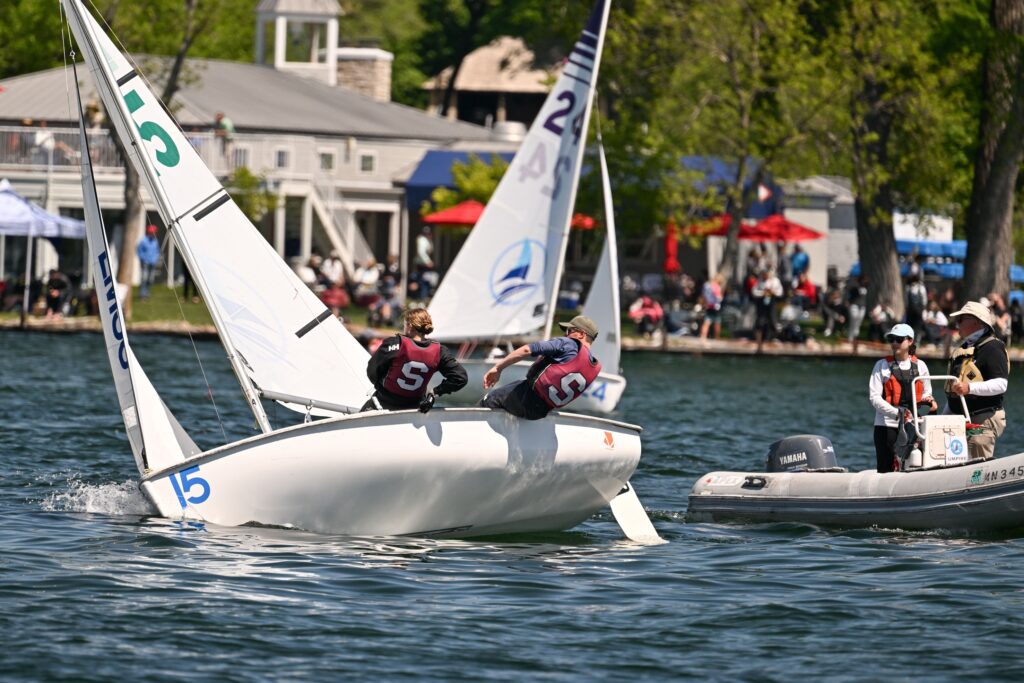
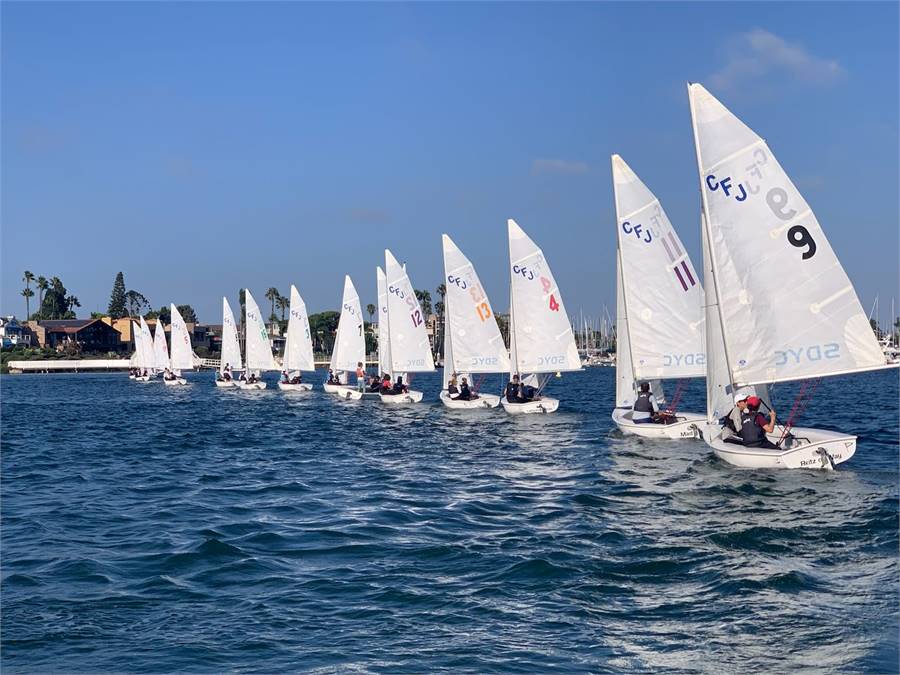
With 20-30 coach boats swirling around, we’re putting 100+ kids on massive starting lines in 2-3 heats, where in many cases collisions are inevitable, fouling is rampant, and starting becomes an all-or-nothing, rules-be-damned gamble. Learning to “get off the line” at a large Optimist event can teach bad lessons, as the Seawahnaka PRO noted, ones that kids then take to the next level. “Successful” sailors become role models for the younger ones, and the younger ones watch, and emulate, what they do. At that next level, where fleet sizes almost always go way down, not only do these poor habits not work, they have to be un-learned, and quickly. And, that can lead to disappointment, and can also lead to kids leaving sailing. And if they are not un-learned, those sailors almost invariably damage their reputation with their peers.
These may well be, by far, the largest fleet sizes many of these kids will ever encounter, at the ripe old age of 10-15. Are they really ready for it?? Is this good development, or what’s best for them at this age? The number of boats on the line in Optimist events compared to protests filed seems to be very uneven when compared to other one-design classes. We discourage protests while we encourage situations where they are going to happen, to the very group of sailors (kids) who are least experienced with rules knowledge.
Forget for a moment about sportsmanship; huge fleets of Optimists can simply be a safety concern. Two hundred, three-hundred or more singlehanded sailors on the water can be a logistical nightmare, but it can also be an accident waiting to happen.
At the end of his remarks this Sunday morning, the Seawanhaka PRO recalled advice from a friend, and reminded us that a poor reputation, especially in sailing, can be made in 5 minutes, but can then take a lifetime to change. There is so much that is right with the Optimist dinghy and the Optimist class. I hope that the class will address his concerns, and continue to provide incredible experiences for our kids.
We invite your comments, and they can be posted by scrolling down and writing them in the “Join the Discussion” box.


team, and even when your not sailing support them. This can be hard at times, but by showing your commitment to the team you will show your coach your dedication. Being on a team is a great experience, and you will make life long friends!
The International Etchells Class concluded its 
Max Kurland is in his second season as the head coach of 
moved on, my old skipper Conner Blouin came on as head coach for two years and really kick started the program and reinvigorated the team with a new culture of sailing. After coaching for two years, he got an offer from Saint Mary’s College of Maryland, so I applied to be head coach and got it!


With the fall sailing season already beginning for high school and college sailing, athletes have been preparing all summer with preseason activities to give them an edge on the course this year. Recently, I had the experience of travelling down to the College of Charleston to participate in their Advanced Racing Clinic for high school sailors. The clinic is geared towards providing sailors with coaching necessary to bring their sailing to the next level in high school or collegiate fleet and team racing. I’m very pleased to say I had an extremely beneficial experience in South Carolina, and that I would highly recommend the clinic to other sailors looking to enhance their performance on the course.
College of Charleston head coach Ward Cromwell, who has led the team to countless national championships, coached the clinic, which took place at the college’s own sailing center, the J. Stewart Walker Sailing Complex. Sailors from all over the country attended, coming from states including Maryland, Massachusetts, Michigan, Texas and California. Day one of the clinic began with introductions between the sailors and coaches and a detailed review on z420 and FJ tuning.
The early stages of the clinic focused extensively on specific rig tuning techniques and adjustments. That evening, after a productive day on the water, clinic attendees were invited to participate in a weekly informal fleet race hosted at the sailing complex With twenty one of the college’s FJs and 420s participating, it was very well attended, and the racing was quite exciting. Nights were spent aboard the USS Yorktown, an aircraft carrier from the Second World War. That in itself made the experience unlike any other I have ever had sailing, working with some of college sailing’s best coaches while also exploring the historical side of the city I was sailing in.
Days two and three went by far too fast. Focusing mainly on team racing, sailors started off doing mostly combo drills, followed by starting drills and racing. Time on the water was followed by a lunch on land and video debriefs. These on-land sessions helped the sailors unwind while focusing on key areas of improvement before heading back out to sail. No time was wasted, with almost the entire day being spent exclusively at the sailing center. Extra curricular activities, like visiting College of Charleston’s campus, were arranged by sailors from the college who had volunteered to help. Before I knew it, it was time to say goodbye to my newfound love of Charleston and head back to Massachusetts.
Sailors don’t have the benefit of playing a game on a field that never moves or changes. By participating in this clinic, I took myself out of my comfort zone of sailing with familiar people in familiar places completely. As athletes, thinking of ways to challenge ourselves on and off the water is part of what we do, and I am so glad to say that this summer, I was able to do just that and gain a tremendous understanding of how diverse sailing can be in the process.
oyster shells at the foot of Duke of Gloucester Street, which, in 1888, became the Clubhouse for the formally organized Severn Boat Club. This oyster pile was rented from St. Mary’s Church and was next to a rickety wooden bridge across Spa Creek. In 1897 a new clubhouse was built and was enlarged in 1912.

Today you’ll mostly see PVC technical clothing in the commercial fishing market, where its durability and smooth shiny outer surface suits it well. Proofed nylons were starting to become available, either coated with a polyurethane or neoprene. The main difference was that the waterproof element was on the inside of the garment, protected from abrasion by the nylon layer. This fabric could be sewn in a conventional way giving better fitting and styled garments.