Sail1Design annually seeks your nominations for the Henri-Lloyd S1D Coach of the Year, for a coach that embodies the qualities (and more) listed in the article below. Sailors, this is your award! The Sail1Design staff chooses the winner only from our readers nominations! This is a great opportunity to recognize a coach that you feel makes a difference! Please write a detailed nomination letter to [email protected]
Nominations close on 15 JUNE 2016
Henri-Lloyd generously supplies the winning coach with a new HL Jacket, and a $500 gift card for Henri-Lloyd Online, to shop and get some of the worlds best sailing technical gear.
All good coaches, regardless of their chosen sport, share some important fundamental qualities that transcend technical knowledge, or specific x’s & o’s. In other words, whether it’s a basketball, tennis, hockey, football, chess, or sailing coach, there are certain key characteristics to good coaching, and none of these really requires technical knowledge of the sport they are in.
Here are some of those characteristics: logistics, organization, energy, leadership, passion, creativity, patience, dedication, motivational skill, humility.
I would bet that you could take a good coach, put him or her in a new sport, and that coach would find some success. Think about the best coach you ever had, and visualize that person in another sport, and you might see just how that person could adapt and still be a difference-maker.
However, we all know that great coaches not only possess these core qualities, but indeed they are also masters of the subtleties, rules, and technical chess moves of the sport they are involved in. Very often, great coaches are former players themselves, and often they are good, but not necessarily great players. In any event, it seems virtually certain that actually having been in the arena at some level, having been a true game player, is a necessary ingredient for a great coach.

So then, what an important advantage sailing coaches have, since the sport allows lifelong top-level competitive opportunities. While it would be impossible for a middle-aged football coach to live, first-hand, what his players go through on the gridiron, middle-aged sailors and coaches can stay current, and can compete right alongside the world’s best sailors, and even win world championships in sailing. Opportunities exist in team racing, match racing, and all types of one-design classes offer regattas, year-round. In this manner, sailing coaches have the ability to get inside the sport, at the highest levels, learn more, and feel the same things that their players go through out on the race course. The empathy gained here is a very powerful tool that great coaches employ when coaching.
Getting into the rhythm of a sailboat race, realizing first-hand the excitement and frustrations of the sport, preparing mentally for each race, “knowing when to tack”, these are all things that coaches must be able to talk to their players about, and talking to them about these things is so much more clear and present when done by someone who is actually good at them, and has done them recently at a high level.
For example, it was always easy for me to say to a team, “make sure when you are in FJ’s at the starting line to allow yourself more leeward room to accelerate since the foils are small and the boats need to go bow down first before they start lifting.” It was really easy to say. It was quite another thing to actually do it, and to go out on the starting line, in FJ’s, and practice what I preached. That was a LOT harder, and I drew a great deal of empathy with my players from that situation and recognized better ways to talk about it and to talk them through it, having been there myself. This is especially true in team racing, where coaches can see plays easily on the coach boat or on the drawing board, but it’s one thing to talk about a mark trap at Mark 1; it’s another thing altogether to go out and be able to execute it. Without being, or having been, in the arena, sailing advice and technical coaching can be somewhat hollow compared to other sailing coaches who know it first-hand and live what they coach.
So, when you look to your coaches for advice or to get to that next level, or if you are a interested in sailing in a college program, take a moment and check out the coaches resumes, just as they will most assuredly be checking yours. The list that makes coaches good coaches should be there for sure, but see if the coaches list how, or if, they stay current in their profession and have the passion to go out on the racecourse themselves. Great coaches usually always have a story, and very recent one, of a lesson learned at a regatta they sailed in themselves. They love to sail and get better, if only to become a better sailor and coach.
While there is a short list of coaches who choose to (and can) do it all, many top collegiate programs now share these coaching qualities by hiring an assistant or co-head coach, who is very often a recent college sailing alumnus and is active in dinghy racing and brings that empathy, right away, to the team. The head coach then ties everything together with experience, maturity, management, and knowledge of the game.

If you’ve ever noticed, baseball coaches actually suit up for games even though they certainly won’t be playing. This historically comes from the old “player-coach” model, and perhaps, this connects them with the game and the player more intimately. Sailing offers the unique ability for all ages to compete at the highest levels of the sport, and great sailing coaches take advantage of this, “suiting up” themselves and making themselves better at coaching by sailing competitively.
About Henri Lloyd
Henri Lloyd was established in 1963 in Manchester, England. Mr Henri, as he is known, founded the company based upon hard earned principles of honesty, integrity and freedom and it is these principles that are the foundations of the Henri-Lloyd brand today. One of Mr Henri’s many talents, passed on to his sons who have steered the business for the last 2 decades, is the ability to treat everyone with the same level of genuine interest, wit and charm whoever they are.
Henri Lloyd’s staff are committed to providing the best service to you, and are always happy to help should you need any assistance in selecting your products.
Past S1D Coach of the Year Winners
2015- Frank Pizzo
2014- Chris Dold
2013- Steve Hunt
2016 ICSA TEAM RACE NATIONALS PREDICTIONS & PROGNOSTICATION!


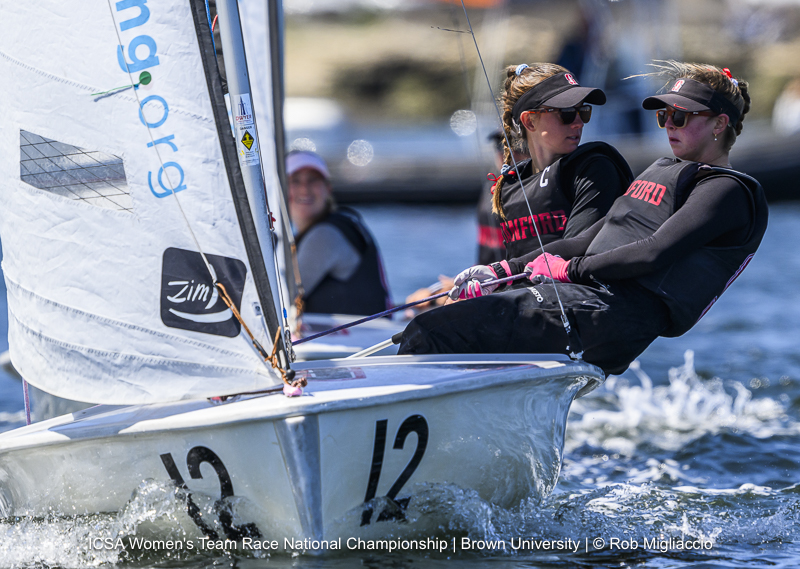
21 MAY, 2016 – Sponsored by Dynamic Dollies, on the eve of the 2016 ICSA Team Race Nationals, here are our ICSA TR Coaches bold predictions and prognostications. Panelists include Ken Legler (Tufts University), Zach Marks (Eckerd College), Clinton Hayes (Stanford), and Johnny Norfleet (Fordham) and Bill Healy (Yale). Follow the action here: http://2016nationals.collegesailing.org/

SailFuture: A Compelling Mission
Editors note – Once in awhile, a company comes along with a mission compelling enough to stand up and take notice. Sail1Design had 2 job posts the other day from SailFuture, and we believe this is one of those companies. Sailing is a wonderful pastime, sport, and endeavor. SailFuture seeks to blend the inimitable joy of sailing with a challenging, but worthy mission, one which Sail1Design applauds. We wish them nothing but the greatest success, and we hope you will consider their career openings.
SailFuture is HIRING
Service Learning Teacher
Mental Health Counselor
SAILFUTURE UTILIZES THE OCEAN AS AN ALTERNATIVE TO INCARCERATION FOR HIGH-RISK JUVENILE OFFENDERS AND INNOVATIVE MENTORSHIP PRACTICES TO PREVENT AT-RISK HIGH SCHOOL STUDENTS FROM ENTERING THE JUVENILE JUSTICE SYSTEM.
SailFuture’s mission is simple: create transformational experiences that empower youth to transform
their lives.
This is not a typical group home. It is not just a place to sleep, but rather a community and secondary
family dedicated to building real and meaningful relationships. Youth will be held to exceptionally high
standards and constantly pushed to reach their full potential.
The SailFuture Group Home model engages crossover and defiant foster youth in a 3-month service
learning program where they live on board a 65-foot sailing vessel and sail around the state of Florida,
leading community service projects at each port of call.
Prior to departing for the service learning program, youth spend 30-days living in a licensed group
home to learn how to sail and determine if this opportunity is the right fit for them.
After the assessment period, youth depart for 3-months to sail around the state of Florida while
leading powerful community service projects and earning their GED or high school diploma through a
fully accredited education program while living on the boat.
During the sailing journey, each youth works with a mental health counselor to create their own
“Personal Development Plan,” outlining their employment, housing, and education goals.
Upon completion of the sailing journey, youth return to live in a licensed group home until their 18th
birthday. Youth work with the same counselor and teacher they lived on the boat with to make progress
on their defined employment, housing, and education goals. All youth are required to participate in an
internship or part-time job while finalizing their high school education or GED when living in the group
home.
Following their 18th birthday, youth will have the opportunity to join the SailFuture graduate living
community in a nearby apartment building, where youth receive subsidized rent and continued
counseling and support, as well as professional networking opportunities.
BOAT DETAILS
SV Defy the Odds is a 1990 MacGregor 65’ Pilothouse. The vessel has 12 beds and 2 bathrooms, a full kitchen, a 110HP Yanmar turbo diesel engine, and a full racing sail inventory. The vessel was acquired in December ‘15 and a $100k overhaul was completed in May ‘15.
All youth will have individual beds in shared cabins. The Master Stateroom will be reserved for staff. In the case of an emergency, SailFuture does have a restricted room that can be used; the isolated aft cabin has a separated entry and exit from the rest of the vessel. In the event of a medical emergency, SailFuture has established response procedures and staff training to provide first responder care on board. A full trauma kit with epi-pens will
be on board at all times. Learn more here: http://www.sailfuture.org/
US High School Mallory Dinghy National Championship Report & Results
By Airwaves intern Jordan Newland
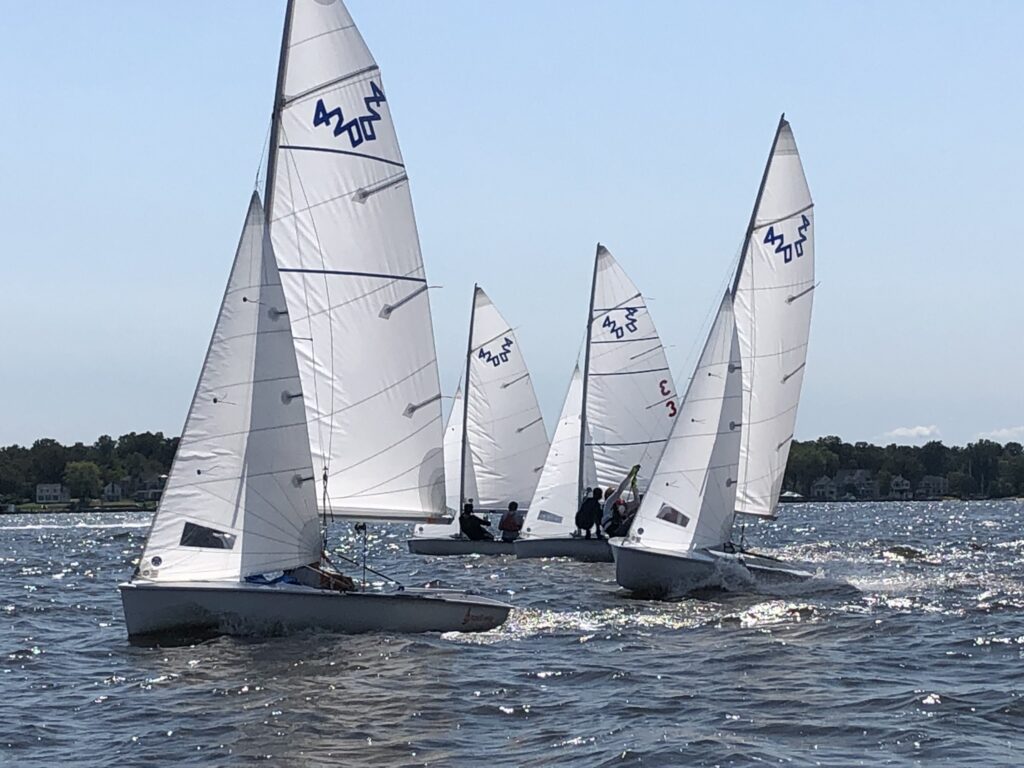
The Mallory Trophy is the pinnacle of high school fleet racing. The Mallory Trophy is ISSA’s double-handed national championship regatta in which the teams sail 420s and FJs. It was comprised of two fleets, A and B, and was hosted by the Collage of Charleston on the 14th and 15th of May. Twenty of the United States best high school sailing teams faced off in this regatta. They came from the seven interscholastic Sailing Association (ISSA) districts. To qualify for the Mallory Trophy, they must have made it to their districts’ Mallory Elimination regatta and be one of the top three teams overall in that regatta. With all of the diverse talent and Collage of Charleston’s new Z420 fleet, this regatta was a real testament to teamwork.

FULL RESULTS HERE
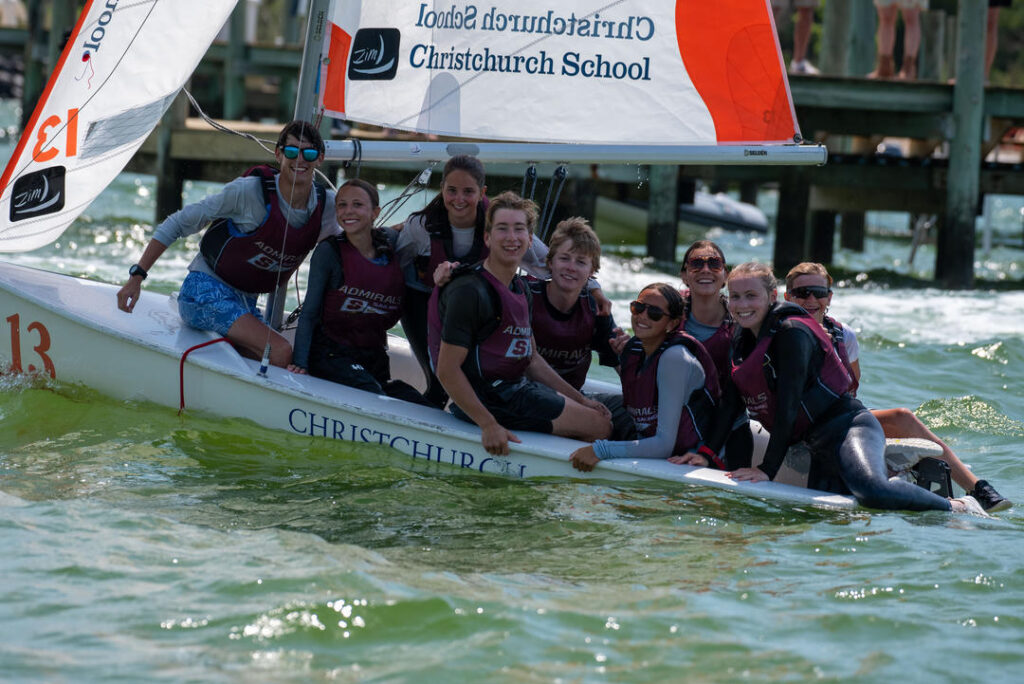
The first day was a beautiful 75 f with a breeze between 7-12 knots coming out of the west. They raced from 10:00am to after 6:00pm getting in an astounding 14 races per fleet, 28 races in total. These races tested the sailors’ skills with medium to heavy wind and current with its occasional 20-knot gusts and 5-½ foot tide. Clear Falls’ Knights from the southeast district ended the day in first place with a score of 119 points. They had a 56-point lead on the next team ChristChurch from the mid-Atlantic district. Point Loma Pointers from the Pacific Coast district followed ChristChruch with a score of 179 points.
The second day was shorter than the first; it only lasted from 9:30 am to about 1:00pm. It stayed a mellow 74 the whole day with a westerly breeze of 8 knots that weakened throughout the day. They finished six races per fleet before they called it a day and a regatta. Clear Falls kept the lead with a final score of 203. Point Loma came in second with a score of 241 points, and Shorecrest Prep came in third with a score of 276 points.
The sailors out did themselves with this regatta. They sailed fast and endured long days of continual racing with a total of forty races. No protests were heard the whole regatta and only two redresses were requested with is very surprising for a regatta of two twenty-boat fleets. Of course, these races would not have been possible with out all of the volunteers. A multitude of Collage of Charleston sailors helped with this regatta, from the coaches to students to dock men. There were also other volunteers such as Ryan Hamm and Ryan Davidson who lead the races and starts. The 2016 ISSA Mallory Trophy Championship ended up being an amazing fleet regatta for all of the teams present and was a great experience for all.
On Coaching
By Joe Cooper
With summer not far off, sailing programs around the country are gearing up for their sailing lesson sessions. There will be high school sailors teaching and coaching Opti sailors, college sailors teaching and coaching high sailors and adult coaches, coaching the college sailors. The interaction between instructor and student is an important one. I am in my seventh season of coaching the Prout High School team and have learned quite a lot about how to not only ‘coach’ but also how to mentor high school students in sailing teams. Here are some of the themes I have found to be important.
RESPECT
The first thing is to actually remember the names of your students. This sounds basic but with 20 sailors I see for only 2 hours a day, three days a week, it can get to be a bit, well entertaining. I discovered last year to my embarrassment I was calling Flora, Fiona and only found out abut it about three weeks in when Flora mentioned it to me, rather casually really.
How one addresses the sailors is important. Today’s society is very used to casual language and, ‘hey guys let’s go’, encompasses almost everyone. I am old enough to have been taught the courtesy of referring to females as Ladies. When I wish to speak with the group, rather than the common, ‘hey guys listen up’ I prefer the, possibly old fashion but more suiting to my personality of ‘Ladies and gentlemen may I have your attention’. If there is a small work party or some other similar small group of sailors I wish to address or instruct I use the same phraseology.
Respect is of course a two way street. Over the years I have made it clear to new team members that if I am speaking, I require their full attention. This includes actually listening to what I am saying, not speaking and NOT using their phones. If I see such inattention I simply stop talking and wait. I do NOT call out the person, but simply wait until either the silence, the stage whispers or the elbow in the ribs brings the attention of all back to what I am saying.
COMMUNICATION

This is very important in sailing for many reasons-Technical concepts, a new language, wind noise and your tone of voice are but a few of the variables a coach needs to be aware of and manage. I tell all my new sailors that they will be a bit confused at first by all these elements. This is made no easier coming from me. Apart from all of the above, I have an Australian accent, I tend to talk fast when excited and, although I am getting better at NOT doing this, I often use sailing slang when speaking in a hurry. ‘Crank the vang’ may as well be Urdu for ‘what’s for dinner’ to a new sailor. So use the terms that the sailors can understand.
Tone of voice is critical when addressing teenagers and in particular novices. Loudness can easily be confused with anger. Sailing can be trying enough for a 15 year old, with not much instruction, plunked in a boat, surrounded by an absolute deluge of new inputs all clamoring for responses, people using new and unknown words and on some days, plenty of wind, cold, wet and once in while, snow. My particular approach to the combinations of emotions on the new sailors face is to smile and say something like its ‘OK, you’re responding perfectly normally’. I tell them that my voice is loud simply to have them hear me and that volume is not to be considered criticism. Speaking of which:
It is of the utmost importance that a sailor not be berated in front of the team. Actually they should not be berated at all and unfortunately I do see this too. People do not generally make mistakes on purpose. If I see a team member struggling with something, my approach is to work on the basis that I have not given sufficient, correct instruction to the sailor. Violations of the behavioral standards you set is a different matter but again not to be conducted in front of other team members.
I should note here that for many reasons new sailors, or rather students with no sailing experience who join the Prout Team are not progressed through a standard sailing instruction program. Rather, I bring them in the RIB for a couple of days, give them a very broad over view of how boats work, balance of forces and so on, introduce them to the vocabulary of words they need to come to grips with and generally put them in a 420 with a skilled sailors within a couple of hours. I tell them before hand that I will do this and that: you will be confused, suffer input over load, will be somewhere from concerned to scared on the fear spectrum, you will get wet, may well be cold, end up with wet stringy hair blowing across your face and will have a blast. Over the course of 7 seasons and perhaps 30 or so such sailors, they have all come back…..I have every year several sailors graduate High School having come in as novice freshman and leave as skilled sailors totally in love with sailing.
TEAM
If anthropologists need groups of people to examine for proof that the Human is a social animal, they need look no further than high school students and H.S. sailing teams in particular. Sailing is the only activity where, when in competition, there is not a coach jumping up and down on the sidelines bawling instructions at the team. The sailors are allowed to go and make their own decisions successful or otherwise. This shared experience of the sailors together in pairs and in the three boats of a team, breeds strong bonds amongst the sailors. Throw in the environment and technical complexities of sailing and there is a great breadth and depth of shared experience. To keep this experience moving along is an important aspect of ‘The Team’ from my perspective. I do a couple of things to support the team idea.
Firstly, I dress as I ask them to dress, which in the New England region, is drysuits. This has the added benefit that I can jump into a boat and give a practical demonstration of some point I am trying to convey to a struggling sailor. It has on a couple of occasions allowed me to help recover a turtled boat with me ending up in the water. And in the event something really goes south I can jump into the water and not become a problem myself in the 45-degree water.
Every time I am out with the team I think of the young lady who drowned in Annapolis a few years ago and cannot imagine having to make that phone call. I carry with me on the RIB a small bag with light line, some tools, tape, a knife, some of the hand warmers that one shakes to effect a warm glow to the hands, and other items I have found to be useful over the years. I also carry a diving face mast.
The Pinnie is the uniform of sailing. I have our team wear their Pinnies all the time, practice or racing. I wear one too. I think this sets the tone that we ARE a team joined by like uniform amongst other elements. Being ‘in uniform’ has the added advantage of more easily identifying the Prout boats and when necessary me, from a distance. ‘Practice like you play’ is a refrain in use these days but I first heard it years ago.
In the 1980 America’s Cup, the syndicate brought in a man named Ron Barassi. He was the Vince Lombardi of Australian football and was there to give us pep talks, along the lines of what today would be called sports psychology. We were all given a book he had written and in the beginning paragraphs it described him showing up for practice with his team. He was kitted out in a clean and washed uniform, his football boots (leather in those far off days) were polished and shiny, the long white laces were spotless and HE was ready to play football. In contrast to the variety of clothing the players were wearing, he was a spotless representation of the Club. At the next practice everyone looked like him. This tale is an important lesson in making a group of individuals a team and is one I try and emulate.
MENTORING
Being huddled in a RIB, with a few teenagers, wet, cold and anxious, or doubled over from laughter is a situation few adults get to share with teenagers. I find that there is ample time to discuss what you are doing, point out the errors a sailor is making and then to highlight the increase in performance from the same sailor after a little coaching. There are a myriad of skills and disciplines used in sailing, apart from the sciences that make a sail boat go. This time in the RIB offers me a perfect opportunity to find out what makes these young men and women tick.
RESPONSIBILITY
The sailors must rig and de-rig the boats. It drives me balmy to see parents rigging and de-rigging the boats for their kids. There are so many reasons why this is a bad habit, it would be its own essay.
Early in in the season I allocate the novices and a less experienced members to a team led by an experienced sailor. These sub-teams allow the skilled sailors the opportunity to develop their own leadership skills and for the new sailors to become a part of the team from the beginning. Boats of course need to be rigged and un-rigged and put away in some kind of organized process. Any damage or failure of some kind needs to be noted and addressed. Making sure the procedure for both ends of the sailing day is clearly articulated and enforced is another critical aspect of the day. If something is not done according to ‘the rules’ then the members or leader of the sub-team is brought back to make it right. Politeness and courtesy is key to this discipline. I refer to this ‘not being your bedroom at home and your mum is not here to clean up for you’, in a jocular fashion (here is where the Australian accent is an advantage).
Coaching young people in sailing is a great way for those of us who have experienced the wonderful, (and the less so….), adventures sailing has to offer to pass on to the next generation. It is also in my case a wonderful way to spend some time with a great collection of young men and women.
Zim Sailing: 2016 29er Charters!!!
Contact ZIM today!

Follow S1D Career Center on Twitter & Get a Jump on Jobs!
Sail1Design manages sailingt’s #1 Career Center, Resume Database, and Job Board. Get a jump on new job ads by following our updates on Twitter!
Follow @Sail1Design
Club Profile: Washington College Sailing Team
The Basics about the College
Welcome to Washington College, where George Washington never slept. But he did walk the streets of Chestertown, donate 50 guineas to our founding, and serve on the Board of Visitors and Governors.
As the first college chartered in the newly independent United States, we are still defined by our close connection to America’s founding era, along with an appreciation for our beautiful Chesapeake Bay environment and a culture that fosters good writing.
News Flash! Washington College is hiring an Assistant Varsity Sailing Coach
Approximately 1,450 undergraduate students from 35 states and 40 nations share a 112-acre campus. A 12-to-1 ratio of students to faculty encourages conversation in and out of class. Beyond academics, there are countless ways to define yourself, develop your interests, and connect with others: 62 clubs, 17 varsity sports, 17 club sports, a half-dozen intramurals, and a packed schedule of student-organized events.
Perfectly situated.
Our setting may be a historic river town surrounded by farmland, but it’s also an easy drive to D.C., Baltimore and Philly. We think it’s the best of both worlds. Traffic congestion only when you want it.
Passionate about the past.
We were founded in 1782—in the closing days of the American Revolution—to educate students who could help lead a free society and do the hard work of democracy. Today our students learn how the lessons of history relate to the issues of today. And, like their 18th-century counterparts, they graduate ready to assume important roles in society.
Psyched about the future.
The need for a rigorous, engaging liberal arts education has never been greater. The main campus sparkles with newly constructed and renovated facilities, and plans are being drawn for a fabulous waterfront campus on the Chester River.
General Washington would be proud.
About WAC SailingNews Flash! Washington College is hiring an Assistant Varsity Sailing Coach
Washington College sails right near campus, with a great boathouse and FJ’s ready to go. The team is part of the Middle Atlantic Intercollegiate Sailing Association (MAISA). Learn more about this team here.
Quick Facts About WAC Sailing:
-
We have hosted the Spring MASSA Silver Championships for the past two spring seasons, and we expect that to continue!
-
We host several MAISA regattas every year, usually a fall qualifier (though we won’t be hosting it this fall), and two team race regattas in a 6 team format. We are upgrading the Tom Noble Team Race and the Washington College Team Race to an 8 team format next spring.
-
We have 18 “new” (only 2 seasons old) FJs accessible from our waterfront campus less than a mile from our main campus.
-
Since 2008 we have made Co-Ed Nationals (first round or better) six times, and Women’s Nationals once.
May 1, 2016
Washington College Sailing Finishes Season at America Trophy
The Washington College sailing team finished its 2015-16 season by placing 14th of 18 teams at the America Trophy – the MAISA Spring Co-Ed Dinghy Championships – this weekend at New York Maritime.
April 24, 2016
Washington College Sailing Competes in Two Regattas in Boston
The Washington College sailing team competed in two regattas in Boston this weekend, finishing 17th of 17 teams at MIT’s Boston Dinghy Cup and 16th of 18 team’s at Boston University’s George E. Morris Trophy.
April 19, 2016
Eric Siegel – Shoreman of the Week
Senior sailor Eric Siegel is this week’s Shoreman of the Week. Siegel skippered Washington to a second-place finish in A Division and a third-place finish overall at The Grant Regatta over the weekend, qualifying the team for the Ameirca Trophy.
April 17, 2016
Washington College Sailing Third at Grant, Qualifies for America Trophy
The Washington College sailing team finished third of 17 teams at the Grant Regatta, hosted by Monmouth, this weekend. The top-six finish qualified Washington for the America Trophy, the MAISA Spring Co-Ed Dinghy Championships, to be held in two weeks at New York Maritime.
April 3, 2016
Washington College Sailing 6th at Team Race Challenge
The Washington College sailing team finished sixth of eight teams at the Team Race Challenge, hosted by Old Dominion, this weekend.
March 27, 2016
Washington College Sailing Seventh at Two Regattas
The Washington College sailing team competed at a pair of regatta in the Hampton Roads area this weekend. Washington placed seventh of eight teams at Old Dominion’s Szambecki Team Race and seventh of eight teams at the Christopher Newport Invitational for the Hanbury Cup.
March 20, 2016
Washington College Sailing 5th in Own Team Race
The host Washington College sailing team finished fifth of six teams in the Washington College Team Race, held yesterday and today on the Chester River.
March 13, 2016
Washington College 11th at College of Charleston Spring Intersectional
The Washington College sailing team finished 11th of 14 teams at the College of Charleston Spring Intersectional this weekend.
Cruise One-Design? Sustaining the Sport of Sailing
By Airwaves writer Tyler Colvin
“The thing that is great about sailing is that it is a lifelong sport.”
If I had a dollar for every time this has come up in conversation, especially when I bring up I am a sailing professional, I wouldn’t be sailing other people’s boats anymore. While this cliche is borderline overused, it is a cliche for a reason. Sailing indeed is a sport that is enjoyed at a recreational and competitive level by people of all ages and socioeconomic backgrounds. Why it then, that sailing participation is is at a 30 year low?
Nick Hayes, statistician and author of Saving Sailing, presented researched that showed from 1980 to 2009, there was a drop from 12.5 million sailors to below 2.6 million. Over the middle of the 2000s, specifically from 2004 to 2012, searches involving sailing dropped over 40%. During this same time period other recreational activities such as surfing and skiing had consistently strong participation numbers (Nevin Sayre).
The argument can be made that during the late 2000s, the Great Recession could have played a part in the drop of Google searches, however that doesn’t account for the slow drop in participation through the .com boom and economic strength of the early 2000s. It is a fundamental change of the demographic; specifically the lack of retention amongst young sailors, that has driven this drop in numbers.

Figure 1: Sailing Participation distribution. From Nevin Sayre Inspiring More Kids
Looking at this graphic from Nevin Sayre (Vineyard Haven YC Junior Program Committee) from his talk, Inspiring More Kids, at the US Sailing Leadership Forum 2016, we can see this decline into the mid 20s. Participation doesn’t start to rebound really until the late 30s, early 40s. From both a financial perspective as a business, but as an overall sport, this is concerning for yacht clubs, boat clubs, community sailing centers, etc.
If we assume that at 8 years old, the average age of a child starting in beginner Optis, we have reached about 100% saturation of the kids who would sail, the fact that we are down below 20% by age 16 is troubling. By this graphic, half of the kids sail Optis for 2 years do not return for beginning FJs/C420s. This is not a localized problem, but a nationwide problem that junior sailing directors have been trying to address for the past few years.

Figure 2: Snowsports Participation. From Snowsports Industries America
Here we see a breakdown of snowsports participation by age group from the Snowsports Industries America. Instead of a steady decline from a young starting age onward, we see a rise in participation among young adults (aged 25-34). The percentages assume a different saturation rate among the population, but regardless this is a stark difference from the exponential decay seen in the sailing participation graph.
Seeing these numbers, we have to ask, what is different about sailing and snow sports? Starting at a beginning level and activity standpoint, both are relatively expensive. Between lessons and equipment, you can spend thousands of dollars on either. So putting socioeconomic standing aside, what else differs?
For anyone who has been through a junior sailing program or sent their child through a junior sailing program, you know the structure of Beginner Optis, Intermediate Optis, Opti Green Fleet, Opti Champ Fleet, C420 Intro Race, C420 Race Team, etc. This is how programs have been structured for decades, and is how US Sailing, as a national organizing body, has focused instructor training courses. Instructors are typically former racers or college sailors. From a young age, junior sailing has been presented and taught as a competitive sport for which the end game is to go to regattas and compete, often in very large fleets.
Skiers and snowboarders have a different experience. Very few skiers or snowboarders ever compete in a race or freestyle competition. In fact, according to the US Snow Sports Association, there were 185,521 entries in all disciplines of competition out of a total of 17.5 million participants. That is roughly 1% of all participants actually competing. Many ski patrollers and ski instructors have never raced; participating on a strictly recreational basis before becoming an industry professional. Everyone skis or snowboards because it’s fun.
It is not too far a leap to get from over-competition in youth sailing leading to a drop in participation in later years. Sailing programs tend to glorify the several young sailors out of a big group that go on to the next level, whether that be national teams or prestigious college teams. Meanwhile, the kids who do not wish to compete, or are just not successful, get washed out the back. If sailing is meant to be a lifelong sport, shouldn’t we be measuring success by the retention of sailors we have from beginning sailing onward?
The advent of alternative sailing programs is a movement that is starting to take hold in the industry. Not only do program directors see a lot of potential dollars in retaining even a fraction of the participants we lose every year, but it’s important as a sport that we remember why we are in the industry to begin with. No one who is in the sailing education industry is doing it for the money. Everyone genuinely loves the sport. In order to help more people enjoy the sport, in fact making these “lifelong sailors” that I hear so much about, all aspects need to be addressed. Kids need to have the option to go out and cruise around if they so choose. We need to give them the tools to do as such.
“There is nothing- absolutely nothing- half so much worth doing as simply messing about in boats.”
–The Wind in the Willows
Move Faster With The Right Cardio For Sailing
By Airwaves Writer Rachel Bennung
Do you ever feel like your just not getting the spinnaker up fast enough, or you feel really exhausted after getting into a tacking duel? You do cardio, but you still feel winded sometimes while sailing? Maybe your problem is your doing cardio, but not the right one to reach your sailing goals. However, with the right cardio you will be able to build your endurance and reach your goals faster. Today you will learn about the different types of cardio, what is the best cardio for sailing, and how to enhance your sailing performance with the right cardio.
Cardio can be categorized in several ways. For the purpose of this article I will categorize them into three types.
- Regular Cardio – This type of cardio includes low-medium intensity, and medium to long duration. The workout lasts for 30 minutes to an hour or more. Examples of exercises would be walking, jogging, and swimming.
- High Intensity Cardio – This type of cardio requires you to maintain a high level of intensity throughout the workout. The workout lasts for 30 minutes or less. Examples of exercises would be performing the same exercises as regular cardio, but at a much higher intensity.
- High Intensity Interval Training – Also known as HIIT, this is a type of cardio where you give 100% effort for the exercises, and then follow that with a short sometimes active recovery period. This cardio gets your heart rate up and keeps it up throughout the workout. This type of cardio workout can range in duration from 10-30 minutes.
So we have regular cardio, high intensity cardio, and high intensity interval training, which one is the best for sailing? Think about your movements on a sailboat, a lot of times they have to be very quick. For example you have to get the spinnaker up or down as fast as possible, or you get in a tacking duel. These movements cause your heart rate to increase quickly. Since in sailing we have times where we need to use more energy, giving 100% effort the best form of cardio we can be doing is High Intensity Interval Training.
By adding high intensity interval training to your workout routine you will start to see a difference in your sailing performance. High intensity interval training will improve your cardio abilities. It will come easier, and you will get quicker all those times on the boat where you need to give 100% effort. Not only will you boost your cardio abilities, but by adding interval training to your routine you will also boost your endurance on the water. By adding high intensity interval training to your workout routine today, you will be able to start maximizing your performance on the water.
Now that we know what is the right cardio to do for sailing, how do we get started? Check out below the 20 minute HIIT workout I created that will start you on your way to improving your cardio for sailing. Also check out the moves in the video.
HIIT Workout:
-Warm up for 5 minutes
-1 minute alternating lunges
-1 minute jumping jacks
-1 minute butt kicks
-1 minute squats
-1 minute high knees
-Set your timer for 15 minutes. Do each exercise giving 100% effort for the amount of reps listed. Rest for 30 seconds between each exercise. Continue the exercises until you reach 15 minutes. Cool down and stretch after completing the workout. (If you want a longer cardio workout set your timer for 20 or more minutes. )
-15 Squat Jumps
-12 Alternating Tap Ups
-15 Alternating Jumping Lunges
-20 Plank Jacks
-15 Burpee Spins
Sailors need to always be on top of their game and ready to move quickly. You may have been doing cardio, however, by incorporating the right cardio into your workouts, high intensity interval training you will see major improvements in your sailing. You will be able to maximize your performance for those movements where your heart rate is high. Along with being able to give 100% effort without being fully exhausted, you will also see a boost in your endurance while out sailing. Get started today with the HIIT workout above and check out the video of the moves.
For more information on fitness for sailing contact [email protected]. Also check out Sailorcise on Facebook, Twitter, and Instagram for daily tips on fitness, nutrition, and sailing.
World Cup Supply: Your Source for Sailing Pinnies
World Cup Supply, a US Sailing MVP Member Benefit Partner, is proud to showcase its popular sublimated sailing pinnies. Worn by elite high school, collegiate and yacht club race and team programs and improved for 2016, World Cup Supply pinnies are an excellent way to increase visibility, and show coordination while being safe and comfortable. You can visit our new Pinnie Design Guide, request a custom order quote and learn more at http://www.worldcupsupply.com/product/lycra-water-sports-bib-dye-sublimated/ or call 800-555-0593.
High School Sailing Spotlight: PCC Dinghy Championship Report
Sail1Design would like to welcome our newest intern/reporter, Sammy Pickell, to our Airwaves team. Sammy is a high school student and sailor on the Corona del Mar team, and will focus on west coast & high school sailing!
Pacific Coast Championships: Competition Pushes Corona del Mar Sailing Team to the Top!
In summer 2006, two competitive eight-year-olds, Derek Pickell and Rhodes Garner, stood out particularly among racers in the junior sailing sabot program at Bahia Corinthian Yacht Club. The two boys, constantly alternating wins with one another at Southern California regattas, pushed each other to fly up the fleets and rankings, to say the least. However, soon after reaching the more advanced fleet of sabots, Rhodes switched over to Newport Harbor Yacht Club permanently.
Ten years later, now on a new team together, both eighteen year-olds stood proudly holding their trophy with our Corona del Mar High School sailing team. These two had returned, and improved upon their former success that sailing on a team together brought them; Rhodes and Derek led the Corona del Mar Seakings to the Pacific Coast Championship for the Seakings’ first time in decades.
After half our team graduated preceding the 2014-2015 season, the two senior boys first took on the responsibility of skippering our Varsity Gold Division, as the only two upperclassmen skippers on the team. Though obviously racing against different sailors in separate divisions, unlike the sabot days, each boy’s competitive nature and excellent scores constantly motivated the other before his race— a recurring relationship of amicable competition benefiting our sailing team. It was never about Rhodes and Derek simply fighting for scores against competing schools; the sense of the Seakings’ community comes with pushing teammates to race stronger and better, and they were no exception. For many years, the CdM team had constantly fallen as underdogs— always close behind Newport Harbor and Point Loma, yet always edged out. We constantly managed to take third or fourth places, only narrowly qualifying for the Mallory in 2015.
This year at the 2016 Pacific Coast Championships at the US Sailing Center in Long Beach, an area famous for its voracious windsurfers and breezy conditions, our team had our work cut out for us. Heading into the regatta, we ranked third place behind Point Loma and Newport Harbor, the 2015 national champions. To qualify for the Mallory, CdM needed to place in the top four at least. PCISA has over 58 schools actively participating in regattas and is one of the fastest growing regions in the nation. With such a strong sailing presence throughout California, the competition never lulls, and we knew the Pacific Coast Championships would be no exception.
On the first day of the qualifier, the race committee kept the 22 schools racing continuously from about 11am to 6pm. The wind began light and shifty, thankfully a condition very familiar to Corona del Mar. The drastically shifting offshore breeze made it necessary for us to play the sides of the course intelligently and facilitated the importance of focusing on boat speed. As a 10-12 knot breeze began to fill midway through the day, keeping our boats completely flat became essential. Small waves also emphasized the need for good boat handling and warranted the infantile stages of surfing on the downwind legs. The race committee kept a pace of fast rotations to achieve as many races as possible. Rhodes and I (A division) and Derek and Victoria Thompson (B division) each began and ended the day with consistent, upper fleet scores. We ended the day smoothly and secured a second place behind the Francis Parker School, with Point Loma on our tails.
On Sunday, the sailors faced almost identical conditions as Saturday. It was still fair game for any team— the point values were so close that CdM could not afford to make a blunder during a race. Rhodes and I managed to secure strong pin starts at the
beginning of the day, as Derek and Tori sailed more conservatively from the middle. Nonetheless, each team sailed well, Derek and Rhodes always remembering to exchange advice to the other on the rotation dock about the constantly shifting wind. ! Rhodes and I ended the day in second place, and Derek and Tori directly responded to his success with two strong finishes crucially ahead of Point Loma. Constantly on the cusp of greatness, with its senior boys’ strong competition and teamwork with one another paving the way, the CdM sailing team finally broke through the underdog status— finally ahead of Point Loma and Newport Harbor.
(for full results click HERE)

Teamwork in the CFJ is prevalent everywhere— from the actions between the skipper and crew to assisting your teammates in being mentally and physically prepared come race time. An often forgotten aspect in the process of working as a team is the inner rivalries among team players— the competitiveness and the drive to exceed your teammate’s previous performances. For CdM’s case, the two skippers had pushed each other to the top since sailing sabots from the same yacht club. Inner team competition is a force that molds champion sailors, but more importantly, it creates champion teams. Nationals, here we come!
Corona del Mar, Point Loma, Newport Harbor, and Santa Barbara are headed to nationals this May 14-15 in Charleston, South Carolina !