 Ready to build that core? Having a strong core is an essential component to your sailing performance. With a strong core you can hike longer and harder. Also with a strong core you will find you are less sore after a long day of sailing and you will recover more quickly for your next event. Not only is having a strong core important to your sailing performance but everyday living. With a strong core you can prevent injury, improve your posture, and have more efficient overall movement.
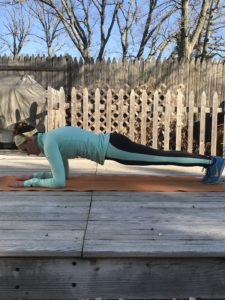
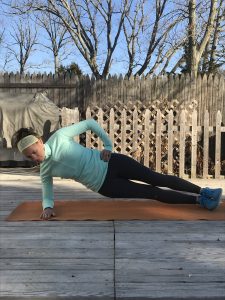
One of the best moves that requires no equipment at all to build your core is the plank. The plank is a move that can be made into various exercises that challenge all the major muscles groups and stabilizers. These exercises improve strength and help you prevent injury. The plank is an exercise you can do anywhere, and it only takes a couple of minutes every day to build your core strength.
In the 30 day plank challenge, you will have fun while building your core strength. Thischallenge only takes a couple of minutes to complete each day. By the end of the 30 days, you will feel stronger and be ready to hike harder and longer! Remember always practice proper form to avoid injury.
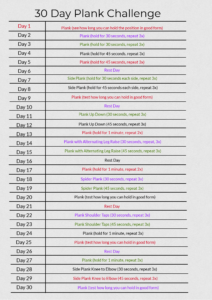
Check out the video with all the plank moves for the 30 day challenge. After the 30 days, you will see excellent results and significant improvements in your core strength helping to improve your sailing performance. Good luck and tell us how you are doing with the challenge!
For more information on fitness and nutrition for sailing contact [email protected]. Also check out Sailorcise on Facebook, Twitter, and Instagram for daily tips on fitness, nutrition, and sailing.
About Sail1Design
Sail1Design is a grassroots organization, by sailors for sailors, dedicated to the youth, high school, college, and one-design sailing communities. Born in 2007, Sail1Design has grown considerably, and reaches out to all sailors wishing to enjoy and learn more about our sport. We have three main areas of business:
SAILING/MARINE INDUSTRY CAREER CENTER & JOB BOARD
We offer sailing’s #1 Career Center and Job Board, always chock full of incredible sailing job opportunities. Our comprehensive career center also offers job seekers the ability to create their own web page, highlighting their experience and posting their resume. Likewise, employers can search our resume database to find the right match for that open position. Sail1Design is proud also to be the official job board of the Intercollegiate Sailing Association (ICSA), the US High School Sailing Association (ISSA), and US Sailing.
MARKETPLACE & PROFESSIONAL BROKERAGE
Unique to the industry, Sail1Design hosts and manages an active private, by-owner marketplace, focusing on performance and one-design sailboats & gear. For all boats under 25′, our ads are free. What makes us different is that we also provide, side-by-side, professional brokerage services as well. We have had great success helping our sailing clients market and sell their boats, using our powerful client base, social media, and the brokerage industries multiple listing service to ensure your boat gets noticed.
AIRWAVES NEWS & CALENDAR
S1D also hosts Airwaves, an interactive, user fed Sailing Calendar and informative Sailing News, Articles, tips, & more. Airwaves has developed a great niche in the sailing publication world, and now boasts a seven-member staff of dedicated sailors, all contributing to our varied content.
Blog
Airwaves Job Board & Career Center: Not Just for Coaching Jobs Anymore
Sail1Design pleased to offer the sailing community our popular sailing job board, rich with summer, and full-time coaching opportunities. In our 10 years of business, however, our job board has grown into a full-fledged sailing/marine industry career center, with full-time, year-round positions available for those seeking opportunities or a career in the sailing/marine industry.
Our resume database features outstanding young and experienced talent. While wishing our clients a Happy New Year, we also invite you to see us in a new light: your path to a new career! Employers, invest in our Airwaves Career Center for your hiring needs; you will be glad you did!
SAILING/MARINE INDUSTRY CAREER CENTER & JOB BOARD We offer sailing’s #1 Career Center and Job Board, always chock full of incredible sailing job opportunities. Our comprehensive career center also offers job seekers the ability to create their own web page, highlighting their experience and posting their resume. Likewise, employers can search our resume database to find the right match for that open position. Sail1Design is proud also to be the official job board of the Intercollegiate Sailing Association (ICSA), the US High School Sailing Association (ISSA), and US Sailing.
Club Profile: Housatonic Boat Club
 News Flash: The Houstonic Boat Club is hiring a Sailing Director, & Sailing Instructor Positions!
HBC, THE OLDEST ACTIVE YACHT CLUB IN THE STATE
On January of 1887 seven Stratford men, John and Frank Benjamin, Frederick C. Beach, Henry Parson, The Wheeler brothers and George Strong, met to form a club for, as our charter reads “ …social intercourse, and to promote and encourage an interest in yachting.” and the Housatonic Club was formed. By April of that year its two-story clubhouse was raised on pilings at the edge of the river channel on the property of Alfred Ely Beach, Frederick Beach’s father and publisher of Scientific American. The site was chosen for its commanding view of the river, and an easy reach up or down the river in the prevailing southwesterly breeze.
JUNIOR SAILING PROGRAM
The Housatonic Boat Club’s Junior Sailing Program offers youngsters (ages 8 to 16) an opportunity to learn the basic skills of sailing and to gain more proficiency as they advance as serious competitors or recreational sailors. Our capable and experienced sailing instructors are US Sailing certified and teach the fundamentals of seamanship from wind direction, the river’s current, sailing rules and racing  strategies, boat care, to sail trim and knot tying. The 7-week program, conducted on the Housatonic River and Long Island Sound, is geared to learning about sailing in a fun and creative environment while at the same time encouraging participants to develop self-confidence, responsibility, team building and of course an awareness of boating safety. Junior Sailing at the Housatonic Boat Club is a stepping stone in making lifelong sailors who are taught to respect each other, their sailing community and their marine environment.
News Flash: The Houstonic Boat Club is hiring a Sailing Director, & Sailing Instructor Positions!
HBC, THE OLDEST ACTIVE YACHT CLUB IN THE STATE
The Housatonic Boat club is in its 129th season – the oldest active yacht club in the state! In January of 1887 seven Stratford men, John and Frank Benjamin, Frederick C. Beach, Henry Parson, The Wheeler brothers and George Strong, met to form a club for, as our charter reads “ …social intercourse, and to promote and encourage an interest in yachting.” and the Housatonic Club was formed. By April of that year its two-story clubhouse was raised on pilings at the edge of the river channel, at a cost of $1,204, and a 200-foot catwalk stretched across the marsh to the riverbank, on the property of Alfred Ely Beach, Frederick Beach’s father and publisher of Scientific American. The site was chosen for its commanding view of the river, and an easy reach up or down the river in the prevailing southwesterly breeze. On 21 May forty-one members held an organizational meeting, and at the official dedication of the clubhouse on the Fourth of July membership in the Housatonic Club totaled fifty-one. John Benjamin, owner of Benjamin J & Co., an early member company of the New York Stock Exchange, was elected first president – the only one ever elected by the general membership – and held that office until his death in 1906, when Frederick Converse Beach succeeded him.

HURRICANES
Storms, ice, hurricanes, and tides have always been a threat to HBC. The disatrous hurricane of 21 September 1938 drowned the Lewises and wiped out their Thimble Island cottage only a week after Club boats visited them; water at the Club rose two feet above the deck. But the worst property damage of all resulted from the surprise hurricane of 1950. Fortunately the clubhouse had been moved onto new pilings in 1948, and the main deck was loaded with twenty tons of mushrooms being winter-stored: it was the only structure to survive. All else was demolished – bathhouses, lockers, floats, even the 200-foot catwalk across the marsh to the bank. Everything had to be rebuilt. But with a bond issue to the members and the work of many eager hands under the skilled direction of Bud Olsen, the Club was soon better than ever, with a new sailhouse and a new bathhouse, and in 1960 a kitchen. But again in 1955 hurricane floods in August and September raged down the river. A derelict barge tore loose and swept through the fleet. Boats picked up their mushrooms and floated out to sea. The river dredge Arundel flipped onto its side across the channel near Crimbo Point, crushing boats swept against it and blocking the Channel for two years. In all, seven HBC boats were destroyed.
Later hurricanes spared us, until the 1985 storm ruined floating equipment and severely damaged docks, again requiring members to rally and repair.
LAND TROUBLE
HBC’s greatest threat was not the weather. In 1952 the Club learned that the land, then in trusteeship to a bank, was about to be sold. A special committee, Ira Peterson, Ray Baldwin, and Al Beach, presented a plan to form a syndicate of members to purchase the Beach estate for the Club. Housatonic Properties was incorporated by nine members, and on 19 March 1954 they bought the whole property, then sold the uplands to the American Shakespeare Theatre with the stipulation that it never be used commercially, and on 17 May 1954 deeded the eleven acres of marshes and the road to the Club. After 67 years, the Club finally owned the land on which it sat.
 ORIGINAL FLEET
At the start the fleet included cats, cutters, cat-ketches, and sharpies berthed in slips, with kayaks, canoes, and Whitehalls on the floats. In 1888 James Leavitt introduced the first power boat – a Naphtha launch – which did not require a steam engineer on board, and soon the Beach family owned one, too. Bedell Benjamins’s steam yacht, with five-man paid crew, was too large to keep at the Club, so he tied it up at his own dock, upstream from Bond’s. Soon the first gasoline launches with one-lung engines, appeared.
FACILITIES
The Club’s facilities were intentionally spartan. In 1891 a bathhouse and a sandy beach, reached by a 160-foot plank walk along the edge of the marsh, provided a spot for swimmers. In 1893 John Beach’s studio was floated in for use as a men’s bathhouse. A winter project to lengthen the clubhouse was completed in time for the 9 May 1896 Club opening. Until 1933 oil lamps provided light. Running water came in 1946, when pipes were laid across the fields to Elm Street every spring, and taken up each fall. A one-hole p rivy, with a view down to the river, was hidden in a closet beneath the clubhouse stairs – a true water closet.
CLUB PARKING AND STORAGE
In 1956, although the pristine marsh and catwalk made the decision difficult, the need for Club parking and boat storage demanded that the property be developed. Fill was obtained from the state highway department and local industries for the yard and the road, and both were raised. In 1975 the town offered to oil the road (which belongs to the Club) and in 1977 the yard was fenced. In 1994, the year of the great asbestos scare, DEP spread an impermeable cap across the yard. Then in 2000 the federal EPA further elevated and capped the land, added shoreline rip-rap, paved the boatyard, and fenced and landscaped the property. With a whole new look and with new water and sewer line connections, the Club enters a new millennium.

Much has changed since we toasted this new century. Not only have we adjusted ourselves to the new regulations of the later part of the 1990’s, but also we have enlarged our membership and our fleet, both in length and numbers. Our grounds were dug and capped by the EPA. Opening Day was held “off-campus” that summer, and early on we traveled to and from the mooring field from Birdseye Fishing Dock. A boat barn was constructed so that the members could spend the winters maintaining the club’s launch, Junior Sailing fleet and workboat. The clubhouse had new steel pilings installed to replace the wooded ones that were put under the house in 1979. The launch operator’s office was constructed in place of a few of the sailing lockers. Old windows were replaced with new ones and a new awning was installed to protect us against the elements. Yes, we move along, thanks to the unique Corinthian spirit of our membership.
Historical Information extracted from Club’s former Commodore Lew Knapp in his book Stratford and the Sea

Club Profile: Community Sailing of Colorado
By Airwaves Senior writer Taylor Penwell
An Interview with Executive Director Brandon Kass
What is the Community Sailing of Colorado?
We are a nonprofit organization committed to make sailing accessible to all in Colorado. Our programs impact the Front Range Colorado communities through a variety of programs including adults classes, youth camps, junior race team, low to no cost adaptive sailing clinics, and free open house sail nights from April-October. In our mountain-based region, water is one of our most valuable resources. We are proud to be an organization that works hard to share a scarce watersport, such as sailing, with everyone we can.
How did Community Sailing of Colorado get its start?
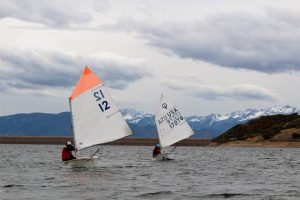
Our founder Steve Frank wanted to provide access to sailing for children in Colorado after transplanting from the Boston area. His idea of CSC came from Community Boating, Inc., in Boston, where he learned to sail and found a passion for the sport. After moving to Colorado, he began soliciting donated boats and received a few old sailboats to run a couple youth sailing camps. This expanded into a full summer programs and eventually grew out of its initial location and moved into the Cherry Creek Reservoir. Community Sailing of Colorado was officially founded in 1994. Since 2010, we added new programs for adults and an adaptive sailing program for individuals with disabilities. In 2014, we added a second location in Boulder, CO and have ultimately doubled our programming.
 What is CSC’s mission?
“Make Sailing in Colorado Accessible to All. Teach Skills, Build Confidence & Have Fun!”
What does CSC offer its members and the community?
Summer camps for kids, adult sailing classes, free weekly open house nights, free weekly adaptive sailing clinics, a beginner friendly competitive social sailing league, low to no cost outreach programs for partner organizations who serve at-risk populations and low to no cost adaptive programs for groups working with individuals living with disabilities,
Who is Brandon Kass and what changes have you made at Community Sailing of Colorado?
I grew up in a sailing mecca in the state of Iowa;). I was fortunate to have a public sailing club on the lake my family had a summer cabin on. At age 8, my siblings and I spent our first summer sailing with the Okoboji Yacht Club Sailing School. Lake Okoboji has a long history of racing scows and I quickly began racing as well. Ultimately, I became an instructor, coach and director of that program. After my first year of college, I had an opportunity to move to Southern California where I immersed myself in the sailing scene. I was fortunate to work with the Long Beach Yacht Club, Lido Isle Yacht Club and ultimately with a public sailing center called the Leeway Sailing Center in Long Beach, CA. This is where my love for a community program really developed by providing sailing for underprivileged youth in the area. After 7 years working and racing in California, I moved to back to Iowa to complete my degree. After that I found myself in Denver working in the hospitality industry when this opportunity of executive director of CSC came about. I jumped at this unique opportunity and haven’t looked back. I still race (and own) scows competitively on my home lake when I can and also race keelboats in Colorado and around the country.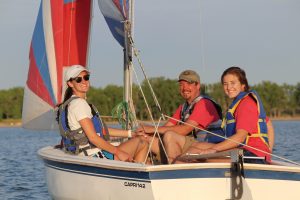
Here is a bit more about Brandon Kass from a previous publication.
At the helm is Iowa native Brandon Kass, who grew up sailing on Lake Okoboji in the “Iowa Great Lakes.” He became an instructor at age 15 and had the opportunity to learn under the direction of Rob Coutts, older brother to acclaimed Olympic, America’s Cup and professional sailor Sir Russell Coutts. Then at age 20, he relocated to southern California, where he worked for the Lido Isle Yacht Club in Newport, the Long Beach Yacht Club and the Leeway Sailing and Aquatics Center.
After seven years on the West Coast, Kass returned to Iowa to finish college and pursue a career in hospitality with Marriott Hotels, a position that took him to Denver. And in 2010, that’s where his passions for sailing, teaching and providing access to the water took hold of him once again: A small local nonprofit was looking for an executive director to help run its summer sailing programs for a couple hundred kids.
Kass seized the opportunity, and under his leadership, Community Sailing of Colorado has experienced startling growth. When he started, the nonprofit served roughly 200 kids each season. Today, it serves almost 3,000 people annually.
 What is the sailing scene at Community Sailing of Colorado?
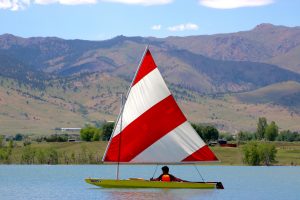
“Community” is the most important word in our title and it is exactly how we would describe our sailing scene. We are a nonprofit, non-yacht club, and non-membership based organization that truly values our community as a whole and we are incredibly welcoming to anyone and everyone who is even remotely interested in sailing. On any given day you may have a 5 year old out sailing at camp and turn around to see a 15 year old racing mid-afternoon followed by a 65 year old learning how to sail for the first time. One of my favorite things about CSC is when our programs merge and we have some of our Junior Race Team helping with an adaptive sailing night. To watch as perspectives grow and to see an appreciation for sharing a passion with someone new take shape, truly embodies what our community is all about.
Tell us about the Junior Sailing Programs
Our Junior Sailing scene is a combination of a few programs. We run summer camps that during the day for kids 5 – 17 years old. Then a couple afternoon each week we have a competitive optimist race team as well as a high school race team that sail from early April to late October. In addition, during the spring and fall we also offer an After School Adventure Sailing class for our juniors who are interested in learning to sail or even hone their skills.
Where are you located?
Colorado! No really, it’s true. Cherry Creek Reservoir (12 miles south of Denver) and Boulder Reservoir (3 miles northwest of downtown Boulder)
 What does Community Sailing of Colorado offer to its members in the winter?
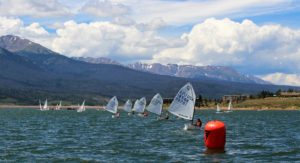
We have a huge gala fundraiser in the spring where we gather about 200 people from our community together for an incredible evening that includes an open bar, plated dinner, silent auction, live auction and fun activities (hint: this year we’re getting a mechanical bull!) It’s an awesome night and something to look forward to each year. We also have a movie night where we rent out a theater and screen a sailing related movie for our community. In year’s past we’ve had someone involved in the movie Skype in for a live Q&A post screening, which is really fun. This year COYOTE is the film of choice and we’re really excited about it. Other possibilities that aren’t nailed down yet are a trivia night, and bingo brunch.
What sailing events are on the schedule for the upcoming season?
- 19th Annual Spirit of Sailing Gala Fundraiser | April 14, 2018 | Denver, CO
- US Sailing Rocky Mountain Junior Olympic Festival | August 10-12, 2018 | Cherry Creek Reservoir
- Boulder Junior Regatta | August 26 | Boulder Reservoir
- Year End Fundraiser & U Gotta Regatta | September 8 | Cherry Creek Reservoir
Is there a weekly race scene?
We have a beginner-friendly competitive sailing league that runs two 5-week series in the summer at our Denver location. This is made possible through our partnership with Play Mile High. In addition, our sister organization, Denver Sailing Association, runs Wednesday night keelboat racing and Thursday night dinghy racing at Cherry Creek Reservoir.
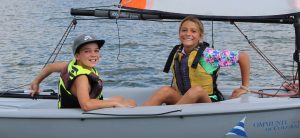 What important values does Community Sailing of Colorado hold?
Everyone should have access to sailing regardless of financial, physical or mental barriers. Community access to sailing is what drives our programs and is something we hold in very high esteem. We feel that sailing should not be an elite sport in which only a select few can participate given the inherent financial constraints. This is why we provide free weekly open house sailing nights for anyone to come out and enjoy. In addition to eliminating financial barriers we work very hard to ensure that our community members living with disabilities have the opportunity to go sailing at low to no cost as well. We host free weekly adaptive sailing clinics for individuals with disabilities and their friends or families to enjoy time on the water.
What would you tell someone interested in joining?
There is sailing in Colorado, and lots of it! If you are interested in learning how to sail, we can take care of that! We have sailing programs for children, adults and individuals with disabilities. Come try out sailing during one of our (12) free sail nights throughout the summer. This is an “open house” style event where one of our staff or volunteers takes individuals and families for a sail while providing some basic instruction. We also offer a junior racing program for those young sailors wanted to take their game to the next level.
Where do you see the organization in the coming years?
We would like to continuing building our adult programs and strengthening our junior programs. The next frontier for us is to continue to offer new adult programs that engage millennials, one of the fast-growing age groups here in Colorado. Eventually we would like to host adult racing classes for our sailors to transition into the local racing scene. Our hope is to also see our Adaptive and Outreach Sailing Programs expand and build new relationships with even more service-oriented organizations. One dream of ours is to host an inclusive regatta where all our sailors (abled and disabled) will race against each other and we don’t feel we’re too far away from making that happen.
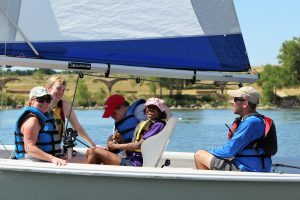 HISTORY OF CSC
Community Sailing of Colorado—CSC—has enjoyed over 22 years of teaching sailing on Colorado lakes. CSC was established in 1994 and soon after began teaching sailing on Standley Lake in Westminster, CO. The organization was created by Steven Frank, who recognized a need for a well-structured program to educate kids in the Denver area through sailing and water activities.
Today, CSC hosts sailing camps and classes for all ages across the Front Range from April through October each year. Throughout the summer, CSC offers weeklong Learn to Sail, Intermediate, and Advanced Sailing Camps along with Little Puffs Camps for first time sailors; allowing youngsters develop sailing skills in fun and challenging ways. Camps are conducted at the Boulder and Cherry Creek Reservoirs. We also host a growing Junior Racing Program to hone advanced sailing skills and techniques for those looking to compete in local, regional and national competitions.
Over the years, CSC has shared the joy of sailing with over 15,000 students since its inception with many of them receiving scholarships to participate in our programs. We pride ourselves on the countless number of community outreach events and free sailing opportunities we’ve held over the years. These opportunities allow us to partner with community organizations and share the joy of sailing with those who might not otherwise have the opportunity.
In 2011, CSC purchased two Access 303 Wide-Seater Dinghies, boats specially designed for adaptive sailing. This launched our Adaptive Sailing Program for individuals with physical and mental disabilities and set our organization along the path of developing this program to reach everyone in our community. Our Adaptive Sailing program has grown throughout the years to reach over 500 people in Colorado just this season. This is due to the many community partnerships serving individuals with disabilities. Our challenge as an organization is to continue to “Make Sailing in Colorado Accessible to All. Teach Skills, Build Confidence & Have Fun.”
Sail1Design's Marketplace: A Resource for Sailors for 10 Years. Get your Holiday Gift!
As a gift tot the entire sailing community, we are offering free ads at ALL levels for the holiday season! Use the coupon “getitsold” and your ad, no matter how bog your boat, or featured, will be free!
10 Years Serving the Sailing Community: So Far, So Fast
Unique to the industry, Sail1Design hosts and manages an active private, by-owner sailing classifieds & marketplace, focusing on performance and one-design sailboats & gear. For all boats under 25′, our ads are free. In fact, we are the official classified site of the US Optimist Class (USODA) and the US 420 Class. Over our first decade of business, we have helped thousands of sailors connect with fleets of boats, RIBS, sailboats, gear, and more. Our mailing list covers most all clubs in the country, and we are actively involved in youth, high school, college, and adult one-design sailing. Take advantage of our experience, connections, and exposure!!
If your class would be interested in taking advantage of our services, please contact us. We work hard to help sell your boats, promote your class and make sure your needs are met. We would make a separate category just for your class!
What makes our sailing classifieds different is that we also provide, side-by-side, professional brokerage services as well. We have had great success helping our sailing clients market and sell their boats, using our powerful client base, social media, and the brokerage industries multiple listing service to ensure your boat gets noticed. Our brokerage has a national reach, and we have been very successful for our clients.
As a gift tot the entire sailing community, we are offering free ads at ALL levels for the holiday season! Use the coupon “getitsold” and your ad, no matter how bog your boat, or featured, will be free!
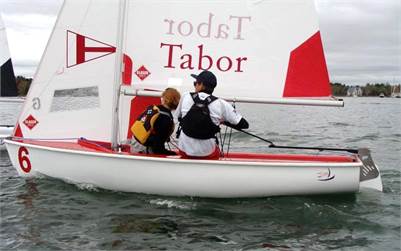
Tabor Academy FJ Fleet For Sale
- Viper 640 For Sale in FL, $15,000
- i420 For Sale, N. Carolina, $4000
- Fleet of 8 420’s For Sale, Charleston, SC
- Fleet of 22 Hunter Xcite Sailboats for sale, MD
- 3 JY15 Sailboats for sale, MD
- Laser For Sale, NY, $1500
- J/22 # 698 For Sale, Annapolis, MD, $7000
- Alerion Express 28 For Sale, CA, $69900
- c420 For Sale, almost New, Marion MA $9500
- 2014 McLaughlin Optimist, Naples, FL, $1400
- 2010 Laser, Sloatsburg, NY, $3800
- 13′ RIB with Honda 30hp Motor, RI $1500
- C&C 30 One-Design, CA, $149900
- Vanguard 420, Coronado, CA, $2500
- Vanguard 15, Huntington, NY, $2500
- Zim Club 420, St. Augustine, Fl $8900
- Fleet of 10 Club 420′s, Boston University, MA
- 3 Zim 420’s For Sale, RI
- A-Class Cat, VA, $1000
- Fleet of 6 FJ’s For Sale, Hotchkiss School CT
- Fleet of 9 420’s For Sale, Hotchkiss School, CT
- 2015 International 420 Nautivela, NJ, $11000
- Zim Black c420, #6121, ME, $7200
- 3 Club 420’s For Sale, Bristol, RI, $13000
- 2014 McLaughlin Optimist, VA, $2750
- 29er, CA, $3000
- Blueblue i420, Cape Cod, $7500
- Custom 24ft. Racer, FL, $7500
- 2008 club420, Jamestown, RI, $3500
- Fleet of 6 2003 Flying Junior Sailboats
- Fleet of 6 Collegiate FJ’s For Sale
- 2008 Vanguard c420, RI, $3500
- RS Aero For Sale, 20155, Lightly used! TX
- Blue Magic Optimist, MD, $3100
- 2003 Vanguard c420, RI, $4200
- Vanguard 15 with Trailer, CT, $3500
- 29er USA-1838, Annapolis, MD, $5500
- J/111 For Sale, Price Reduced. CA
- Lange High Performance Optimist, ME, $2250
- ZIM c420, NJ, $9250
- RS VISION, MO, $11500
- 2016 McLaughlin Race Optimist, CA, $2195
- 2003 LASER, #177328, FL, $2300
- 2017 ZIM c420 with Trailer!, NJ, $10000
- Coronado 15, OR, $1000
- Sailing Pavilion Available in Boston!!
- McLaughlin Pro Racer Optimist for sale. Fast Boat, Great Race Record, MD, $3800
- 2 Race Ready Lasers with Custom Trailer, MA, $14500
- Vanguard C420, Clearwater, FL, $5000
- 49er for sale, IN, $2500
- Laser VAGO, IN, $8500
- J/30 For Sale, CA, $24,900
- Winner Optimist, DE, $2500
- 2010 LP c420, MA, $7500
- OPEN 5.70 For Sale, Sausalito, CA, $15,000
- ZODIAC PRO OPEN 550, WI, $35,000
- Fleet of 8 Hobie Getaways! CT
- Fleet of 9 Hobie Waves!, CT
- 20 LASERS for SALE!!, Westport, CT
- Whitecap Composites Collegiate 420, LIKE NEW, MA, $7400
- PS2000 29er, Falmouth, MA, $6500
- Fleet of 4 Club 420’s For Sale, Newport, OR
- 470, Jensen Beach, FL $1200
- Fleet of 4 Hobie Waves, Jensen Beach, FL
- Winner Optimist, Naples, FL, $1600
- McLaughlin Pro Racer, Center I., NY $3000
- 420 Double Stack Trailer, St. Petersburg, FL $2500
- Like New Winner Opti, DE, $2550
- J/22 #698, Annapolis, MD $8500
- FLEET OF 7 Zim C420’s! RI
- I420 in Excellent Condition, Riverside, CT, $5200
- 2004 Vanguard Laser, NY, $3200
- 2005 Laser, SC, $3500
- 2008 Vanguard 15, MD, $2700
- 4 Boat 420 Trailer, Charleston SC, $4000
- Winner Optimist, Annapolis, MD $2100
- Blue Magic Optimist, Annapolis MD, $2950
- Fleet of 3 Club 420’s for sale, Bristol, RI
- LaserPerformance 420 USA-6627, Marion, MA, $8999
- 2015 Nautivela i420, Stamford, CT, $10,000
- Blue Magic Opti, Little Silver, NJ, $2750
- ZIM Pro Optimist, Duxbury, MA, $2800
- Like New Winner Optimist, DE, $2750
- Beneteau First 30, CA, $89500
- Winner 3D Star Optimist, FL, $3300
- McLaughlin Pro Racer, FL, $2300
- 12 Seitech Dollies For Sale, CT, $250/ea
- OPTI/Laser 4 Boat Enclosed Trailer, Fl, $3200
- 2 RS Visions for sale, Bronx, NY, $7000
- 2012 ZIM c420 #7225, Marion, MA $7000
- Triple Stack DInghy Trailer, NY, $2800
- J/124 For Sale, Alameda, CA
- J/92 For Sale, CA
- 75′ IACC America’s Cup: Il Moro de Venezia
- J/133 For Sale, gorgeous boat!!
- J/160. What a boat!
- S1D also offers private, by-owner listings. Check us out!
SAIL1DESIGN MARKETPLACE & PROFESSIONAL BROKERAGE
Sail1Design hosts and manages an active private, by-owner marketplace& sailing classifieds, focusing on performance and one-design sailboats & gear
If you have a boat to sell, or are looking for a boat, let our experience and attention to detail go to work for you! Contact us today at [email protected] to learn more!
One Design Class Profile: 49er
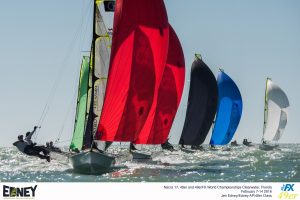
In 1996 the 49er was chosen to be the twin trapeze skiff choice for Olympic sailing. It was designed by Julian Bethwaite and is an evolution of the International 14’s and 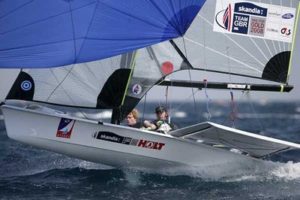 Aussie 18’s. The 49er was an overnight success, with 80 boats competing in the class’s first international regatta a year after being named the new Olympic skiff. Now 5 Olympics later the 49er has evolved into the top skiff boat for the Olympics.
The History
The 49ers history starts back in 1996 where top sailors from around the world traveled to Lake Garda for a trial of different classes to see which would be the new twin-trapeze skiff for the 2000 Olympics in Sydney. The 49er proved to be the favorite for the sailors, and by November 1996 it was named the new Olympic skiff. Once named the Olympic skiff the production for the 49er was in high demand, with a waiting list developing within a matter of days after the Olympic announcement. Boat builders around the world worked hard to fill the demand. Two of the major boat builders that helped to grow 49er class are Ovington Boats based in England and Mackay Boats in New Zealand. The European Championships in Weymouth was the first international regatta held in September 1997. A total of 80 boats were already competing only a year after being announced as the new Olympic skiff. Since its launch in 1996, the 49er has been an instant hit and has evolved into the favorite skiff boat around the world.
The Boat
The name of the 49er comes from its hull length in meters, which is 4.99. Julian Bethwaite designed it, and it incorporates ideas from his design of the Aussie 18. The 49er is easy to handle and is controllable in conditions over 20 knots. Build out of fiberglass and carbon fiber the 49er is strong and light, weighing in at 275 pounds when fully rigged. As with any boat, the construction has gone through some changes through the years. In 2009 Mackay Boats build the new class molds which are now used by all builders worldwide. Also during this time, other improvements were made including a significant upgrade to the wings which are now pinned in place instead of sitting on sliding tracks. The wings are 9 feet wide with allows the crew to have maximum leverage. The sail area is 639 square feet which makes this small boat very fast! The vang uses a “ram vang” system; this system benefits the boat in three ways. First, it is a safer system because it pushes the boom down from above rather than pulling it down from below, which holds the mid-mast forward and prevents it from inverting when under pressure from the spinnaker. Second, it leaves the front cockpit open which allows for the crew to move more freely and efficiently across the boat. Thirdly, it brings the mainsail working area down to the deck level which helps reduce the drag. These boats are built for speed with top speeds over 20 knots, which makes it essential for the skipper and crew to work together to avoid any mistakes which can lead to capsizing. To be competitive on the water 49er sailors need to be reactive and quick-thinkers.
49erFX
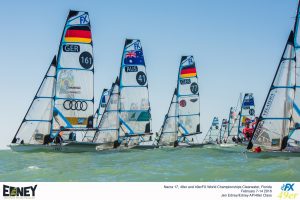
The 49er introduced a new exciting form of sailing to the world. Mackay Boats in New Zealand found a way for more sailors to get involved and developed a smaller rig that fit into the 49er, the 49erFX. They trialed the 49erFX against several other boats, and it was selected to be used for the 2016 Olympics in Brazil. The 49erFX has made the experience of the 49er available to top women sailors. The FX uses a main with a wider head and only five battens, with the wider head a stiffer mast is needed to keep the boat in control through different wind conditions. The FX sail design makes it so that it can compete with the 49er in most upwind and downwind conditions. Two differences sailors notice the most between the 49er and FX is the rig depowers the boat, making it more easy to handle in winds 20-25 knots. Another positive difference is the performance downwind; the FX more easily bears away as the spinnaker is much flatter and flies further off the boat. Also, the bow lifts more out of the water which means sailors can go through waves without nosediving as they would in the 49er. This skiff requires sailors to be on top of their game with their skills, balance, and be in top shape. The 49erFX is a thrilling skiff that has paved the way for women sailors to compete in a high- performance boat and has shown the world that women sailors are amazing athletes!
For more info on the class go to www.49er.org
Click here for a video about the 49er.
Click here for a video about the 49erFX.