Final S1D ICSA Team Race Rankings Locked In. Women’s Selection? Not Exactly.
The final Sail1Design rankings are here, and as always, they’re backed by a panel of coaches who have been watching this fleet all season. Big thanks to them for making this possible.
If you want a clear picture of how teams stack up heading into Team Race Nationals, this is it. Racing kicks off this week in New Orleans, hosted by Tulane and the Southern Yacht Club.
These rankings give you a clear picture of the field heading into Nationals this week. The selection process? Not as clear.
Check out the rankings HERE, then keep reading!
Open Rankings
COPYRIGHT 2025 ROB MIGLIACCIO
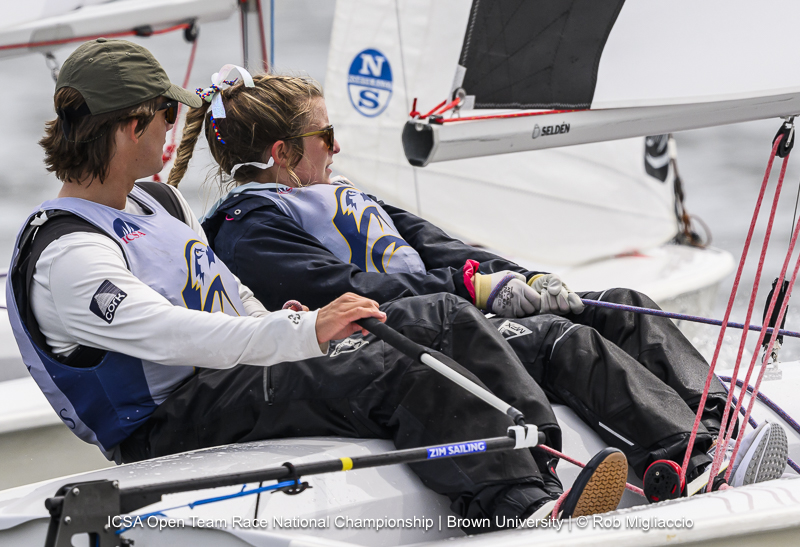
Harvard finishes the season ranked No. 1, followed by Stanford and Roger Williams, with College of Charleston moving up to fourth in the final Sail1Design Open rankings. The natural question: are these our final four?
Charleston’s position here is worth noting. They were ranked sixth in the previous edition and now sit fourth. In a ranking system built on observation alongside results, that kind of movement usually means one thing: they’ve changed how they’re sailing relative to the fleet.
Navy, Brown, Georgetown, and Boston College are next. The last minute bump from Charleston could be an indicator that really any of these top teams could be a contender when racing starts this week.
Navy, coming off a win at the MAISA Conference Championships, is a particularly interesting case. As ranker Chris Klevan put it: “Are they waiting to peak at the right time?” That uncertainty pretty much defines this part of the rankings, for all teams.
Women’s Rankings
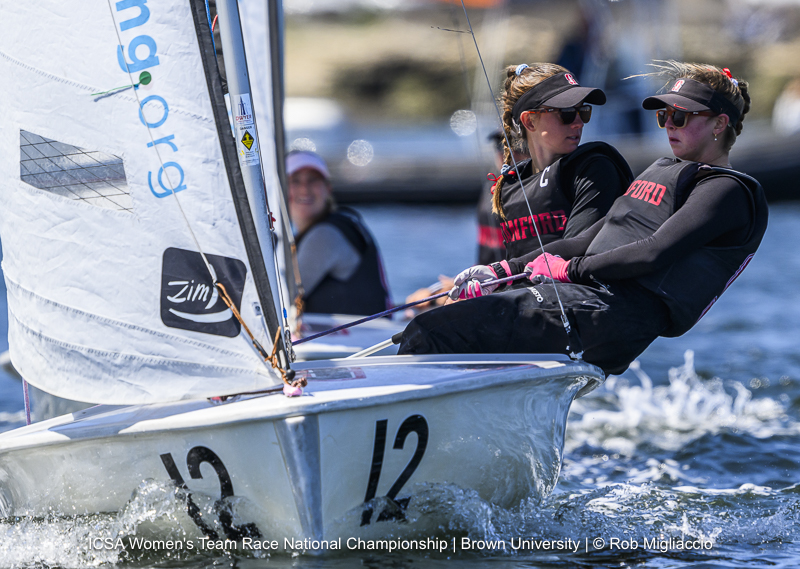
On the women’s side, defending champions Stanford sit at the top of this final edition of the S1D rankings looking solidly set up for another run at the title.
Yale comes in at Number 2 in this edition. Klevan, who is both the Stanford coach and a ranking panel member, pointed specifically to the Bulldogs’ strength in light air. If Nationals turns into a light-air regatta, that could tighten things quickly.
Brown sits third, with Cornell in fourth as the top-ranked team out of MAISA. Cornell’s conference championship performance backs that up. They went undefeated, finishing with 16–0 record.
Dartmouth is ranked fifth and has held a top-five spot all season. Harvard sits sixth, followed by Tufts in seventh and host team Tulane in eighth.
Like the Open fleet, there are multiple teams with a realistic shot at making the final four. It’s going to come down to who puts it together at the right time.
How Nationals Berths Are Decided
Before any of that plays out on the water, the bigger question is how the teams heading down to NOLA for the 2026 Team Race Nationals were selected in the first place.
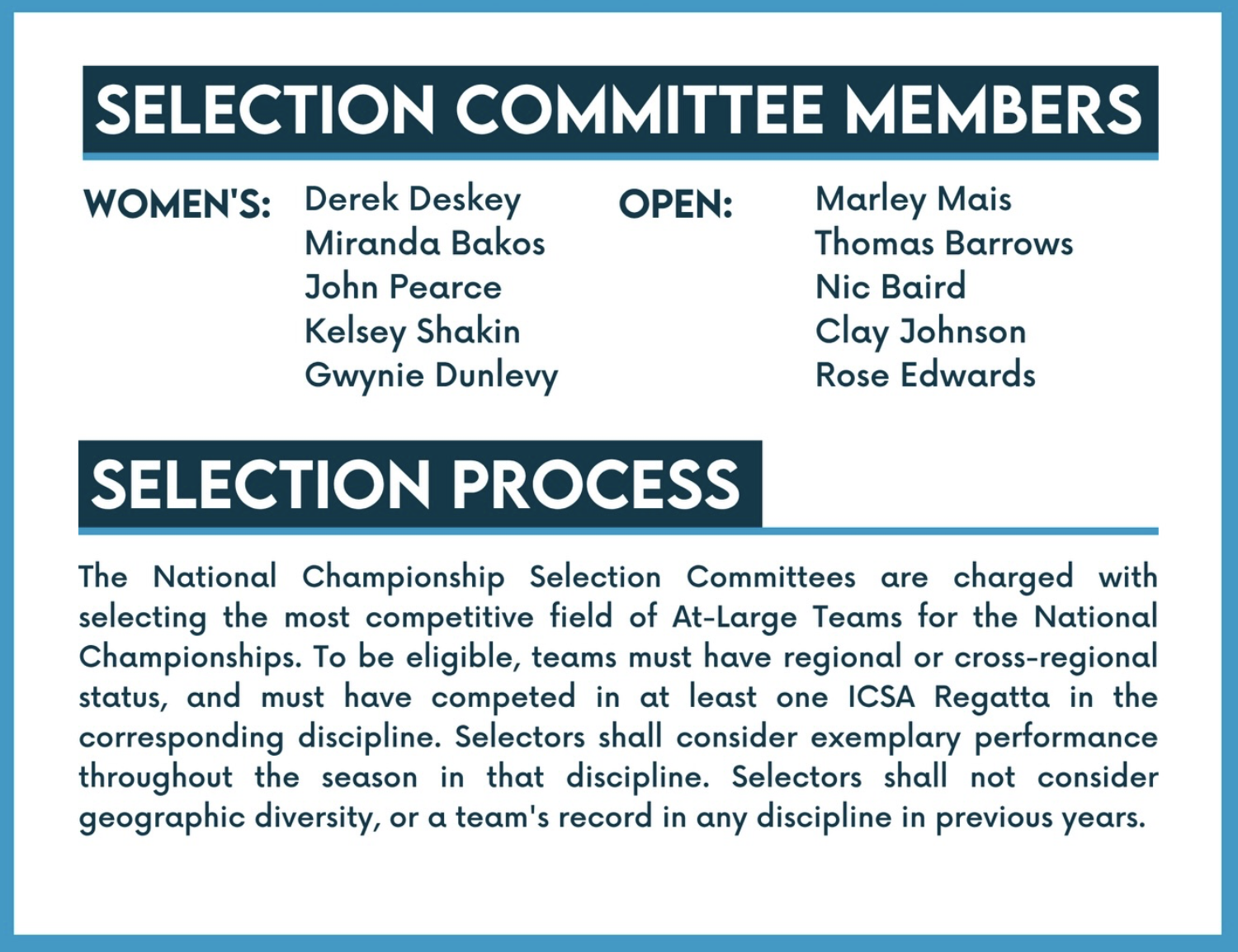
Unlike the S1D rankings, which reflect input from active coaches, the Nationals lineup is determined by an ICSA selection committee, alongside automatic bids from conference champions. According to the ICSA, the committee is tasked with selecting “the most competitive field” based on “exemplary performance throughout the season,” explicitly not considering geography or results from previous seasons.
From the College Sailing Instagram
On the women’s side, this year’s committee consisted of Derek Deskey, Miranda Bakos, John Pearce, Kelsey Shakin, and Gwynnie Dunlevy. The open division committee included Marley Mais, Thomas Barrows, Nic Baird, Clay Johnson, and Rose Edwards.
For the 2026 nationals, that process has come under more scrutiny than usual.
On April 15, ICSA announced the selected teams for both Open and Women’s Team Race Nationals.
In the Open division, Navy (MAISA), Northwestern (MCSA), Harvard (NEISA), Stanford (PCCSC), College of Charleston (SAISA), and Tulane (SEISA) earned automatic berths by winning their conference championships. With 16 total berths and six taken by automatic qualifiers, the selection process fills out the remaining spots. That structure can lead to some tough outcomes. This year, teams like Yale (ranked 14th in our final edition) and Miami (ranked 15th) will not be racing.
The Controversy
The women’s fleet is where things get more complicated.
In the initial release, Cornell (MAISA), Michigan (MCSA), Yale (NEISA), Stanfor (PCCSC), College of Charleston (SAISA), and Tulane (SEISA) earned automatic berths, with six additional teams selected to complete the 12-team field.
Following that announcement, ICSA President Greg Wilkinson issued an update regarding the selection process (full statement below).
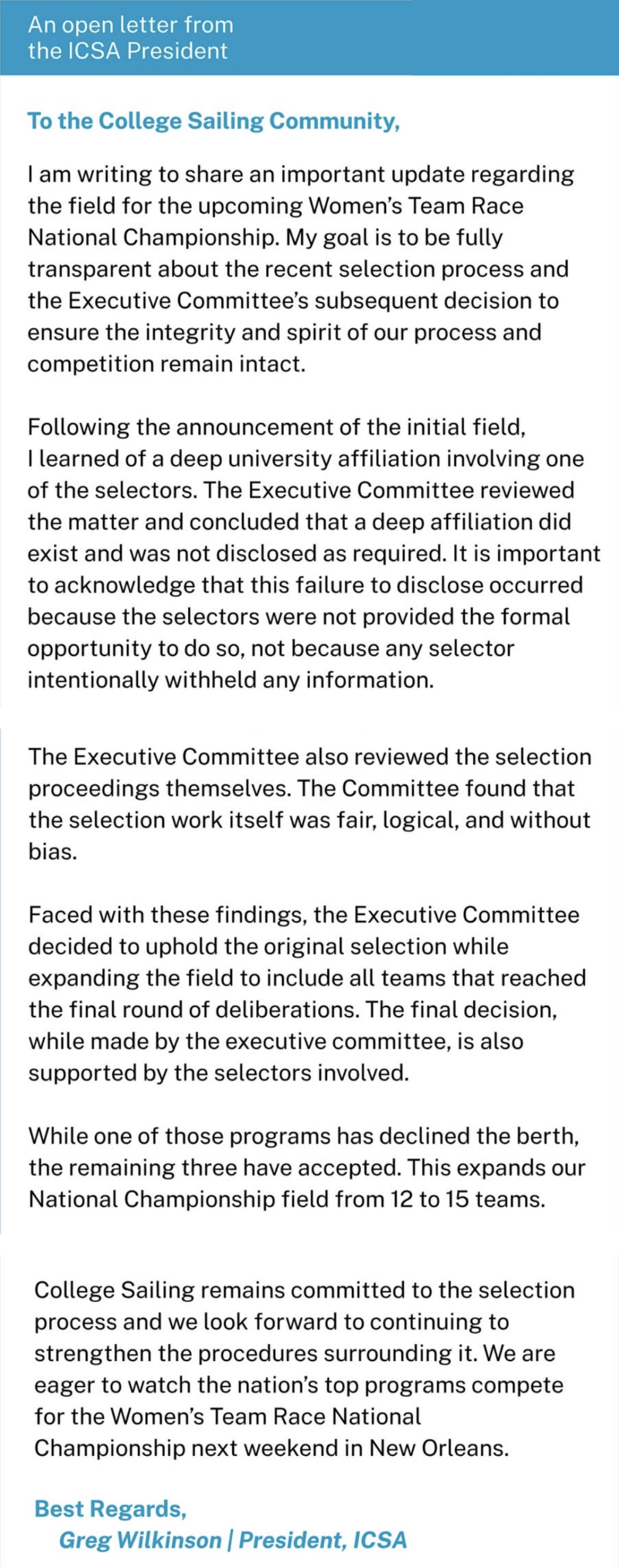
In that statement, the ICSA Executive Committee acknowledged an undisclosed “deep university affiliation” involving one of the selectors after the field had already been announced. While the committee maintained that the original selections were “fair, logical, and without bias,” it still chose to expand the field to include additional teams from the final round of deliberations. With one team declining, the championship will now be sailed with 15 teams.
That decision raises a few immediate questions.
If the process produced the right 12 teams, why add more? And if other teams were close enough to be included after the fact, why weren’t they in from the start?
At a minimum, it suggests the margin between “in” and “out” was anything but clear.
To see how that explanation landed, I went to the comments on the Instagram announcement. The reaction landed somewhere between confusion and outrage.
One user, @mateo_rod.riguez, wrote:
If the selection process was found to be unbiased upon review, then shouldn’t the selected teams remain unchanged? … Saying the selection was unbiased but then still expanding the field is contradictory imo.
That sense of contradiction came up repeatedly. User @augiedale commented:
Rules are meant to be followed not bent. This seems like a slap in the face to the multitude of teams that have been on the bubble the past few years.
Others were more direct. @silenth805 put it simply:
If the process was fair to begin with, then why add teams? Where is the integrity?
There were also a few comments pointing out a potential upside. @diegoscbr noted:
about time Open and Women’s have the same number of berths
While expanding the fleet brings the divisions in line numerically, it also raises a practical question: with the Women’s event still scheduled for two days, can the same level of competitive fairness be maintained for a larger field that would typically be scheduled over three days?
Beyond the official post, the conversation carried into other parts of the sailing community. One of the more visible responses came from @guardians_of_the_monohull on Instagram—a satirical account, self-described as the “New York Times of Sailing,” known for blending humor with pointed commentary.
Their post leaned into the speculation already circulating. In response, one of the selectors clarified in the comments:
Clarification — ICSA Executive Committee changed the selections to add additional teams. Selection Committee did not.
From the College Sailing Instagram
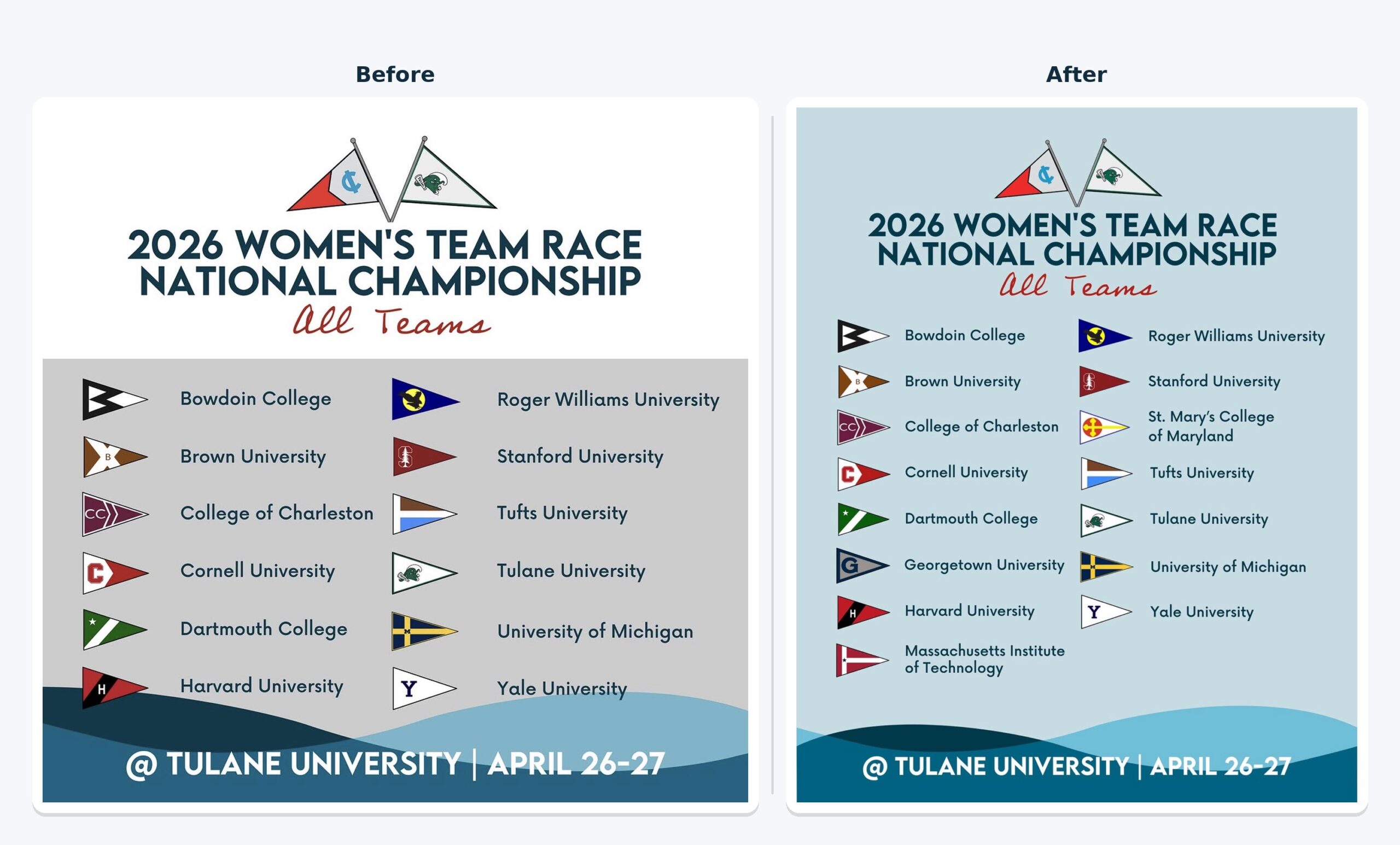
That distinction matters. The original selections and the later expansion appear to have come from different parts of the process, even if they now exist as a single outcome.
As for questions about conference representation, particularly how this could have or should have opened the door for more MAISA teams, the selection criteria are clear: berths are meant to be awarded on merit, not distributed across conferences. Whether that standard is always applied cleanly is a separate conversation, and one that will likely follow from this situation.
Some of the reaction has also focused on where teams sat in the Sail1Design rankings versus where they landed in the final field. Those comparisons only go so far, these rankings are intentionally independent of the ICSA selection process and aren’t meant to directly determine berths.
Still, when rankings, selections, and late changes all intersect like this, it becomes harder to separate perception from process.
The field is set. Expanded, debated, and now final.
Open Team Race Nationals begin April 23rd, with the Women’s event starting April 26th. From here, it’s straightforward: results get decided on the water. That said, the lead-up hasn’t gone unnoticed.
If you want a closer look at how teams stack up heading in, view the final Sail1Design rankings HERE.
As always, the conversation doesn’t stop here. If you have insight, opinions, or context that should be part of the conversation, drop a comment below or reach out at [email protected]. We will be watching how this plays out.
Good luck to all teams competing.
Time to race!
COPYRIGHT 2025 ROB MIGLIACCIO