By Airwaves writer Joe Cooper
The rapid commercialization of the America’s Cup and the Volvo Ocean Race has introduced to the rest of the sailing world in a dramatic fashion the idea of “professional sailor”. But just exactly IS a Professional Sailor?
 At the top of this pyramid are the “Top Guns”. This is the miniscule pool of sailors at the ultra-elite level–the likes of Ben Ainslie, Russell Coutts, Paul Cayard, Jimmy Spithill and their compatriots around the world. Commonly these elite sailors will fly into the regatta, do their magic thing and fly off to the next one. That is when they are not under contract to either a VOR or America’s Cup program. These two events are the largest consumers of professional sailors and supporting “technicians” who make their daily bread as “professional sailors”. And some go back and forth between events.
Outside of these two events that the non-sailing public in the US are exposed to, one needs to go to Europe, particularly France to find more pro opportunities. In Europe there exists a community of professional sailors and support teams who compete in “regular” yacht racing, in specialty classes like the TP52 and in the solo sailing scene. The solo scene is hugely popular in France in particular and the teams are today fully funded sports entities with many members and multi million Euro budgets sponsored by in some cases billion Euro publicly traded companies across a wide cross section of industry. These programs are in a very real sense Professional Teams.
To a young sailor with high-level skills and successes in high school, college, or perhaps in one-design or smaller keel boats (AND has a passion for sailing) the idea of being paid to “go sailing” or “sailing for a living” might sound pretty attractive.

But just what does this idea of professional sailor really mean? I think there are several classes of sailors that might accurately describe themselves as professional sailors. But the variations in actual sailing skill can be pretty wide though.
After the “Elite” there is another group, a much larger cohort of sailors, split into a few sub classes. There are those who get paid for their sailing skills, for instance navigating, (think VOR) or sail trim skills, or grinding, big, fit and strong AND ideally good to very good sailors. Basically the larger and more professional programs have professionals at all positions. Think the TP52 community. The open 60 and Maxi multihull teams have not only sailors, but large support teams that go along with them.
These folks are the support technicians, the guys and increasingly, girls, who prepare the boats. Many are retained for a particular trade or craft skill and are hired for this specific skill they bring to bear on the program. They may not have the elite sailing skills necessary to be hired for just sailing, but their sailing skills are perfectly fine. This group includes boat builders, riggers, sometimes sail-makers, and electrical and electronics specialist. A work perk for this cohort is often delivering the boat after a race.
 Any professional program or team needs leaders, people who in this case have good sailing skills, and so an understanding of the requirements needed to get it all done. So a breadth of sailing experience and good people, planning and management skills are very desirable. Depending on the program, some, perhaps many of the support team will sail on the boat. At the highest level though, VOR and AC, the sailors sail and the techs fix stuff (at least ashore).
Top sailing skills will get you noticed, as will World or Olympic successes, but these top results are available only to a select few. The most logical pathway to a life as a Professional Sailor is not only to have top-level sailing skill and success, but technical skills to. Oakcliff Sailing on Long Island Sound is the closest thing in the US to a school for professional sailors. At Oakcliff Sailing you can “study” elite sailing AND develop mechanical skills. If you have had summer jobs on racing boats, you know or have seen what these various skills are: a bit of fiberglass work, a bit of winch maintenance, maybe some paint touch-up skills, perhaps some carpentry fitting out the container or the trailer.
If you’re inclined, you may spend some time with the sail makers, riggers, electrical guys and so on. And if you pay attention you will notice the management skills of the boat captain at play. Skills and experience in planning things like transport & logistics, managing the work-flow, getting important parts in or out of different countries with a variety customs both legal and social, dealing with vendors and boat yards and the universe of interpersonal activities humans need to develop.
During the 2011/12 Volvo I did a review of the crews sorting by country. Something like 45% of the sailing teams were New Zealanders. Why? Apart from the fact they sail year round, all the time, almost regardless of the weather, and they live in a country renowned for hard weather. The second component to the success of the Kiwi’s in offshore sailing has to do with the educational system in NZL. The idea of a trade skill is at least on a par with the idea of a university degree in NZL. In the US, well not so much. The meme in the US is that “vocational” school is for the “not so bright kids” is both wrong and changing.
New Zealand and many other countries have very well-developed apprenticeship programs intended for high school graduates. These apprenticeships teach young men and women a craft and/or a specific skill. Reading through the skill sets of the Kiwi’s aboard the VOR boats reveals a universe of boat builders, engineers, electricians, hydraulic specialists, sailmakers, riggers and guys with deep computer and electronics skills. Having mechanical skills AND top end sailing skill is a very high value combination. Especially now in the VOR where the crew limits demand each person crew in the crew be not only a good sailor but who can contribute a skill to support the boat when the shore team is not around.
This technical or mechanical expertise is of value to a team, any team, but at the end of the day personality is a large component, a key essential required of the individuals of any team effort: Personality, effort, fitting in, being prompt for work, if being not early. I have seen, twice, a mediocre sailor get selected for America’s Cup programs by dint of the above. He demonstrated all of these characteristics and was always the first to the boat and the last to leave.
And do not under any circumstances underestimate physical fitness. Being in top physical condition, including cardio vascular performance, strength, fast recovery time after effort and flexibility will all demonstrate to the boat’s management that you are a serious professional, or at least intending to become one.
 Finally there is that great residual image everyone has of sailors: having a few beers. I have some mates in the UK who are keen on solo and double handed sailing although as amateurs. One season they pooled their funds and hired one of the top French solo guys to come over for the weekend and do a series of coaching sessions. On the Saturday afternoon after sailing and formal debriefing, the owners all went to the pub to have a beer and talk about the day. The coach went to the gym for his work out and when they later met for dinner he drank only water.
Years ago the guys who worked on race boats enjoyed it, had fun, drank beer, traveled the world and in general got up to all sorts of mischief. We certainly made a living. Today it is possible for good sailors with some technical skills to make a life of it.
Blog
Club Profile: Camp Winadu
 Camp Winadu is America’s finest full season sports camp for boys. It is located in the Berkshire Mountains of Western Massachusetts only 2 1/2 hours from NYC and Boston. Winadu combines the high-quality instruction of a sports specialty camp and the fun and camaraderie of a traditional overnight camp. Boys of all skill levels thrive at Winadu where they learn new skills, gain confidence, and build lasting friendships. Our mission is “Building Character Through Sports,” and we are passionate about helping boys grow as people and athletes through our unparalleled sports program.
Camp Winadu is hiring summer sailing instructors!
 We’ve Got Community!
Camp Winadu is a community where boys are taught to treat others with compassion and respect. During summers of nonstop fun, our campers grow and mature as positive members of our camp family. Winadu’s professional staff creates a comfortable environment that allows boys to learn new skills, gain confidence, and build lasting friendships. Our great traditions give boys a complete sleep away camp experience and reinforce the values of our community.
We’ve Got Character!
At Camp Winadu, we are passionate about power of sports as a teaching tool. Our mission is “Building Character Through Sports.” Sports create the opportunity for children to learn critical life lessons while having tremendous fun.
Through our sports program children learn:
- sportsmanship
- to win with humility
- to lose with pride in their efforts
- to be good teammates
- to respect their opponents
- to take care of their bodies
- to value cooperation
- to value consistent sustained effort
We’ve Got 3 Goals!
- We play sports to have FUN.
- Always try your BEST.
- Always be a good SPORT.
We’ve Got 1 Rule!
Don’t be afraid to make a mistake.
We believe children learn best in an environment where they are encouraged to try new things and improve their abilities without fear of criticism. Camp Winadu is hiring summer sailing instructors!
Back to the Future? A Look at the Lark Dinghy
By Rachael Silverstein
Since the first inter-collegiate dinghy fleet race in 1930, small boats and fast racing have become a healthy addiction for young sailors across the country. In 1934, Princeton developed the Tiger dinghy, which expanded college racing along the east coast. More recently, schools have tried the Vanguard 15, Tech Dinghy, Firefly, and Lark as their chosen double-handed boat, but the Club 420 and Club FJ have taken over the scene. A wide array of classes has been tried and tested through the generations of college sailors and many will follow, but some teams have held onto their boats and don’t intend to let go.
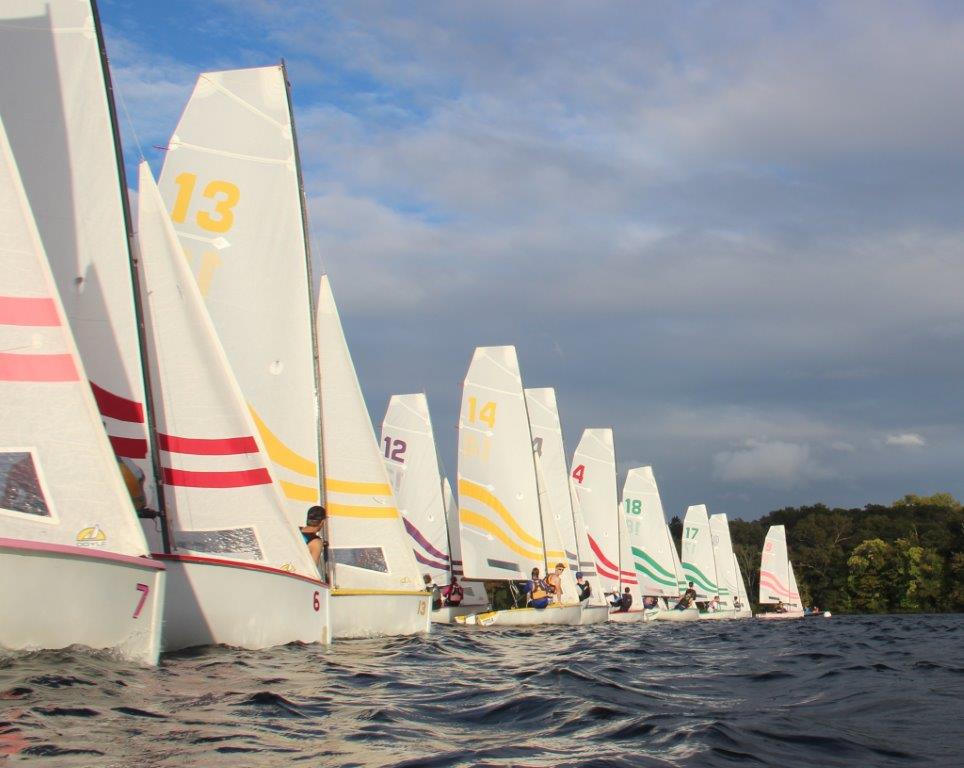 As the sport grows on the collegiate level, there is a push to find a boat that meets the specific needs of a competitive college dinghy. For Ken Legler, Head Coach of Tufts University Sailing Team, the college dinghy decision is easy. When asked why he devoutly chooses a new fleet of Larks decade after decade of coaching Tufts, he declares, “primarily because sailing is supposed to be fun.”
In 1972, Tufts traded in the Wee Nips, a single-sail vessel similar to Tech Dinghies, for a fleet of Larks, and hasn’t looked back. The team has sailed through five fleets of Larks, and is making room for their sixth by Spring 2016. Larks, primarily built in England, were more difficult to purchase and maintain than their mainstream counterparts—420’s and FJ’s. For their new fleet, the Jumbos teamed up with Whitecap Composites of Peabody, MA to undertake Lark construction with a more “institutional use in mind.” Legler works closely with Whitecap on a design to “improve durability and make repairs easier.”
 Although Tufts sailors aren’t training in FJ’s and 420’s, the team’s long history of racing success does not suggest that practicing in Larks is hurting them in any way. Legler explains, “Larks are different, at least a little, from FJ’s and 420’s, just as those two classes are different from each other. There are small technical differences in how the sails are trimmed… The Lark is the same size as the 420 and FJ, and as such we are training the right sized people. It is more stable than an FJ, but less stable than a 420.” To make up for those differences, Legler enters his team into regattas every weekend, “at all levels, including club events, for our new crews to train muscle memory for sailing FJ’s and 420’s.”
When the sailors are practicing at home, Larks keep the sailing on Mystic Lake exciting.“The boats have an incredible feel to the helm and to the acceleration,” Legler describes, “the deep and narrow blades allow for instant sharp turns for team racing and other tactics. The light rig allows for dynamic mast movement for even faster maneuvers.” Racing doesn’t slow down when the wind lightens up, either. “Larks are very easily driven in light air due to the long, narrow waterline allowing good racing in winds as low as one knot, which is not the case in club dinghies,” he admits. The boats can sail as fast as the wind in up to six knots and plane as easily as a Laser, making it an ideal boat for sailing on Mystic Lake.
Whether the Lark will catch on as a popular college dinghy is uncertain, but they are waiting for willing sailors at the Bacow Sailing Pavilion. Legler labels this class as boats that “are rewarding when sailed well and unforgiving when not sailed well.” He believes that college sailing should be done for love of the sport, and provides his sailors with a fleet that is fun and challenging to sail. The way Coach Ken Legler sees it, “if college sailing is part of the education and part of the whole college experience for student sailors, then there is no better boat to enjoy the aesthetics, the healthy outdoor exercise, the camaraderie, and the challenges of friendly competition.”
From the Experts: Headsail Changes
By Airwaves writer Andrew Kerr
The call of “change the headsail “has resonated with teams since the inception of competitive sailing.
It is one of the ultimate calls to action for a team as the crew hurriedly goes about their tasks, very often under the pressure of time, tactical needs and weather concerns.
 I remember- as a good example of this – one quite seemingly regular summer race day at the J24 US National Championships on Berkeley circle in San Francisco a number of years back.
I was onboard Chris Snow’s boat (# 5208) and doing the bow, what was not routine about the day was the fact that the wind was taking a little longer to fill in than normal and we had sailed the first race of the day with the Genoa, ordinarily we would of expected to of changed down to the jib at some stage during that race or at least at the conclusion of it.
We kept looking upwind at the famed Golden Gate Bridge and the fog was still over the bridge and boats sailing around the bay were very underpowered. “It was supposed to be 90 degrees in Oakland by now” someone said. With just over 6 minutes to go the fleet was starting to put up Genoa’s and jockey for position on the starting line.
At about 5 minutes and 20 seconds to go – here came the classic Summer San Francisco breeze – all 22 knots of it. Boats charged around the starting line deliberating whether they had enough time to change.
You could almost feel the anxiety in the fleet as teams weighed up the options of being grossly overpowered at the start or even the prospect of having no headsail at the start.
On our boat there was no deliberating – up came the flaked Jib and our mast person, middleperson and cockpit person and I started the change.
Very little was said – Chris kept maneuvering us close to the line, was conscious of the lay line to the pin end of the line and kept the boat moving well to retain good steerage. The middle person called time and talked strategy / tactics with Chris, the dialogue was as if there was 10 minutes to go – calm and concise.
At about 1 minute to the start the Jib went up to the predetermined halyard tension and we got a good start toward the pin end of the line.
The quick decision, the skippers good presence of mind and the team work that went in to the change was a race and regatta saver and enabled our team t get off the line clean and sail fast upwind while other teams were not as fortunate.
This experience high lighted many facets of the effective headsail change – let’s look at the successful elements behind this dynamic challenge to a team. A lot of these ideas have been race savers in a wide variety of race locations – very often the team will encounter 2 or even 3 sail change ( sometimes more) on a 3 race day featuring changeable weather patterns.
For the purpose of this article we will assume we are hanking on the headsails, ( as opposed to using a head foil) that we are sailing windward/ leeward courses of 1 to 2 miles in length and that the sail changes will be done either prior to the start, between races or sailing downwind with the spinnaker up.
We will also assume that we have a five person team and divide the tasks accordingly.
Let’s take a look at a suggested check list for your team –
Preparation Checklist for a fast change:
(The example given is going from a Genoa to a Jib and applies changing up to the Genoa with a few minor differences):
- Mark the jib tracks for the fast setting so that you know where the Jib fairlead block has to go.
- Mark the Halyard on the Jib so you have a basic idea where the halyard tension will go to.
- Make sure the hanks on the halyards run smoothly and are not frozen or difficult to open.
- Make sure the Jib Blocks are readily available and stored in a commonly known place which is easily accessible.
- Have both the middle & Bow crew have a roll of white tape accessible – for taping the snap shackle on the Jib halyard.
- Flake the headsail(s) you are not using, fold it in to thirds and place a loose sail tie around it. This will be much faster than having to unroll the sail under the pressure of limited time. We tend to do this mainly on bigger boats unless the need for a change is typically predictable based on the typical conditions – i.e. – San Francisco bay in the summer time.
- Reeve an extra set of Jib sheets on to the headsail you are not using – saves time.
- Store the flaked (or rolled) headsail with the tack facing forward – this will enable you to place it on deck facing the right way to be hanked on.
Team Roles (5 person team)
Skipper:
If before the start – keep the boat moving well and close to the line. Avoid getting stuck in irons with the main only!
Don’t get too far away from the line!
Very often a team will have a tendency to get sidetracked when changing before the start – keep the boat close to the line so you aren’t late. Being late to the line is a common tendency to be avoided.
– If the line is restricted for another fleet then sail up and down from an extension of the line (keeping well clear of the other fleet) so you can continue to make observations and to be able to enter the area quickly when it becomes your line.
If possible steer to keep the boat level and the crew as dry as is practically possible. This is not always possible but something to strive for and can win bonus points back at the club!
Keep you head out of the Boat!!
Some skippers will have a tendency get too involved with what the crew is doing with a pre start sail change and have a disastrous start as a result – avoid this micromanagement!
When sailing bareheaded it is almost like you are sailing a laser – sailing by the main, keeping speed up and maneuvering as smoothly as possible.
Monitor time and RC signal flags and be conscious of the the approach to the line and the lay lines to the start. Keeps the dialogue going with the tactician on where wants to start and encourage him or her to keep making tactical and strategic observations and to keep looking upwind for any changes and to reassess any initial assumptions.
If the tactician is pre occupied through mother of necessity (i.e. You are shorthanded or have an inexperienced team or team members) then you will have to be the one to make the observations.
Business as usual – we are starting as well as the team can in the circumstances.
If sailing Downwind:
If sailing downwind under spinnaker – move your weight aft a little and steer to compensate for the bow being down by the forward weight of the bow crew changing the headsail.
If it’s windy you will want to encourage crew that are not directly involved with the change to get there weight aft to stop the bow submarining and the boat rounding up.
Keep the boat sailing fast and don’t get involved with the sail change – let the crew do their thing and keep the boat well positioned. Again – a business as usual approach – you will want to avoid any luffing duels (typically to be avoided any way!) and keep the dialogue going with the trimmer (s) on speed and the tactician on positioning versus the other boats and the velocity and shifts.
Cockpit:
Generally the cockpit person doesn’t seem to get a vote on whether the team changes to the jib from the Genoa! Could it be that tacking the Genoa in 18 knots is a physical challenge?! !
That being said – if the team has to change very quickly before the start then the cockpit person can help reeve the jib sheets through the ratchet blocks and also participate in a quick flake in the headsail.
More importantly, they can work with the skipper on monitoring the time, reminding the skipper to stay close to the line and also monitoring fleets that have started ahead of you.
If the tactician is in the middle person position then it is a very good idea to have the cockpit person assumes the middle person’s role on the change before the start. This free’s up the middle/ tactician to keep looking around and make tactical observations. This crew organizational flexibility is the hallmark of a good team.
Middle: (Very often the tactician as well).
– If the tactician and you are changing headsails before the start – consider trading roles with the cockpit person (as noted above) to free your self up to look around and make tactical and strategic observations.
– Bring the new headsail up on deck, locate & pass the jib blocks to the mast person.
– Keep monitoring time and stay aware of distance to the starting line.
– If time – help the mast person flake the Genoa, if no time – store gently below with the tack facing forward.
– If changing downwind – reeve the jib sheets through the ratchet blocks as the cockpit person will be preoccupied with trimming the spinnaker. If you are under a lot of time pressure then just reeve the expected needed (loaded) jib sheet. Be sure to budget a few seconds to make sure it is the correct way through the ratchet block and has a stopper knot in the end. The pressure of a lack of time can force basic errors like this!
– A nice feature of the active middle person is also to load the jib sheet on to the expected winch (cross sheeted) and cleat it ( with the sail eased well out) – as the cockpit person will very often have their hands full trimming the spinnaker going in to the leeward mark.
Mast:
– Take the jib halyard from the bow person and attach to the bale on the mast.
– When the bow is unhanking the old sail and hanking on the new sail – watch or hold the leech and clew of the sail as these will have a tendency to wash over the side in rough conditions.
– Take the old sail from the bow person and pass the new sail to the bow person with the tack facing forward for quick attachment.
- If there is time – help the bow & middle (or cockpit) flake the sail (if possible).
If not enough time – pass the sail back to the middle person who can gently store it down below with the tack facing forward.
– If there is a lot of time and it is a permanent change (particularly if the wind is fading toward the end of the day and you are going to the Genoa) then you may consider rolling the sail.
– Put the jib blocks to the pre marked setting on the tracks.
– Reeve the jib sheets through the jib blocks and pass them back (be careful to go under the spinnaker sheets on the port side) to the middle person for reeving through the ratchet blocks.
– If necessary – pass the jib halyard forward from the mast bale (look aloft to make sure it isn’t fouled) and be ready with a back up roll of white tape to tape the halyard snap shackle. The bow person should have this done but it’s always’s good to have a back up.
Generally you won’t have enough hands to flake the sail when going downwind with the spinnaker up as the team will be preoccupied with trimming, positioning & going fast – in this instance passing the sail back to the middle person for storage( with the tack facing forward) will be the way to go.
– If you are changing downwind with the spinnaker up then be prepared to jibe the spinnaker pole while the bow crew is pre occupied.
– When it is time – raise the headsail & set the halyard tension to the pre marked setting.
Bow:
Make sure you stay on the boat! Keep low and move deliberately. ! One hand for your self and one for the boat!!
- Take the halyard off and either put it back on the bail on the mast or pass it back to the middle to attach on to the bail.
- UN hank the sail with sail between your knees so it can’t fall over the side.
- Hank on the new headsail and reattach the halyard (take time to make sure it isn’t fouled aloft) – if you use a snap shackle be sure to tape the shackle closed.
Note: Do you notice that during the fall and spring that this is the time that the tips of your fingers feel particularly frozen!!!
Practice!
It’s a terrific idea to practice changing from Jib to Genoa and back with your older sails.
Do it both downwind with the spinnaker up and also reaching around as if you were in the pre start area. When coaching teams in practice sessions I have timed them in both scenarios and we have strived to reduce the time after each practice change.
Conclusion:
Changing headsails quickly and efficiently is another dynamic team skill that can help your team win races and fulfill its potential over the course of a series.
Take the time to practice it early in the season with your older sails and as a team – take some time to talk about each team member’s role, it will pay dividends at crunch time!
Club Profile: Great Harbor Yacht Club
Great Harbor Yacht Club, situated on picturesque Nantucket harbor, offers its members exceptional recreational opportunities and dining options while making sure to immerse our members in Nantucket’s unique locale.
The GHYC Clubhouse was designed by local architect Lyman Perry, in conjunction with seasoned Club architects, Hart Howerton. The post & beam construction of the Great Room was handcrafted in Pennsylvania, delivered to the island in sections and hand-pegged together by skilled artisans.
The interiors, designed by Boston firm Gauthier & Stacy, create a welcoming environment where members feel at home. The spaces are comfortable yet sophisticated creating the perfect balance of spaces for club events and private receptions.
GHYC offers a full complement of activities for our members and their guests to enjoy. Between the Clubhouse, waterfront facilities, state-of-the-art tennis & swim complex and fitness center & spa, GHYC offers something for every recreation and Nantucket enthusiast.
 Learn more about Great Harbor Yacht Club’s Sailing Program HERE.
The Great Harbor Yacht Club is hiring Junior/Adult Sailing Program Directors:
The Great Harbor Yacht Club in Nantucket, MA is seeking two senior level Directors: Adult Sailing Director and Junior Program Director. The Great Harbor Yacht Club is a fairly new yacht club (est. 2003) with active adult and junior programs. Our programs encompass the full spectrum of skills from learn to sail to competitive racing. We are looking for mature, enthusiastic professionals who take teaching seriously and who are committed to managing programs and staff for the busy 10-week season.
To learn more and apply, CLICK HERE
Club Profile: Sarasota Yacht Club
Camaraderie. At the Sarasota Yacht Club, a spirit of friendship and community makes everyone feel welcome. Whether you glide in dockside or step inside the new luxurious clubhouse, you’re greeted with a warm smile and outstretched hand.
Our varied membership comprised of non-boating singles and families, cruisers and athletes under power or sail, love to call the Club home. While many of our members live in Sarasota year round, many of our mariners are from out of state and still proudly fly the SYC Burgee on their bow. But everyone agrees, no matter how you arrive you always feel at home at the Club.
Sarasota Yacht Club is hiring a full-time Watersports Director.
And at the end of the day, our members can relax and enjoy the gorgeous Sarasota Bay skyline in luxury and style. That’s why our members say “Meet me at the Club!”
A Yacht Club, known as the Sarasota Yacht Club, was organized in the summer of 1907 and located on the north end of Siesta Key.
In 1913 the Club purchased a tract of land on Gulfstream Avenue in downtown Sarasota, and erected a large clubhouse which soon became known as the center of social life in Sarasota. The Club changed its name to the Sarasota Yacht Club and Automobile Club and remained very active until 1917 when John Ringling purchased the property. During World War I the Club headquartered the Sarasota Naval Militia.
The present Sarasota Yacht Club was incorporated June 21, 1926. The automobile branch of the club was not continued. Later, a clubhouse was maintained on Sarasota Municipal Pier from which members sailed their “Fish Class” fleet, winning numerous championship trophies including the 1933 Florida West Coast Fleet Championship. .
 The United States government leased the Club property in 1943 for the duration of the war plus six months for use as an Air Force Crash Boat Rescue Base. The club regained control of its property in January 1946 with the payment of $100.00 to the United States government for improvements made to the site, mainly two barracks buildings, which served as a clubhouse for many years. During the war period the membership declined to 66 regular members. A new clubhouse was built in 1958.
On April 23, 2010 the Sarasota Yacht Club opened the doors to it’s newly constructed 23,000 square foot clubhouse.
Sarasota Yacht Club is hiring a full-time Watersports Director.