420 Class: Club Versus Collegiate By Airwaves writer Tyler Colvin

As one of the most highly utilized youth training boats in North America, the 420 was designed in the mid 20th century as a stepping stone for the Olympic 470 class (www.usi420.org). Since its introduction into the youth sailing community, two popular variations on the design have risen to the forefront of modern junior sailing. The Club 420 is possibly the most popular youth double-handed boats on the continent (closely followed by the Flying Junior, or FJ), and Collegiate 420 following suit as one of the most popular boats among collegiate programs in the United States.

The Boat: Club 420, Youth Sailing Staple
Throughout junior sailing programs in the country you will find various vintages of Club 420s with half a dozen popular manufacturers that have come and gone over the years. Club 420s are everywhere, with nearly 8000 hulls produced to date.
Recently, the C420 North American Championships were held at Brant Beach Yacht Club in New Jersey and had a showing of 113 boats from yacht clubs and junior sailing programs across the country. These ranged from Pleon Yacht Club in Marblehead, Massachusetts (the only youth run program in the country www.pleon.org) to San Francisco Yacht Club, Chicago Yacht Club, Larchmont Yacht Club and Annapolis Yacht Club to name several.

A youth sailing staple, most veterans of junior sailing or youth learn-to-sail programs have stepped foot in, crashed and inevitably capsized a C420. Designed to be easy enough for beginner sailors to master the basics, yet fast enough to maintain the interest of budding All-Americans, the C420 is a mix of simplicity and technicality. Weighing in at a modest 230lbs, the 13’9” long, 5’4” wide dinghy has a single trapeze, centerboard and has a sail plan (main and jib) of nearly 141 square feet (236 square feet with spinnaker). Construction is glass-reinforced plastic (GRP) with an aluminum rig, metal side stays and Dacron main and jib. Optimum sailing weight is around 270lbs for skipper and crew combined, although lighter or heavier boats can be just as competitive.
The Boat: Collegiate 420, College Sailing
The recent increase in interest in sailing as a collegiate sport can be attributed to several factors. These include the willingness of student run organizations to fund sports clubs, the desire of schools to show diversity in their available activities and alumni donations making expansions of small teams possible.
Most teams exist on the club level with funding coming from these generous alumni, club sport governing bodies and athlete dues. All of these factors require the involvement of as many students as possible, to become future alumni, demonstrate high participation numbers to governing bodies and encourage large numbers of dues paying athletes. Thusly, many club teams thrive on introducing new sailors to the sport on a steep learning curve and encourage them to go to events on the weekends.
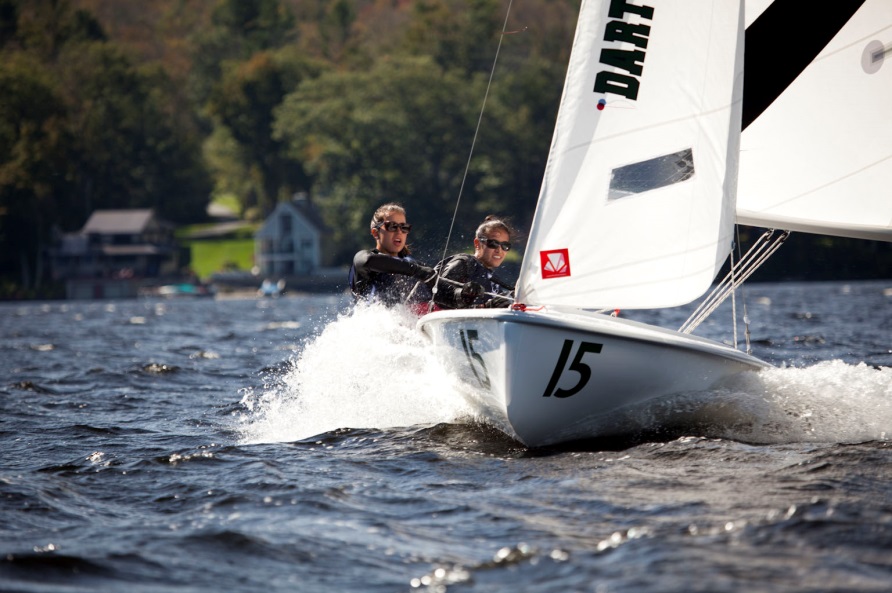
A boat for new sailors and veterans of junior sailing circuits, the Collegiate 420 is a stripped down version of the Club 420 in an effort to not overwhelm new sailors or school sailing team budgets. No trapezes or spinnaker, a simpler mainsheet and heavier duty construction, the Collegiate 420 is a different animal than the Club 420. Optimum weight is still around 270lbs however due to the inability to tune many of the normal rig adjustments, emphasis is put a lot on light, medium and heavy air crews to keep the boat powered up and flat.
Set-Up and Sailing: Club 420
Tuning the Club 420 is fairly simple with only a handful of adjustments to the rig. The main areas of concern are mast rake, rig tension and mainsheet bridle height. Mast rake is adjusted from the side stays where pins in the adjustable chain plates can be moved up or down accordingly. Rig tension is administered by pulling on more or less jib halyard tension. Because the jib has a contained luff wire, as tension is pulled on it takes up the tension from the forestay and tightens the rig. Mast butt position, while adjustable, is never adjusted. Bridle height changes the angle at which the boom is sheeted as well as leech tension while sheeting. Reliable tuning guides can be found on the North Sails website (http://www.club420.org/PAGES/Library/tuningGuide.htm).

Upwind the C420 is very weight conscious. This puts a premium on crew weight position in the boat as well as constant sail trim. An oversized rudder makes over steering through maneuvers slow and violent. In light air, the skipper and crew weight wants to be forward and together as much as possible. It is important to get the boat moving well before trying to point high. As breeze increases, the sooner the crew can get out on the trapeze the better; this powers up the sails and gives a very noticeable increase in speed. In full trapping conditions the boat will plane easily upwind and skipper and crew should work in tandem to keep the boat as flat as possible.
Off of the wind the boat is sailed best under spinnaker with the sail full and out in front of the boat. Skipper and crew roles switch so crew can see the sail while skipper balances the boat and trims the main accordingly. Medium to heavy wind conditions will allow the crew to trap while trimming the spinnaker, which are the fastest points of sail for the boat.
Sailing the Collegiate 420
Collegiate 420s involve much less set up than their Club cousins. This comes to the surprise of many former junior sailors who are used to going through the motions of checking rake, tension and the myriad of other tasks associated with the C420 circuit. Most college fleets are tuned to be identical in these aspects and changing them during racing is prohibited. There is no bridle to adjust as well, so sheeting is done from a block mounted directly on the centerboard trunk; that being said, there are ways to power up and change the geometry of the collegiate rig.

Because stays are fixed, mast rake can only be adjusted through jib halyard tension. The luff wire in the jib controls the amount that the mast moves forward and back, something easily seen when initially pulling tension on the halyard. Reducing the amount of mast rake, that is to say putting the mast tip more forward, involves pulling on more jib halyard. Taking tension off rakes the mast back and reduces the power of the rig.
Sailing the Collegiate 420 is not much different than the C420 besides the lack of trapeze. Crews must get out and hike as soon as wind speeds allow and skippers must drive the boat off the power of the main, which is significantly larger than the jib. Collegiate boats are known for going through several crews over the course of a weekend regatta in order to optimize weight for the conditions on hand. Heavier crews keep the boat flatter in more wind, lighter crews allow for hiking in less wind and reduce combined weight. Off wind without the spinnaker is conducted by going “wing on wing”, which involves having the jib and main on opposite sides of the sail to optimize the sail area of the boat.
Class Associations: Leading the Charge
The C420 class association is large, active and has a very strong support system. Because so many of the boats (nearly 8000) are being sailed today, most junior sailing events are conducted in private or club owned C420s. Well organized championship events such as Nationals and North Americans attract hundreds of the top boats from around the country and across the continent. A well laid out website is straight forward and helpful with calendars of events, classifieds and tuning guides (http://www.club420.org/). It would not be possible for such a large and diversified class to flourish without the help of such an involved class association from regional to national levels.

Collegiate 420s are sailed in, well, college, and the Interscholastic Collegiate Sailing Association is in charge of governing all college sailing. It is comprised of current and former college sailors and coaches who meet several times a year to discuss events, regulations and policy. Seasons run from early September to mid November, and again from January to June with national championships sailed at the end of each in six different disciplines.
Why Sail a 420? Rather, Why Not?
Of the limited number of youth training boats that are currently in use, what the 420 brings to the table is unmatched. Affordable at under $10k for new boat with trailer, or under $6500 for a competitive used boat, the C420 provides many years of fast and fun sailing from learn to sail to national championships. A large organized class association and the popularity of the boats ensures relevance in years to come and helps maintain value of the boat longer. Additionally, because of the popularity of the Collegiate 420 in college sailing, the C420 prepares future All-Americans for success in the most competitive one design stage in the country. The C420 is the top choice for youth trainers.
Blog
Vanguard 15 Elegy Rebuttal: I Ain't Dead Yet
By guest writer Mike O’Connor. This article is in response to our recent post: Elegy For the V15; Good Things End, But That’s OK
I would not write off a one design fleet that has regattas with 30 boats on the line just yet. It is true that numbers are not what they once were in certain areas, but there still are thriving V15 fleets out there, including: Annapolis, who just wrapped up a successful team race event, San Fran maintaining an active fleet, Nashville growing and stepping up as evidenced by their hosting Nationals in October, and Larchmont who has already booked two regattas with 30+ boats and two more regattas on the schedule. Fleets are still active and while new boats aren’t rolling off the racks (ahem LaserPerformance) there still remains a vibrant community of dedicated racers who love the boat.

From my own experience running Larchmont’s program I can attest that we are currently experiencing a surge in V15 participation this year. Our standard Sunday series has averaged 15 boats a week, and our two most recent fleet race regattas both netted 30+ participants. Both of these recent regattas saw several young college faces who were first time racers in the fleet. True these numbers are far off the Buzzards 80+ and Wianno Midsummah’s days (both venues I crashed in the car for); however all the fleet needs is a little creativity and boat manufacturing to start drawing people back.
Sailors and boat builders are constantly agonizing over the decline of the V15 and searching for its replacement for the fresh out of college crowd, but what’s wrong with the V15? There are just about 2000 in existence. From a price standpoint they provide much more bang for your buck than the other fleets being contemplated. A used V15 can be had for 1K to 3K right now perfect for the fresh out of college crowd. It seems less likely that parents will pony up $11,000 for a new “whatevers next boat” vs. paying the cheap price of a used V15, and as every long term V15 racer out there knows the most important factor in winning is often times simply a new set of sails (roughly $1K). So set a google alert and watch as the advertisements under $3K roll in. Also, check out V15’s for sale on Sail1Design’s Marketplace. Once set up with a boat and some fresh sails all it takes is a little searching to find your local fleet and get out on the water. Hint: you can find them in San Fran, NYC (Larchmont), Chicago, Marblehead, Newport, Nashville, and Annapolis just to name a few.
In a recent article John Storck (an old jr. sailing friend of mine) hit the nail on the head when he speaks of the fun and social attitude as being what we all loved the most about the good old days of V15 racing. With just a bit of creativity and drive we can get that back. The main issue with the fleet (outside of the economic downturn but that is a discussion for an economics class) is that it became almost a “professional” atmosphere that ultimately drove out the casual racer and non-all American college crowd. Lots of folks stopped wanting to travel to get smoked by the top guns and as a result stayed home in their local fleets which drove down national participation. People are still out there racing the V15 and I would propose some simple steps to get the fleet back on track:
- Get creative with formats: The 2vs.2 team race was a hit because it was fun, social, different, and also pairs people up randomly so everyone feels included and levels the playing field. LYC runs their June fleet race event college(A/B) style with docks to change off of which promotes everyone meeting and hanging out. This past June LYC had 18 teams (36 total skippers) out to race with only 10 of those skippers owning a V15 of their very own. The beauty of the event is that by doubling up you can loan out 1 boat to two people and maximize your exposure and bring in new skippers. These types of events are key to rekindling fleet morale.
- Advertise to new sailors: Hitting the standard college crowd is important but there are others out there as well. What about the Female Racers? Each year you have dozens of female skippers graduate from the college ranks but they don’t end up in V15’s. LYC ran a first time ever Women’s only event with 3 weeks notice last year and we netted 10 signups with minimal prep time. Of that group 5 have joined the LYC fleet this summer. What about parent/child race days? Parents are the ones with the cash so you get a parent/child team who has a blast and I guarantee you will see a new boat on the line the next weekend. So coordinate with your Jr. Program directors or talk to Head Instructors and get the young kids out racing.
- Coordinate between the fleets. This one is important and easier said than done but we need to organize a Fleet Captain counsel to get everyone connected and on the same page. Lack of communication between the fleets has contributed to the overall malaise and improving lines of communication will help build back momentum.
- Have FUN! A bit corny but true… how often did you hear these words as a Jr. Sailor and they still have merit. We sail because it’s fun so toss some beers from the committee boat, have some BBQ’s, free hot dogs whatever but happy sailors are participating sailors so make sure not to forget the fun.
While the national events have been impacted by a lack of travel, the V15 still remains the cheapest and best option for someone looking to get out on the water and racing. Why tear down and build from scratch when the V15 has proven to be a fun, competitive, and social fleet for the past two decades? I’m looking forward to the future and am positive that with just a little push we can continue moving the class forward, and if you need proof come to LYC. I’ll hook you up with a boat for the day and beers will be on me.
~Mike O’Connor (no, not the Harvard coach)
#1327
CJ Buckley Team Race Regatta Report

Remembering CJ Buckley
East Greewich, RI (July 30, 2014) — The 12th annual CJ Buckley Team Race for the c420 class Team Racing Nationals was sailed out of Goddard park this past week with 33 teams competing, more than 250 sailors from 26 states, the virgin Islands and Bermuda. The regatta was massive with 2 racecourses averaging over 150 races a day for 3 days.

The regatta was much more then races though it was a chance to remember a junior sailor who was a great competitor, teammate and friend. CJ Buckley wrote in his application for Tabor Academy “ Sailing is life. The rest is just details.” Most if not all of the competitors never met CJ himself but all of the competitors knows a kid like CJ and sees those same passionate qualities around them. The “CJ” is all about that passionate spirit with hard core racing mixed with “that was a great race” or “ congrats”. The “CJ” is also about volunteerism and giving back to the sport everyone loves with the regatta solely run by volunteers in a public park. College coaches, junior coaches, parents, local families, East Greenwich Yacht Club and Greenwich bay sailing association all donate their time and resources to provide a regatta with the spirit and passion of CJ.
At the end of day 3 the championship was down to just two teams and the racing did not disappoint. The Finals came down to the regatta leaders, “Timone and the Pumbas” against the “Milton Academy Mustangs”. The finals were a best of 3 series and the champions were crowned in race 3. Racing was tight from the start of race 1. Timone balanced into an early lead at mark 1 with a 1,2,5 combination, but the mustangs would have none of that and battled on the downwind legs to convert their team into a 1,2,6 by the last leg. The Mustangs held on for the win in race 1. Race 2 Timnoe lead off the line and never looked back and evened the score. So it was now down to the final race winner takes all. The race all the way around was even with combinations changing and a heated last reach. In the end the Mustangs were able to hold on for a win in the race and a win for the regatta. The racing was heated and tough but both teams looked over at each other across the line and congratulated each others team on a great race and a great series. That’s the way CJ would have it end.
The “CJ” could not happen without the dedication of two brothers Kyle and Justin Assad who have dedicated so much time and effort to make sure CJ lives on. The brothers, their friends and of course the Buckley family work tirelessly to make a special event for so many Junior sailors.
The top three teams were:
- Milton Academy Mustangs: Nick DiGiovanni, Eli Burnes, Henry Burnes, James Maguire, Scott Paderaen, and Davis Tantillo.
- Timone and the Pumbas: Martina Sly, Ian Morgan, Carter Pemberton, William Cannistraro, Andrew Sheerin and Taylor Kirkpatrick.
- Team AYC: Nick Floyd, Trevor Long, Kyle Comerford, Amelia Hardy, Harrison Hawk and Tessa Fullmer.
Complete results and teams can be found at : http://cjbuckleyregatta.net/index.html
Press Coverage: Warwick Beacon Article Providence Journal Article
About CJ Buckley
CJ Buckley was a junior sailor who grew up sailing on Greenwich bay out of the Greenwich Bay Sailing Foundation. CJ Loved the sport and would do anything to be on the water with his friends. CJ was diagnosed with a brain tumor and underwent chemo therapy. In December of 2002, after a year and a half battle with cancer, he passed away. CJ’s father said about CJ “He loved the excitement and challenge of being on the water”. “ He was a talented Sailor and Firece Competitor”. Even when CJ was undergoing intense Chemotherapy he got in his boat and went sailing.
About The Club 420 Class Association
The Club 420 Association was established in 1980 to promote, foster, encourage and sponsor one-design sailing. The Association sponsors a class North American Championship, US and Canadian National Championships as well as regional championships for the class across North America while promoting the class to all ability and experience levels of youth sailing. Since 2006, the class membership has more than doubled from 300 to its current 715 members. The class offers many regional, national and North American championships in both fleet and team racing formats as well as clinics across North America. Our Nationals / North Americans have had 175 boats attend, with all levels of sailors competing in some of the finest and socially fun regattas you will attend.
About The Club 420
The Club 420 is a two person dingy which forms the base of many local, high school and collegiate programs in North America. Simple for beginning sailors and yet challenging enough for collegiate champions. The Club 420 offers more learning opportunities than any other double-handed boat you can find. Over 5,000 Club 420s are sailed in youth, high school and collegiate programs all over the United States, Canada, Mexico and the Caribbean.
For more information please visit our website at www.club420.org or visit us on Facebook
Contact:
John Vandemoer, Executive Director
Email – [email protected]
Optimist Team Race Nationals Report: Girls Rule

Girls Rule the Day at Opti Team Racing Nationals, By Airwaves Writer Clinton Hayes
The reason why I said yes to being PRO at this year’s Opti Team Racing Nationals, in large part, was because friends of mine had done the same the last couple of years and said it was the best thing they did all summer. Although there’s still time left, its looking like that might be the case for me as well. California Yacht Club in Marina Del Ray, CA in cooperation with the United States Optimist Dinghy Association, set the stage for a great event with dozens of volunteers and another dozen umpires. As PRO I also have to thank the trusty California sea breeze for making our job easy with very few course changes. 23 teams with 4 boats on a team, many with a substitute, sailed over 300 total races across 2 racecourses in just 3 days.
For those of you like me who haven’t been around Optis in a long time and haven’t seen any 4 on 4 team racing, the racing ranged from challenging at best to completely crazy. The Optimist stops and starts in an instant making almost any team racing move possible at any moment. The small size of the boat and high skill level of most teams meant boats got within an inch of each other without fouling.
Check out this video http://usodanationals-2014.org/graphics/UploadFile/11303/16345/teamracing2_.mov.
I was not jealous of the tough job the umpires had sorting out whether or not contact had occurred. I would put any of these 13 year olds up against the best match racers in the world in terms of “selling” a call to the umpires. It was very fun to watch.
I did manage to pick up the basics of 4 on 4 team racing. There are basically 2 winning AND stable combos: 1,2,3,X and 3,4,5,6(kind of like a play 2 in 3 on 3). Really the play is to have 3 of your 4 boats in the top 4 or put 2 of the other team’s boats in 7th and 8th. 1,2,6,X also wins but is very unstable because so many opponents’ boats can work together to pass your 6 back. 4 on 4 favors “playing back” which kept most races exciting till the very end with many lead changes on the finish line.

Gold Fleet racing. Photo credit to Sara Proctor sailfastphotography.com
I could go on talking about team racing but what I really want to say something about are the girls. It’s clear that the Optimist is special because the girls and guys really compete on the same level. Scroll down the fleet racing results and you’ll see it’s pretty close to 50% girls in the gold fleet:
http://usodanationals-2014.org/tp70/page.asp?ID=315736.
A large part of this is probably the more identical size of girls vs. guys of that age but another part is equal opportunity. There are only 2 female team races in the country that I know of, the Duplin Team race at Tufts(a college event) and the Chix only team race hosted by Harvard this year http://www.ritra.org/chix-only/. College fleet racing has both girls and coed competition, why not team racing? A very small percentage of girls will go on to start in a college team race nationals but what about the rest? Most of them love team racing just as much as the guys but don’t get a chance to compete outside of practice. Working hard at team racing practice for the sole benefit of the coed skippers seems like a pretty unfair situation.
Beyond the opportunity issue is the pure skill I saw out of both genders, but especially the girls. I coach high level college team racing and I saw things from some of the girls that I wished I could have videoed to show our incoming freshmen how to hold a pin and the right way to do a trap at mark 3. Needless to say, I was very impressed. In the finals the two best teams met for a first to 3 wins series. LISOT Gold struck first before the teams traded wins with team CERT/SPYCRT taking the 5th race and the regatta win. After watch all that racing it came as no surprise that the winning team had more girls than guys. Winners of the 3rd vs. 4th sailoff, SailStrong Red, also had more girls than guys. That amounts to more girls than guys total on the podium.

Teams Black and Yellow at the start line during the finals. Photo credit to Sara Proctor sailfastphotography.com
My hope is these talented young sailors keep having fun team racing. Each day I was shocked to hear that at 5pm the kids still wanted to keep racing when the umpires and Race Committee where burnt out hours before. It was crazy how much they loved it because they don’t get to do it that often. I especially hope that most of these super talented girls will keep driving in team races as they enter high school and college. My pledge to them is that as long as I am involved with college sailing I will work to establish a girls college team racing nationals so hopefully by the time they are 18 and showing up to campus their freshmen year they have something to work toward in team racing.
I’d like to thank to USODA for bringing me and my girlfriend(Co-PRO Erin Pierce) to this great event. Two people in particular worked so hard to make everything possible. Bill Stump form California Yacht Club took care of any logistical problem the event faced and Genoa Fedyszyn, USODA executive director, lead the way to make everything work. Thanks! And maybe see you next year.
Elegy for the Vanguard 15: Good Things Do End, But That’s Okay…
Sail1Design would like to welcome John Storck to the Airwaves team!
By John Storck III

With the recent cancellations of both the NYYC Team Race, and the 2v2 Random Pairs Regatta (both historically strong events in the V15 class), it seems more evident than ever that the boat and its class are quickly decaying into stories for the grandchildren. Vanguard 15 Fleet Race regattas began declining in participation years ago, but only recently have the long-preferred team race regattas followed suit. Many people have tried to figure out why this has happened, and many people have fought nobly to save it. I’m not attempting to do either of these things, but rather give a simple tribute to a class that gave me some of the best times of my life.

Yes it’s true- we used to have 80+ boat fleets at major fleet race regattas, and more than 20 teams at many team races. More importantly, the class seemed to be built on a priority of having a great weekend with your friends. My friends and I sailed our way to an 0-20 record on Saturday at our first ever Mid-Summah’s Team Race, and we had a great time.
It was certainly a low-rent district of sailing, mostly consisting of college students or recent graduates. Boats would show up on Saturday morning in varying states of readiness, but through the friendly atmosphere, everyone would make it on the water eventually. Housing was typically an oversight, leading to far more people crashing on a local’s floor than their parents would have liked. There were rarely trophies, and no one cared. The smiles on people’s faces and hugs exchanged on Sunday afternoon were far better. And that’s what kept people coming back, despite whatever condition their boat, sails, car, etc. were in.
Now, I know the class isn’t totally dead, and there are still some great local pockets, but I wanted to point a hopeful gaze toward the future. The V15 class was amazing, and something else will be as well. It wasn’t long ago that the J/70 was only an idea. What’s important is to learn from the strengths of past classes like the V15. The one thing that is obvious is that it was built through a pre-existing community; college sailing. When I was a freshman, I knew I would buy a V15 for the following summer. All of my friends seemed to be doing the same. So think about your sailing community. Think about your region. How many of your friends are thinking about what’s next? Imagine if you all agreed on what type of boat you would buy, and just made it happen. You could be gathering in different spots all through the summer with your friends to have a great weekend. That’s what the V15 class was, and I’m confident something else will be. I know it’s not that easy, but why can’t it be? Call a few of your friends today to get the conversation started.

I feel truly fortunate to have been able to be a part of the V15 class for many years during its absolute height. I’m blessed to have a lifetime of memories assembled within the shallow cockpit of a V15. And I know there are hundreds of people who share that feeling.
Here’s to the V15 class, and all those who I shared the good times with. The grandkids better enjoy the stories, because we’re going to tell them anyway.
What class is next? What are your thoughts? Share with us your memories of the V15 below!!!
Club 420 2014 North American Championship Final Results & Report
LONG BEACH ISLAND, NJ — The 2014 c420 North Americans finished here in beautiful Long Beach Island, NJ. Today was the final day of racing for both Gold and Silver. The fleet left the beach under cloudy skies and a dying northerly breeze. Race 1 started in 8kts and finished in 3 kts. The racing was challenging for sure. After that the conditions really fell apart and it was clear that no more consistent breeze was on the horizon. The Race Committee called the regatta after just that one race but thirteen for the whole series.

The Team of Martina Sly and Ian Morgan, Annapolis YC and Coral Reef YC, are our 2014 North American champions. They sailed an amazingly consistent regatta with all the scores in the top 10. After racing both Martina and Ian were over joyed with the regatta “ The regatta was so much fun with all the different Conditions, it really challenged you.” Ian Morgan commented. Martina Sly talked a little bit about the keys to the regatta “ Our boat speed was really good in all conditions, we really focused on keeping the boat flat and avoiding the windward heel in the choppy conditions.” “ The key was to be consistent and stay in the top group, we sailed in pressure and sailed high on reaches to keep our air clear and our boat moving.” Also sailing a great regatta was second place finishers Nick Hernandez and Zack Jordan, Sarasota sailing squadron and LISOT. Rounding out the top three was Augie Dale and Kennedy Placek from Pewaukee YC and San Francisco.
The Brant Beach Yacht Club and its army of volunteers were on every detail and made the event a huge success. “ We love coming here” Said Class president John Morgan. BBYC is known for their great hospitality and excellent Race management and both were in excellent form at this years North Americans.
Pictures and interviews are being posted on the Club 420 Association Face Book page.
For final results scroll down, or they can be found at: http://www.bbycnj.com/Results/show.php?rgtID=198
About The Club 420 Class Association
The Club 420 Association was established in 1980 to promote, foster, encourage and sponsor one-design sailing. The Association sponsors a class North American Championship, US and Canadian National Championships as well as regional championships for the class across North America while promoting the class to all ability and experience levels of youth sailing. Since 2006, the class membership has more than doubled from 300 to its current 715 members. The class offers many regional, national and North American championships in both fleet and team racing formats as well as clinics across North America. Our Nationals / North Americans have had 175 boats attend, with all levels of sailors competing in some of the finest and socially fun regattas you will attend.
| Pl | Sail | Crew | From | Tot | 1 | 2 | 3 | 4 | 5 | 6 | 7 | 8 | 9 | 10 | 11 | 12 | 13 |
|---|---|---|---|---|---|---|---|---|---|---|---|---|---|---|---|---|---|
| 1 | 9119 | Martina Sly & Ian Morgan | CRYC – Annapolis YC | 34 | 2 | 1 | 1 | 2 | (4) | 2 | 1 | 1 | 7 | 3 | 2 | 4 | 8 |
| 2 | 5711 | Nick Hernandez & Zack Jordan | Sarasota Youth Sailing – LISOT | 56 | (11) | 8 | 2 | 11 | 3 | 4 | 5 | 1 | 4 | 4 | 5 | 6 | 3 |
| 3 | 6956 | Augie Dale & Kennedy Placek | LISOT-Pewaukee YC | 80 | (18) | 1 | 3 | 1 | 1 | 3 | 11 | 9 | 9 | 11 | 16 | 10 | 5 |
| 4 | 5433 | Lucy Wilmot & Alexander Ron | San Francisco YC | 93 | (33) | 4 | 9 | 4 | 12 | 1 | 8 | 19 | 13 | 2 | 7 | 2 | 12 |
| 5 | 6100 | Carter Pemberton & William Cannistraro | Wianno YC | 94 | 16 | (47) | 10 | 15 | 6 | 23 | 3 | 2 | 5 | 6 | 1 | 3 | 4 |
| 6 | 7320 | Matthew Kaplan & Sean Walsh | Larchmont YC | 97 | 1 | (21) | 6 | 13 | 18 | 4 | 4 | 4 | 18 | 8 | 3 | 7 | 11 |
| 7 | 7212 | Eduardo Mintzias & George Williams | CRYC | 117 | 7 | 2 | (17) | 9 | 10 | 6 | 2 | 2 | 11 | 16 | 9 | 30 | 13 |
| 8 | 7054 | Emma White & Grace Lucas | Annapolis YC | 130 | 1 | 2 | 2 | 5 | (13) | 10 | 9 | 12 | 27 | 10 | 28 | 18 | 6 |
| 9 | 702 | Thomas Walden & William Hundahl | St. Thomas YC – Pleon | 133 | (14) | 5 | 1 | 2 | 12 | 8 | 1 | 5 | 15 | 7 | 13 | 5 | 59\DNF |
| 10 | 3912 | Peter Lynn & Chris Manson-Hing | Pleon YC | 138 | (32) | 15 | 11 | 16 | 5 | 17 | 20 | 17 | 2 | 5 | 6 | 14 | 10 |
| 11 | 7273 | Matthew Safford & Griffin Webber | Pleon – Sandy Bay YC | 144 | 7 | (36) | 34 | 9 | 27 | 1 | 12 | 7 | 1 | 13 | 20 | 11 | 2 |
| 12 | 5251 | Nic Muller & Andy Widmeier | Brant Beach YC | 148 | 11 | 7 | 3 | (18) | 5 | 3 | 6 | 3 | 19 | 34 | 15 | 22 | 20 |
| 13 | 7217 | Shawn Harvey & Andrew Swerdlow | Coral Reef YC | 153 | (59\RAF) | 8 | 5 | 13 | 23 | 5 | 23 | 6 | 6 | 25 | 21 | 17 | 1 |
| 14 | 4143 | Nick Floyd & Trevor Long | Annapolis YC-CYCCM | 155 | 3 | (21) | 6 | 1 | 9 | 13 | 16 | 9 | 14 | 9 | 8 | 8 | 59\DNF |
| 15 | 70 | Paula Resto & Ciara Rodriguez | Coral Reef YC | 159 | 8 | 14 | 4 | 3 | 2 | 7 | 3 | (28) | 16 | 30 | 33 | 25 | 14 |
| 16 | 7056 | Connor Bayless & Jake Vickers | Annapolis Yacht Club | 162 | 28 | 6 | (47) | 4 | 9 | 15 | 5 | 11 | 28 | 17 | 12 | 20 | 7 |
| 17 | 6201 | William Gallagher & Rhett Ullmann | Larchmont YC – LISOT | 181 | 23 | (35) | 13 | 21 | 7 | 8 | 18 | 10 | 17 | 23 | 10 | 16 | 15 |
| 18 | 5889 | Kyle Comerford & Amelia Hardy | Annapolis YC | 187 | (21) | 9 | 12 | 3 | 20 | 5 | 13 | 6 | 26 | 14 | 11 | 9 | 59\DNF |
| 19 | 4565 | Kristopher Swanson & Sally Wilmot | Richmond YC-St. Francis YC-SFYC | 199 | (12) | 12 | 7 | 7 | 2 | 11 | 8 | 10 | 3 | 1 | 55 | 59\DNS | 24 |
| 20 | 7316 | Mark Davies & Graceann Nicolosi | Chicago YC | 219 | 10 | (44) | 22 | 19 | 13 | 11 | 7 | 3 | 36 | 35 | 19 | 28 | 16 |
| 21 | 7275 | James Collins & Ethan Andersen | Pleon | 223 | 9 | 3 | 5 | (33) | 8 | 18 | 6 | 12 | 38 | 32 | 59\DNS | 12 | 21 |
| 22 | 5964 | Meg Gerli & Alexandra DelBello | Mantoloking YC – LISOT | 225 | 6 | 25 | (26) | 22 | 19 | 16 | 10 | 19 | 12 | 21 | 29 | 29 | 17 |
| 23 | 7582 | Hector Guzman & Annabel Carrington | Christchurch School | 226 | 6 | 13 | 8 | (20) | 14 | 19 | 12 | 16 | 24 | 26 | 35 | 31 | 22 |
| 24 | 4836 | Andrew Sheerin & Taylor Kirkpatrick | Ida Lewis YC – BCRP | 230 | 13 | 5 | 11 | 14 | 4 | (19) | 11 | 13 | 10 | 19 | 27 | 44 | 59\DNF |
| 25 | 4205 | Josh Dochoda & Kyle Dochoda | St. Petersburg YC | 244 | 12 | 9 | 15 | 19 | (31) | 18 | 28 | 4 | 25 | 24 | 38 | 33 | 19 |
| 26 | 6920 | Jackson Wagner & Jackson Ritter | San Francisco YC | 246 | 15 | (32) | 14 | 16 | 8 | 7 | 4 | 21 | 34 | 33 | 34 | 1 | 59\DNF |
| 27 | 6939 | Stephan VerHulst & Sofia Bratt | Coral Reef YC | 247 | (18) | 16 | 4 | 10 | 1 | 2 | 2 | 17 | 37 | 42 | 52 | 46 | 18 |
| 28 | 8280 | Gracie Howie & Katie deLisser | Coral Reef YC | 248 | 2 | 7 | 24 | 14 | (29) | 16 | 14 | 5 | 35 | 20 | 25 | 27 | 59\DNF |
| 29 | 7004 | Nick DiGiovanni & John Wetzel | Wianno | 259 | 4 | (49) | 23 | 42 | 22 | 12 | 9 | 27 | 30 | 12 | 4 | 15 | 59\DNF |
| 30 | 6207 | Timothy Greenhouse & Oliver Parsons | American YC | 266 | 14 | 3 | 9 | (23) | 15 | 9 | 19 | 23 | 8 | 29 | 44 | 34 | 59\DNF |
| 31 | 7086 | John Mastrandrea & Michael Mastrandrea | Rochester YC | 276 | (38) | 24 | 26 | 36 | 18 | 20 | 7 | 8 | 32 | 15 | 18 | 13 | 59\DNF |
| 32 | 6913 | Taylor Gavula & Juliana Rustum | Bay Head YC – LISOT | 290 | 17 | 10 | 13 | 17 | (30) | 22 | 17 | 16 | 54 | 18 | 23 | 24 | 59\DNF |
| 33 | 6902 | Clark Uhl & Matt Homa | Pleon | 303 | 24 | 4 | 15 | 24 | 6 | 9 | (27) | 7 | 21 | 45 | 39 | 50 | 59\DNF |
| 34 | 7596 | Anna-Luisa Brakman & Katerina Howie | Noroton YC | 303 | 5 | 12 | (18) | 7 | 11 | 10 | 17 | 15 | 31 | 27 | 50 | 59\DNS | 59\DNF |
| 35 | 7315 | William Curtiss & Amanda Engemen | Chicago YC | 312 | 13 | 11 | 21 | (23) | 11 | 12 | 15 | 15 | 52 | 51 | 26 | 26 | 59\DNF |
| 36 | 6684 | Noah Kelleher & Sarah Kelleher | Sail Newport – BCRP | 318 | (55) | 26 | 36 | 11 | 3 | 23 | 13 | 14 | 22 | 38 | 14 | 59\DNS | 59\DNF |
| 37 | 1869 | William McMullen & Noble Reynoso | San Francisco YC | 325 | 8 | (29) | 27 | 8 | 19 | 13 | 24 | 25 | 44 | 31 | 30 | 37 | 59\DNF |
| 38 | 4763 | Willy Comerford & Maggie Schult | Annapolis YC | 334 | 35 | 10 | 21 | (38) | 15 | 22 | 10 | 24 | 40 | 48 | 31 | 19 | 59\DNF |
| 39 | 7005 | Elizabeth Mignon & Drew Lorenz | Bay Head YC | 340 | 3 | 18 | 7 | 6 | (28) | 24 | 19 | 21 | 50 | 50 | 47 | 36 | 59\DNF |
| 40 | 7533 | Henry Burnes & Caden Buckley | Wianno | 341 | (44) | 31 | 16 | 25 | 27 | 21 | 28 | 13 | 29 | 37 | 17 | 38 | 59\DNF |
| 41 | 7302 | Ryan Hennessey & Connor Hennessey | Annapolis YC | 352 | 22 | 17 | 24 | 26 | (42) | 27 | 25 | 37 | 42 | 40 | 41 | 42 | 9 |
| 42 | 7477 | Kyle Riggs & Daniel Medici | East Greenwich YC | 357 | (29) | 11 | 19 | 6 | 25 | 28 | 15 | 23 | 58 | 43 | 49 | 21 | 59\DNF |
| 43 | 3776 | Catherine Kerner & Keily Gleason | Manhattan Sailing Club – LISOT | 360 | 39 | 14 | 37 | 39 | 23 | (44) | 18 | 14 | 33 | 28 | 24 | 32 | 59\DNF |
| 44 | 7278 | Clay Snyder & Stephanie Fort | Coral Reef YC | 367 | 4 | 6 | 32 | 28 | 37 | (47) | 20 | 18 | 45 | 53 | 22 | 43 | 59\DNF |
| 45 | 7210 | Benjamin Kern & Carolyn Corbet | Coral Reef YC | 372 | 22 | (35) | 28 | 12 | 16 | 27 | 14 | 20 | 41 | 39 | 46 | 48 | 59\DNF |
| 46 | 3617 | Cameron Giblin & Gray Benson | SSYC | 379 | (45) | 26 | 10 | 35 | 20 | 14 | 16 | 18 | 57 | 41 | 36 | 47 | 59\DNF |
| 47 | 7053 | Nicholas Memoli & Kevin Gallagher | Beverly YC | 381 | 20 | 20 | 18 | (48) | 14 | 17 | 30 | 11 | 46 | 52 | 54 | 40 | 59\DNF |
| 48 | 5790 | Porter Kavle & Aidan Morgan | Annapolis YC | 402 | 16 | 29 | 23 | 24 | 26 | 29 | 26 | (31) | 23 | 54 | 42 | 51 | 59\DNF |
| 49 | 3311 | Matthew Logue & Jack Denatale | RYC – LISOT | 403 | (41) | 19 | 14 | 29 | 35 | 14 | 34 | 34 | 39 | 44 | 43 | 39 | 59\DNF |
| 50 | 6128 | Charlie Hibben & Ginny Yeats | Wianno YC | 404 | 15 | 37 | 20 | 36 | 17 | 6 | (55) | 43 | 51 | 49 | 53 | 54 | 23 |
| 51 | 6610 | Alex Fasolo & Graham Johnson | Bay Head YC | 405 | 29 | 28 | (34) | 5 | 26 | 34 | 29 | 31 | 53 | 22 | 37 | 52 | 59\DNF |
| 52 | 7311 | Bailey Cornog & Kate O’Donnell | Chicago YC | 407 | 33 | 22 | (39) | 22 | 25 | 28 | 23 | 22 | 56 | 36 | 40 | 41 | 59\DNF |
| 53 | 7481 | Jack Spears & Mariah Millen | Royal Canadian YC | 414 | 17 | (37) | 30 | 28 | 28 | 25 | 31 | 29 | 43 | 56 | 45 | 23 | 59\DNF |
| 54 | 7581 | Jack Elkin & Carter Little | Christchurch School | 415 | (40) | 25 | 32 | 29 | 17 | 31 | 22 | 32 | 55 | 46 | 32 | 35 | 59\DNF |
| 55 | 5787 | Elizabeth Hansen & Megan Ploch | Larchmont YC | 420 | 9 | 33 | 20 | 37 | 24 | 20 | 36 | (42) | 20 | 58 | 59\DNS | 45 | 59\DNF |
| 56 | 7434 | Sonia Lingos-Utley & Drew Bailey | Wianno YC | 428 | 19 | 30 | 25 | (33) | 7 | 30 | 25 | 30 | 48 | 47 | 59\DNS | 49 | 59\DNF |
| 57 | 7584 | Alex Moreno & Erik DeMario | Christchurch School | 437 | 19 | 20 | 12 | (42) | 33 | 34 | 24 | 25 | 47 | 57 | 48 | 59\DNS | 59\DNF |
| 58 | 6879 | Peter Steo & Kim Kusinsky | Rochester YC | 455 | 27 | 38 | 25 | 10 | 38 | 24 | (40) | 26 | 49 | 55 | 51 | 53 | 59\DNF |