Annapolis, Md. (May 30, 2014) – Today was the last day of racing for the Sperry Top-Sider Women’s National Championship on the Severn River at the U.S. Naval Academy. Eighteen women’s collegiate teams raced for the Gerald C. Miller Trophy and Dartmouth College came out the victor for the second year in a row.
The day started with a short on shore postponement while the race officials waited for the breeze to fill in. The temperature was in the 60s with cloudy skies. A light northerly at around 4 knots filled in and racing got underway. After a set and a half the breeze died again and the teams went in for a long lunch break. By the afternoon temperatures rose to about 70 degrees with more sun in the sky and the winds shifted to the east remaining light and eventually shifted to a southerly direction, which was stable, but light again around 5 knots.
 Today the divisions swapped boats again, A-division sailed in Z420s and B-division sailed in FJs. The sailors completed seven races today in both divisions on windward leeward courses with 4 legs for a total of 17 races in each division for the championship. The race committee was able to start the last race of the day minutes before the 5 p.m. racing time limit.
Going into today’s racing Yale University and Dartmouth were neck-and-neck with only three points separating them. The U.S. Naval Academy trailed the top two by 35 points and behind Navy, the other teams were more condensed, which allowed for movement on the scoreboard today. Most notable was Old Dominion University who moved up from ninth place yesterday to finish just one point behind Navy in fourth place.
The home and host team, Navy, won the Ann Campbell Trophy for finishing the event in third place. The Navy women sailed consistently and were a well-balanced team. Sailing for Navy was Mary Hall ’15 with Elizabeth Morrison ‘14 in A-division and Marissa Lihan ’14 with Emma Ferris ’15 and Megan Hough ’16 in B-division.
After an all-day battle, Yale finished second winning the New England Women’s Trophy. It was not until the fourth to last race of the day that Yale gave up their lead. They battled back and forth with Dartmouth and even had some leads in B-division, but they could not hang on to them.
“Dartmouth’s A-division was pretty much unbeatable today,” says Bill Healy, assistant coach for Yale, “We tried to stay as close as we could.” Yale’s A-division suffered a few over-early starts and while Healy says their B-division did a fabulous job, in the end it was not enough to take home the win.
“It is bittersweet for us,” Healy says of finishing second, “Especially for the seniors who have worked hard for four years and wanted the win.” Sailing for Yale was Morgan Kiss ’15 with Katherine Gaumond ’15 in A-division and Marlena Fauer ’14 with Eugenia Custo Greig ’14 and Charlotte Belling ’16 in B-division.
Winning the Women’s Championship title and the Gerald C. Miller Trophy for the second year in a row is Dartmouth. Deirdre Lambert ’15 with Avery Plough ’14 sailed in A-division and Kelsey Wheeler ’14 and Lizzie Guynn ’16 sailed in B-division. Lambert and Plough won four of the last five races helping their team to stay well ahead of Yale.
“We knew it was going to be a really tough day. Conditions were changing all of the time as they had been the whole regatta,” John Stork III, co-head coach for Dartmouth says. “There were two things we knew we had to do well. We had to start well and we had to be fast. So if we could control our destiny off of the starting line and be fast then we knew we would have a shot,” Stork explains about going for the win today.
Dartmouth did not talk about winning the event for the second year in a row, but Stork confessed, “We quietly all believed it was possible.”
This will be Stork’s last year coaching college sailing and he says, “It’s been an amazing run with these girls and with this team and it’s something I am going to cherish for the rest of my life.”
Lambert, Wheeler and Guynn were also part of the pairings that won the championship last year. This is the fourth time that Dartmouth has won the Sperry Top-Sider Women’s National Championship they also won in 1992, 2000 and 2013.
After racing awards were presented at the Robert Crown Center for the top teams and also for the first place finishers in each division. Deirdre Lambert ’15 and Avery Plough ’14 from Dartmouth won the Madeleine Trophy, awarded to the low-point A- division team. They finished with 60 points total, 41 points ahead of the second place pairing.
Marlena Fauer ’14 with Eugenia Custo Greig ’14 and Charlotte Belling ’16 from Yale won the Judy Lawson Trophy, awarded to the low-point B-division team. They finished with 89 points total, 20 points ahead of the second place pairing.
For full results visit the event website: http://2014nationals.collegesailing.org/. To view or purchase photos from today’s racing and awards visit: www.ebrianschneider.com.
Women’s Final Overall Results
1. Dartmouth College, 185
2. Yale University, 190
3. U.S. Naval Academy, 275
4. Old Dominion University, 276
5. Massachusetts Institute of Technology, 286
6. U.S. Coast Guard Academy, 291
7. Hobart and William Smith Colleges, 296
8. College of Charleston, 305*
9. University of Rhode Island, 305*
10. Boston College, 328*
11. Eckerd College, 328*
12. Stanford University, 336
13. Bowdoin College, 359
14. Brown University, 381
15. University of Hawaii, 414
16. Georgetown University, 417
17. University of South Florida, 419
18. University of Wisconsin, 423
* Head-to-head tiebreaker
Racing will continue in the Spring Intercollegiate National Sailing Championships with the APS Team Racing National Championship, which will take place over the next three days at St. Mary’s College of Maryland. Sixteen teams will report at 8:30 a.m. for a Competitor’s Briefing and the racing will follow.
Live coverage, sponsored by LaserPerformance, will continue tomorrow with highlights and updates. Click on “Live Coverage” on the event website for these up-to-date racing details. Social media coverage will be provided on collegesailing.org. To learn more about the teams competing in the events and to follow the racing and results visit the event website: http://2014nationals.collegesailing.org/.
The Inter-Collegiate Sailing Association (ICSA) is the governing authority for sailing competition at colleges and universities throughout the United States and in some parts of Canada. Visit www.collegesailing.org to learn more.
S1D Welcomes our Newest Team Member: Selden Mast!
Selden Mast …for Sailing; and for Summer
Greetings! Allow us to introduce ourselves. We are Selden Mast Inc.; your connection to the Selden Group. For over 50 years, Selden is proud to have manufactured the most durable and reliable sailing spars in the world.
Located in Charleston, South Carolina, Selden Mast Inc. is the largest dinghy spar manufacturer in North America. We also distribute a large array of Selden dinghy products ranging from our complete line of dinghy deck hardware to a huge selection of all the well-known Selden dinghy components.

On this page, we will provide monthly updates from our company to keep you in the loop on what we’ve got cooking down here! From product reviews and announcements to updates on Team Selden we got you covered.
With the summer sailing season just around the corner, we are hard at work producing all of your dinghy needs to guarantee you have a fun and enjoyable season on the water. Be sure to check out our freshly redesigned website at www.seldenmast.com to find the Selden dealer closest to you.
If you have any reason to contact us directly, feel free to e-mail us at [email protected].
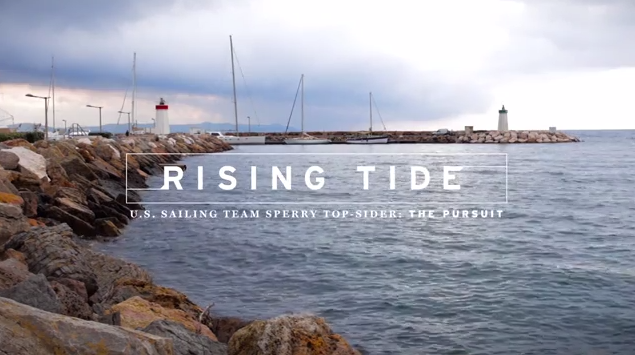
US Sailing's Olympic Rising Tide Video
The US Sailing Team Sperry Top-Sider has released Episode 2 of their video project “Rising Tide”, titled “Youth Infused” which focuses on the younger members of the team including Annie Haeger, Briana Provancha, Charlie Buckingham, and Caleb Paine. Check out the new video with some great footage from the Sailing World Cup Hyères in France, and stay tuned for more episodes to come!
Follow the US Sailing Team Sperry Top-Sider at its social media hub: http://bit.ly/Qz1d0q
Read the latest US Olympic Sailing Newsletter: http://bit.ly/1qt6dkq
Subscribe: http://eepurl.com/EZH6D
Team One Newport Supports Newport-Bermuda Race
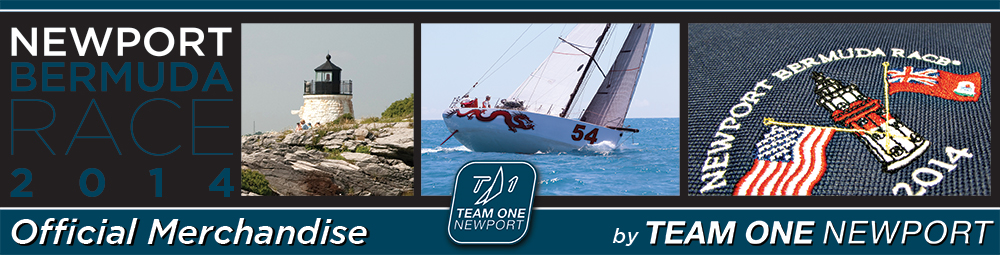
Team One Newport is proud to be the Official Merchandising partner for The Newport Bermuda Race. Having been in the sailing outfitters business for thirty years, we have the expertise where it counts. We are sailors, so we know what sailors need for offshore racing and what they want for when they are on land. That’s why the Cruising Club of America selected Team One Newport to supply the merchandise for the hundred and sixty nine boats entered in the 2014 Race.
Our online store boasts a large selection of both clothing and accessories, all customizable with your boat name and sail number. We know that for any blue water passage, comfort is key. As such, we are proud to supply practical technical shirts that keep you dry by wicking away moisture and pull-over fleeces for layering under foul weather gear during chilly night watches. For looking sharp at crew dinners, we have everything from causal polos to button downs, in styles for both men and women and in a variety of colors.
Our know-how is not limited to sailing apparel; we are also masters when it comes to customization. For customized gear, make sure you place your order by June 6th or before to ensure you receive your items before the June 20th start. In the event that you would like an item that is not featured on our online store, we are happy to customize anything else we sell with the iconic NBR logo. We can decorate nearly anything so we encourage you to browse online and in our store at 561 Thames Street.
Team One Newport will also be selling these items at registration at the New York Yacht Club’s Harbour Court. We will be selling Bermuda Race gear up until race day—and beyond—if you would like to memorialize the occasion. Conveniently located in downtown Newport, we are an easy walk from the water for sailors needing to pick up last minute items before heading the 635 miles to Bermuda. And there’s no need to limit attire to race participants. Family, friends, and fans can show their support for this year’s race by getting decked out as well!
The Bermuda Race is on every sailor’s bucket list. Don’t miss this opportunity to commemorate the 2014 Race!
Visit www.team1newport.com or call us at 401-847-4327 for more information.
2014 ICSA Team Race Nationals Preview and Final Rankings!
Sail1Design ICSA Team Race Rankings
Nationals are upon us! Teams across the country have been practicing all season, and we are down to the final 16 teams that have qualified in their conferences to compete for ICSA’s APS Team Race Nationals Championship for the Walter C. Wood Trophy. The pool of teams this year is one of the strongest in recent history, and so the fight from start to finish will be tough, with no easy races and every win counting.
Teams that have had great seasons could miss the Top Eight with just one or two bad races, and the Top Four will be determined by those who come to Nationals at the top of their game!
Stanford has yet again dominated the spring season with a deep squad and great practice competition, and are a favorite going into the event. We will see if they can finally put the pieces together this year and come away with the victory! St. Mary’s will be close on their heels, and with a home water advantage they will also be a tough team to beat. Yale is another favorite to finish near the top, returning much of last year’s championship team.
Follow the action at St. Mary’s College of Maryland May 31st to June 2nd to see who will be crowned the champions.
SEE THE RANKINGS AND COACHES PROGNOSTICATIONS: CLICK HERE
Olympic Sailors Face a Murky, Potentially Dangerous Road to Rio
Shared from the New York Times, this report uncovers an alarming situation at Guanabara Bay, the upcoming site of the 2016 Summer Olympic Games. Unless something changes, sailors may well face dangerous health concerns while competing in the polluted waters of Guanabara Bay in Rio. Sailors have reported animal caracasses floating in the water, horribly polluted sewage-infested water, garbage floating in the Bay, collecting on foils, and one sailor reported capsizing after hitting a partially submerged sofa.

The Z-420 Takes Off: A New Institutional Dinghy, and More
The 2014 College Nationals, just around the corner, will feature this year for the first time, the all-new LaserPerformance Z-420. This boat is a more modern and thoughtful upgrade from the club 420, adding new ideas to a boat originally designed in, gulp, 1959. Time will tell if this boat can meet the reliability and durability bars set by its predecessor, but most reports so far indicate the boat is far livelier and more responsive. It seems the development of this boat offers more than just a college dinghy; trapeze, spinnaker, mast ram, all point to a new one-design class.

In fact, since all college national championships must now be sailed in LaserPerformance boats, the institutional future seems “Z”, at least on the 420 side. Many top colleges have wasted no time, and already have in their boathouses, or have ordered, new z 420 fleets. See earlier article on this exclusive ICSA-LP agreement. To date, 134 Z-420’s have been built, with many more on order. Here’s the list:
- Wayzata Community Sailing Center
- Dartmouth
- Jacksonville
- Stanford
- St Mary’s College
- Tabor Academy
- Yale
- Navy
Schools with confirmed purchase orders:
- Roger Williams,
- Boston College
- Brown
- USF
- LPEU
- Washington College
From the manufacturer:
The z420 has been designed to insure the future success of collegiate sailing through the collaborative efforts of many college coaches as well as sailing industry designers, experts and racers.
The results are distinctly evident when you sail the z420. The team was able to reduce nearly 50 lbs from the weight of the existing c420 scv and still make the hull 40% stiffer– so the levels of performance have completely jumped off the charts.
Boat Handling: Rounding the Windward & Offset Marks
By Airwaves writer Andrew Kerr
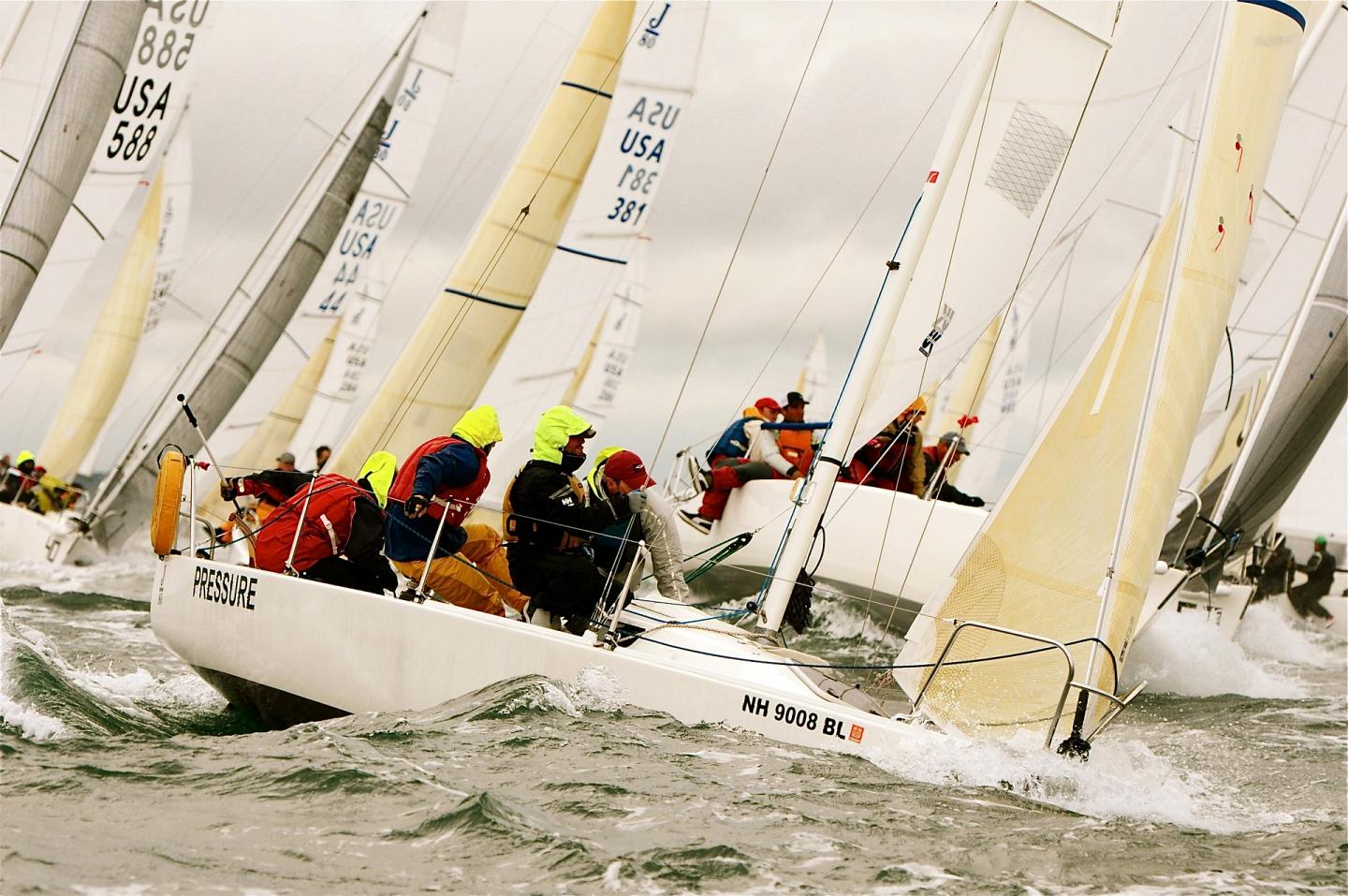
This article takes a look at the important elements of rounding the windward mark and offset mark, in this article we will look at the boat handling skills a team needs to practice & develop, in a future article we will look at tactics we can use at these marks. A lot of multi-class events and big fleet venues are opting to utilize offset marks as a means of reducing congestion (& protests!) at the weather mark. With that in mind take every opportunity for your team to practice rounding a mark, sail on a reach for a short distance and then bear away and set the spinnaker. Even if your team does not anticipate sailing with an offset mark this season, the vast majority of the information below will help your team be smoother at the windward mark rounding.
Approaching the windward mark:
– Hike hard coming in to the mark so the boat is flat and fast!
– When the bow person sets the pole hike especially hard and if possible pull the pole topping lift up from the hiking position
– If it is a long sail to the offset mark then delay setting the pole until you have rounded the windward mark to minimize disruption – particularly in heavy or very light conditions – the caveat to this is if you can set the spinnaker between the marks.
– Ease the vang a couple of inches (be sure to recelat it!) to the preset downwind mark to help preset the mainsail leech tension for downwind sailing and also to help the boat bear away by opening the mainsail leech.
– The Jib trimmer really wants to focus on perfect trim of the sail and not be distracted – particularly important if sailing in dirty air from another boat or getting lifted into the mark requiring the Jib to be eased for max speed.
– Top skippers keep the boat going fast at all times – keep the boat rolling and be sure not to pinch too much , have the crew keep calling out waves and puffs all the way into the mark so you can be anticipating the elements. This is a chance to extend on boats behind you and catch boats ahead, boat length by boat length.
Between the windward mark and the offset mark – sail fast!!
As a coach I observe and video tape a lot of races and one of the common threads is the gains and losses for teams when sailing between the marks – particularly in the extremes of conditions – very light or heavy air. Key elements for sailing fast between the marks are:
– Trimming the sails well – keep the Jib tell tales flowing – this does mean easing it and when it is time to set the middle grabs the clew of the sail and holds it inboard to facilitate the spinnaker going up smoothly.
– Particularly when it is breezy – sailing the boat flat and not allowing excessive heel.
– When it is light – minimizing movement and being smooth will maintain momentum and speed.
– Determine how much pre feed on the spinnaker foot you want – if it is light then gently feed the foot out so that it doesn’t disrupt the Jib, if it is breezy then you may want to delay until the boat is around the offset mark and flat and pointed downwind so that the foot of the sail does not get out of control. In medium conditions you likely will be able to pre-feed most of the way but be careful of the sail touching the offset mark or a leeward boat.
– Take an opportunity in light/ moderate conditions to ease the Cunningham all the way off and the outhaul to the eased setting for downwind sailing.
– The bow person can point to the offset mark to help the skipper gauge where it is as well as the middle looking to leeward helping keep track of it.
Setting the spinnaker between the marks:
With the wind shifting to the right and your team getting lifted on starboard tack going into the mark there may be an opportunity to set between the marks, here is a check list for this:
– Make sure you get a good visual on where the offset mark is – it is easy to lose sight of it when setting the spinnaker!
– If there is a boat to leeward of you and slightly ahead of you (preventing you from bearing away)- head high and then bear away and go behind them – this will give you the ability to set and get inside and be able to jibe at the offset – you don’t want to be pinned outside them.
– Be sure that the leeward twing is all the way off and the windward twing all the way on.
– Caution – if the twing line is too long it can scoop the offset mark – have them long enough but not too long!
– Pull the guy back so that the pole is at least 9 inches to almost a foot off the forestay – the guy will stretch this much at least on a reach when the spinnaker fills.
– Luff the spinnaker if necessary to get the spinnaker halyard all the way to the top and then sheet in.
– If breezy – delay pulling the Jib down to keep the weight on the high side until the boat has flattened out. In this instance if you have the spinnaker and Genoa up at the same time be sure to keep the Jib sheet well eased to allow the spinnaker to fly – if it is slightly over trimmed the sails forms a vacuum of stall and collapses the spinnaker.
– When bearing off at the offset mark ease the spinnaker sheet first and that will make squaring the pole much faster and easier.
Rounding the offset Mark:
– Look to round the mark tactically if at all possible – aim half to three quarters of a length to windward of the mark and then smoothly turn down while giving the main a good and fluid ease, the goal is to minimize the loss of the turn , very often teams button hook turn around the mark and end up losing a lot of speed and positioning.
– Backstay off as soon as you can and when possible organize the Main traveler so it is centered, assuming the mainsheet is long enough.
– As soon as you possibly can make sure you have a crew member looking back for velocity and the angles of other boats.
– Hoisting the spinnaker in light air at the offset mark :
-Be sure to keep the pole forward as the apparent wind is well forward – slightly over trim the spinnaker sheet and when the boat speed and apparent wind angles start to get closer together then slowly start to bring the pole aft. Pulling the pole aft prematurely in light air is a common mistake and will collapse the spinnaker every time, watch for this one in your early season sailing.
Extra’s extras, extra’s!
– Put a mark on the vang so you know how much to ease it to set the mainsail. Leech tension with the top baton parallel to the boom once you are downwind.
– Mark the topping lift so that the pole is set to the correct height
– Mark the spinnaker halyard so you know when it is fully hoisted
– Do a practice bear away set and mark the spinnaker sheet & cleat it when the pole is squared and the sail full. This pre set mark will allow you to focus on pulling back the guy on the set and free a hand up with the spinnaker filling nicely.
Conclusion:
All the above is well worth practicing – there are good gains to be had here for your team and over the course of a series the points gained will add up. In a future article we will examine some tactics your team can use at the windward and offset mark.
Good sailing!
O'Pen Bic NA's: The Future of Sailing is happening in BERMUDA
Vice Commodore and Chairman of RHADC Sailing Committee Neil Redburn commented “This is the future of junior sailing if we are serious about increasing participation”
The Royal Hamilton Amateur Dinghy Club hosted what will likely go down as a “legendary” O’Pen BIC North American Championships. Sailors traveled from as far as Hawaii and France to join the fun and amazing Bermudian hospitality. Twenty races and an epic freestyle expression session were held in ideal conditions ranging from 6 to 20+ knots.
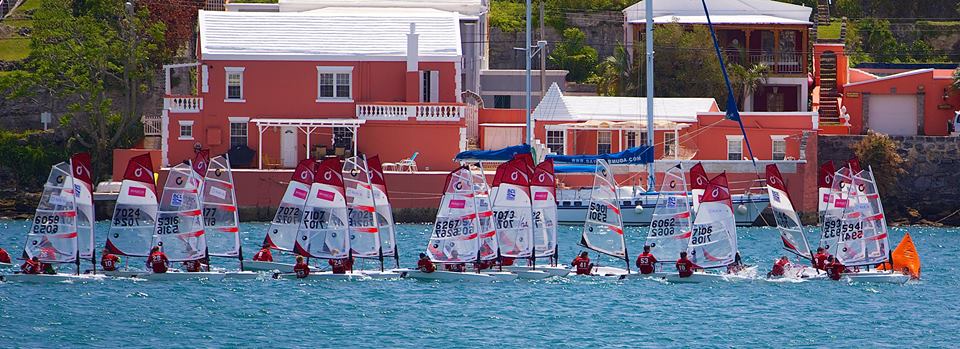
PRO Charles Tatem commented “This was one of the most fantastic children’s events I’ve ever been involved with – it is so positive to all the competitors and not just the few at the top. Everyone is encouraged to perform at their best and not someone else’s concept of what is best…….”
The racing was spectacular with a mixture of “conventional” and “Un-Regatta style” courses, sometimes with required freestyle moves, capsizes, stand-up sailing, and 360s. RHADC Sailing Director Nico Stefani commented “This really teaches the kids how to develop great boat handling skills, which can be transferred to skiffs and other high performance boats”
Going into the event it was unknown which sailors would prevail, but regardless of the course requirements the top sailors always came out on top. By the end it was clear the Bermudians were the class in the “O’Pen” age group while the Hawaiians cleaned up in the Under 13s. Mikey Wollmann came from behind in the last race to narrowly take out reigning Female 2013 Optimist and 2014 Byte North American Champion (and big sister), Ceci Wollmann by one point. Ceci will be representing Bermuda at this years Youth Olympics in China. Lars Von Sydow (Hawaii Kai Boat Club) rounded out the podium by eaking ahead of Peter Dill and Joe Arrowsmith from RHADC. Andre Stowasser representing the French Sailing Federation rounded out the top sailors overall. Kanoa Pick edged out fellow Hawaiians, JP Lattanzi and Marcos Baez, in the Under 13 age group. Close behind was the Miami Yacht Club team.

Nevin Sayre of Open BIC North America reminded everyone each day at the skippers meeting “All competitors were reminded of Rule #1 – Have Fun!”
The focus was on energised sailing with all sailors encouraged, regardless of ability and to have them coming off the water with smiles on their faces. A skateboard ramp, built by the Bermuda Skateboard Association, and a DJ playing some radical tunes, added to the cool factor off the water. Short, sharp races and quick turnarounds kept the sailors engaged and lunch breaks ashore with games added to the fun.
In the Freestyle competition, it was the young Hawaiians who also wow’ed the judges the most with an incredible display of boat handling, agility, and creativeness. The spectators went wild with Marcos’ now famous “plank walk”, tacks in front of the mast, and his fluid ability to steer the boat with just his weight. Close behind on the judges cards was the tandem team of JP and Pearl Lattanzi with Pearl’s gymnastic moves, head stands, climbing the mast and JP’s “happy dance”.
Every sailor left the regatta with new friends from around the world and individual accomplishment. The sailors’ improvement during the event was infectious. Based on their great success, the Royal Hamilton Dinghy Club is eager to host the O’Pen BIC Worlds in the near future, and it’s safe to say they will have full endorsement from all the participants. O’Pen BIC regattas are known for their focus on fun, learning, and sportsmanship. To see just how happy the kids were with the O’Pen BIC North Americans, check out:
http://www.youtube.com/watch?v=UlaqcE194NM&feature=youtu.be
R.H.A.D.C would like to thank sponsors Arch Reinsurance Ltd., Bermuda Tourism Authority, BCL, Bermuda Forwarders, Tidal Asset Management and Isolated Surfboards without whom this would not have been possible.

Results and more photos can be found at:
https://www.facebook.com/rhadcbermuda
————————————————————————————————————————–
R.H.A.D.C. offers a full sailing program, following the US Sailing curriculum, with learn to sail, beginner, racing and advanced sailing classes for all ages including adult. We have a proud history of producing highly accomplished racers but also instilling a lifelong love of sailing in many more.
“Where Fun Happens”
The Royal Hamilton Amateur Dinghy Club
“Mangroville”
25 Pomander Road
Paget, PG BX
[email protected]
2014 Sail1Design US Team Racing Grand Prix
The Vanguard 15 Class in conjunction with Sail1Design will once again sponsor a Grand Prix Team Racing Series. The inaugural 2013 season saw great success with 20 teams scoring series points and the Rhode Island Pistols taking the series title. This year will feature a brand new event, the Buzzards Bay Regatta Team Race. This annual stop for the V15 Class will now be sailed in a Team Racing format.
Sponsors:
RITRA: RITRA(Rhode Island Team Race Association) will support these events with colored sails and team uniforms. They will also be providing professional race management at the BBR Team Race. Charter boats are available for all events thru RITRA.org
Sturgis: TBD
Atlantis: TBD
Other: Expect prizes from Sail1design and other sponsors. If your company wants to get in on the action send an email to series coordinator, Clinton Hayes –[email protected]
Regattas:
Marblehead Team Race: June 21-22 http://www.easternyc.org/page/sailing/racing/team_racing
NYYC Team Race: July 26-27 http://www.nyyc.org/yachting/teamracing/2014-v15-teamrace
Buzzard Bay Regatta: August 2-3 http://www.buzzardsbayregatta.com

Format
Teams will earn points at each event based on their finish position. Scoring will be High Point to allow for teams to only sail 2 events and still potentially win the series. Only the top 12 teams will earn points at each event.
1st– 100 6th– 35 11th– 10
2nd– 80 7th– 30 12th– 5
3rd– 65 8th– 25
4th– 55 9th– 20
5th– 40 10th– 15
If there is a tie between two or more teams, each team’s best three of four scores shall be listed in order of best to worst, and at the first point(s) where there is a difference, the tie shall be broken in favor of the competitor(s) with the best score(s). If a tie remains, they shall be ranked in order of their scores in the last event, then next to last, etc.
Teams
A team is defined by their team name only. Any number or variation of individuals may sail in the series at any time. This eliminates the hassle of substitution rules and allows teams to sail with whoever they wish at each event. The point is to carry a consistent team name from event to event.
In Heaven, Everybody Team Races…
2014 J/70 Annapolis NOOD Regatta Report & Results
By Geoff Becker
Skipper: Will Welles Tactician: Geoff Becker Trimmer: Emory Williams Bow: Collin Leon
Day 3 2 races (Race 5, 4 legs…Race 6, 5 legs) Wind 10-15 knots from the West, with gusts up to 20 knots.
Building west winds provided some excitingly puffy and shifty conditions for the final day of the Annapolis NOOD Regatta. Upwind and downwind were challenging for the fleet as the breeze pumped up to 20+ knots and then would die down at times to around 8 knots. With the up and down winds today, many boats had up and down scores in the two races. Our team was no different, finishing in 22nd in Race 5, our worst race of the series, and then bouncing back with our best race finishing the regatta with a bullet in race 6. Our final score was good enough for 7th overall and we certainly had to be happy for that result after all the tough sailing during the regatta.
In shifty conditions many have a strategy to sail up the middle of the course and stay on the lifted tack. While that plan works well in most venues, the wind today was so puffy and shifty; the big changes in the wind seemed to come from the sides of the course. Big right puffs from the right and big left puffs from the left never seemed to be able to make it completely across the racecourse. When this happens, the two directions clash as they cross the racecourse and often there is much less wind and less favorable shifts in the middle.
These conditions were especially challenging when behind in the fleet, because the leaders would sail toward the sides leaving only the unfavorable middle free of traffic. When that happened today, we decided to choose a side that looked best overall and head to that side regardless of shifts on the way. This made catching up difficult because the only boats we were likely to pass were boats that tried to sail up the middle of the course.
This strategy also played true on the downwind legs and there seemed to always be more breeze on the edges. We tried to determine which side might have more breeze, while rounding the windward mark, and then sail higher angles to stay in the bigger pressure. That worked very well for us in the final race as both the higher angle and being on the edge of the course allowed us to get the boat up on a plane more easily and move us up to the front of the fleet.
Our takeaways from Day 3 are…
1. Sometimes the sides are best in shifty conditions.
2. Sail toward the side that will have the most pressure long term.
3. Use the edges downwind to stay in the biggest puffs.
FINAL RESULTS:
| 1 | USA 96 | Savasana | J 70 | Brian Keane | 4 | 2 | 6 | 1 | 9 | 6 | 28 |
| 2 | USA 51 | Black River Racing | J 70 | Doug Strebel | 6 | 14 | 2 | 2 | 1 | 10 | 35 |
| 3 | CAN 246 | Touch2Play | J 70 | Martin Kullman | 7 | 3 | 1 | 20 | 5 | 3 | 39 |
| 4 | USA 40 | B Squared | J 70 | Bryan Cameron | 13 | 8 | 4 | 15 | 6 | 4 | 50 |
| 5 | USA 85 | Ocho Cinco | J 70 | Allan Terhune, Jr | 3 | 13 | 12 | 6 | 20 | 2 | 56 |
| 6 | USA 187 | Catapult | J 70 | Joel Ronning | 1 | 1 | 20 | 11 | 17 | 9 | 59 |
| 7 | USA 2 | Scamp | J 70 | Will Welles | 14 | 10 | 7 | 12 | 22 | 1 | 66 |
| 8 | USA 482 | X | J 70 | Dan Cheresh | 2 | 33 | 3 | 4 | 14 | 17 | 73 |
| 9 | USA 217 | Joint Custody | J 70 | Jenn & Ray Wulff | 21 | 6 | 5 | 7 | 7 | 29 | 75 |
| 10 | USA 86 | Stampede | J 70 | Bruno Pasquinelli | 10 | 26 | 24 | 8 | 10 | 5 | 83 |
| 11 | USA 073 | Occams Razor | J 70 | Walt Pletcher | 20 | 7 | 11 | 3 | 16 | 28 | 85 |
| 12 | USA 45 | Wild Child | J 70 | Henry Filter | 12 | 9 | 19 | 5 | 26 | 16 | 87 |
| 13 | USA 35 | Moxie | J 70 | Cole Allsopp | 9 | 15 | 35 | 16 | 8 | 13 | 96 |
| 14 | USA 179 | AFRICA | J 70 | Ian Liberty | 23 | 11 | 15 | 13 | 11 | 23 | 96 |
| 15 | USA 209 | Trouble | J 70 | Peter McChesney | 8 | 12 | 38 | 37 | 3 | 8 | 106 |
| 16 | USA 151 | Reach Around | J 70 | Thomas Bowen | 5 | 5 | 13 | 28 | 2 | 57/DSQ | 110 |
| 17 | USA 218 | Tsunami | J 70 | Todd Olds / Thomas Iseler / Preben Ostberg | 15 | 17 | 10 | 34 | 19 | 21 | 116 |
| 18 | USA 364 | School’s Out | J 70 | John Aras | 43 | 4 | 16 | 9 | 36 | 15 | 123 |
| 19 | USA 34 | Perseverance | J 70 | Bennet Greenwald | 41 | 21 | 25 | 22 | 4 | 11 | 124 |
| 20 | USA 87 | Tick Tock Croc | J 70 | Richard Nesbett | 16 | 23 | 23 | 38 | 21 | 7 | 128 |
| 21 | USA 66 | Eagles Wings | J 70 | John Gottwald | 18 | 32 | 32 | 17 | 13 | 18 | 130 |
| 22 | USA 302 | Off-Piste | J 70 | Paul Cannon | 29 | 20 | 14 | 19 | 30 | 20 | 132 |
| 23 | USA 26 | Jungleland | J 70 | Chris and Carolyn Groobey | 31 | 22 | 27 | 26 | 18 | 14 | 138 |
| 24 | USA 15 | Junior | J 70 | Tim Finkle | 24 | 25 | 33 | 14 | 33 | 19 | 148 |
| 25 | USA 25 | Papawheelie | J 70 | Will Keyworth | 44 | 24 | 8 | 41 | 15 | 24 | 156 |
| 26 | USA 185 | Turbo Duck | J 70 | Bodo & Nick von der Wense | 33 | 36 | 18 | 18 | 24 | 27 | 156 |
| 27 | USA 152 | Sundog | J 70 | Kathy Parks | 17 | 31 | 9 | 39 | 23 | 38 | 157 |
| 28 | USA 46 | Alibi | J 70 | Tris Worth | 22 | 29 | 29 | 23 | 35 | 22 | 160 |
| 29 | USA 200 | Cat’s Pajamas | J 70 | Drake Johnstone | 11 | 30 | 22 | 32 | 12 | 57/DSQ | 164 |
| 30 | USA 199 | Mojito | J 70 | Catharine Evans | 46 | 16 | 26 | 29 | 25 | 26 | 168 |
| 31 | USA 44 | Gnixe | J 70 | Steiner/Lodico/Vickers Chip | 40 | 35 | 17 | 24 | 38 | 25 | 179 |
| 32 | USA 64 | Exit Strategy II | J 70 | Jack Martin | 45 | 18 | 28 | 21 | 37 | 30 | 179 |
| 33 | USA 38 | Goofyfoot | J 70 | John Wilsey | 25 | 41 | 31 | 45 | 29 | 12 | 183 |
| 34 | USA 192 | Turn the page | J 70 | David Becker | 37 | 39 | 44 | 10 | 28 | 36 | 194 |
| 35 | USA 219 | GetMyBoat | J 70 | Vortex Racing | 19 | 42 | 36 | 43 | 34 | 32 | 206 |
| 36 | USA 381 | Tea Dance Snake | J 70 | Peter Bowe / Todd Jenner | 38 | 38 | 34 | 25 | 27 | 45 | 207 |
| 37 | USA 91 | Carlos | J 70 | Mike Sudofsky | 27 | 27 | 47 | 42 | 32 | 35 | 210 |
| 38 | USA 220 | Phoenix | J 70 | Peter Firey | 26 | 28 | 40 | 48 | 43 | 34 | 219 |
| 39 | USA 159 | Torqeedo | J 70 | Brandon, Cindy, Lily & Dylan Flack | 35 | 19 | 21 | 33 | 57/DNC | 57/DNS | 222 |
| 40 | USA 497 | Chinook | J 70 | Frank McNamara | 36 | 34 | 37 | 31 | 42 | 43 | 223 |
| 41 | USA 230 | iZula | J 70 | Kenneth Smith | 34 | 37 | 39 | 35 | 49 | 40 | 234 |
| 42 | USA 243 | VitaminJ | J 70 | Ted Johnson | 32 | 46 | 45 | 44 | 44 | 33 | 244 |
| 43 | USA 375 | Lickity Split | J 70 | Stanley Edwards | 39 | 52 | 49 | 27 | 40 | 44 | 251 |
| 44 | USA 37 | lil’ Grizzly | J 70 | Charles Bayer | 28 | 40 | 42 | 51 | 41 | 57/BFD | 259 |
| 45 | USA 311 | 311 | J 70 | Kurt Winkelmann | 30 | 50 | 41 | 52 | 47 | 42 | 262 |
| 46 | USA 168 | Rarity | J 70 | Marty McKenna | 42 | 48 | 48 | 46 | 45 | 37 | 266 |
| 47 | USA 382 | Zombie | J 70 | Kristen Robinson | 48 | 44 | 51 | 47 | 39 | 41 | 270 |
| 48 | USA 154 | Spice | J 70 | Holly Graf | 51 | 49 | 53 | 30 | 51 | 39 | 273 |
| 49 | USA 365 | brotherly | J 70 | Kyle / Willy Comerford | 57/DNC | 57/DNC | 57/DNC | 40 | 31 | 31 | 273 |
| 50 | USA 357 | Danger Mouse | J 70 | Kristen Berry | 47 | 47 | 43 | 50 | 46 | 46 | 279 |
| 51 | USA 004 | Sport | J 70 | Mark Wagner | 49 | 43 | 46 | 53 | 48 | 47 | 286 |
| 52 | USA 10 | curragh | J 70 | Peter Tuite | 50 | 45 | 50 | 36 | 57/DNC | 57/DNS | 295 |
| 53 | USA 420 | E.L.E. | J 70 | Matt Braun | 52 | 51 | 30 | 57/DSQ | 50 | 57/DNS | 297 |
| 54 | USA 204 | Eowyn | J 70 | Peter Winkelstein | 53 | 53 | 52 | 49 | 57/DNC | 57/DNS | 321 |
| 55 | USA 362 | 362 | J 70 | David Wicker | 57/DNC | 57/DNC | 57/DNC | 57/DNC | 57/DNC | 57/DNC | 342 |
| 56 | GBR 495 | Red | J 70 | Joe Woods | 57/DNC | 57/DNC | 57/DNC | 57/DNC | 57/DNC | 57/DNC | 342 |
___________________________________________
Day 2 1 race (course 4, 4 legs and downwind finish) Wind 6-8 knots from the SW, dying slowly during the race.
Light winds in the morning of Day 2 forced the RC to keep the fleet onshore under postponement for and hour until being sent out to the racecourse for a noon start. The postponement continued out on the water until after 1pm when, after several general recalls, only one race was completed in a light and dying SW breeze. Our team finished 12th in today’s race dropping us to 10th overall, but very close to the group of boats just ahead of us in the overall scores.
With the light winds today, boat handling became more delicate and critical in an effort to maintain speed during the maneuvers. Tacks, gybes, spinnaker sets and take-downs were places where a boat could sometimes gain distance when they were done smoothly and very easily lose distance when done poorly. Our boat-handling improved today and that was a result of the philosophy that smoother is better than bigger. Smooth and controlled maneuvers can be more easily performed and repeated by most every crew, where big boat handing can sometimes be difficult to execute accurately.
Boat handling with big rolls, big flattens and aggressive sail trim is impressive to watch and can sometimes help a boat make gains on the racecourse. However, such aggressive boat handling takes time and practice to master to the point where it can be consistently repeatable during a race. Also, when maneuvers go bigger, the margin for error becomes smaller and even the slightest miscue in timing can make a large negative impact on the outcome. In most cases, big boat handling done wrong, produces an outcome much worse than smooth maneuvers done accurately and under control.
Taking your time and making smooth and controlled maneuvers is the best way to produce repeatable, quality boat handling. Sometimes during a race, in the heat of the moment, “taking your time” is not the main focus. To assist in the timing of boat handing maneuvers, it can be helpful to assign someone on the crew to acts as a narrator during the tacks, gybes, etc.. That person can countdown to the maneuver, identify key timing points (like when to roll, when to flatten) and keep the whole crew working on the same timing. Using such a system and getting the timing of the whole crew coordinated is the best way to produce repeatable boat handling.
Our takeaways from Day 2 are…
1. Boat handling is more delicate in lighter winds.
2. Aggressive maneuvers are a harder to perform consistently.
3. Try to produce smooth and controlled maneuvers in light winds.
Day 1, 3 races (all course 4, 4 legs and downwind finish) Wind 6-14 knots from the West moving to the South for Race 3. Puffy and shifty today!_________________________________________________________
Three races were sailed today, Day 1 of the 2014 Annapolis NOOD, in a post frontal west wind that died out in the afternoon and was replaced by a southerly sea breeze. With the dying and shifting breeze, we saw some puffy and shifty conditions in our course area, the mouth of the Severn River and out in the Chesapeake Bay. The J/70 fleet had another large turn out for the NOOD, with 53 boats on a single starting line. Add the big fleet to the squirrely conditions and today was a real test of patience. Our team ended the day with a respectable 14th, 10th and a 7th earning us 8th place overall after Day 1.
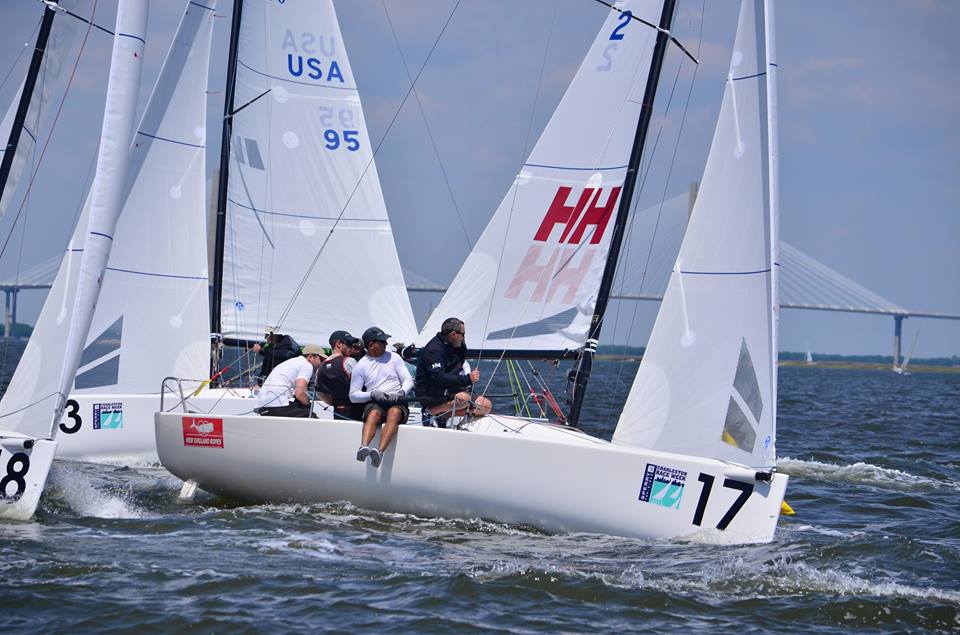
The crew we have for this regatta has never sailed together as a group, even though in various combinations we have all sailed with each other on other crews. Because of that we had to expect some communication issues to occur as we got used to sailing together. Today’s challenging conditions and our new crew dynamic was a recipe for stress and friction on the racecourse today. In some of the cases we handled that friction well and in others not as much.
At one time or another, every sailor encounters stress and frustration during a race. How you deal with those situations can affect the opportunities for passing boats on the way to the finish line. Knowing what to say and how to interact with each other on the boat can help reduce stress and re-focus the group after some bad luck or a negative situation. In our case, being a new group, we found some situations where we just misunderstood what we were saying to each other. We were able to use the time between races to try and resolve those misunderstandings instead of trying to hash it out during the race. Addressing miscommunication issues during a race can easily snowball out of control and surely will detract from the crew’s focus in the race and moving toward the finish line.
Every crew is different, so any method used to reset the stress onboard and refocus the crew will also have to be different. Calm discussions after the race are always a good way to address friction during a race. Trying to solve communications issues during the heat of battle is very difficult and likely impossible. Something simple to try, to help refocus the crew, is to have the conversation stop on the boat altogether for a short period of time. One phrase to use could be, “Ok, 5 minutes of just sailing, no talking.” This gives everyone a chance to take a deep breath, reset and get back to making the boat move forward toward the finish.
Our takeaways from Day 1 are…
1. Try to stay patient in tough conditions.
2. Keep communication lines open and helping the boats performance.
3. Reset the crew when friction becomes distracting to sailing the boat.
College Sailing Notebook: Gearing Up for Nationals
By Airwaves writer & Brown U. sailing team member Lydia Whiteford

The entire spring season, and really the entire year in college sailing, has been progressing towards this: teams all over the country have had or will have in the next week or so the qualifying regatta that will get them to nationals.
The college sailing national championships are quite an ordeal. They are made up of 3 parts, all of which are qualified for separately. The first is the Women’s division fleet racing nationals, which are sponsored by Sperry. They kick off nationals every year, and are conducted over 4 days. The first day and a half (ending on the second day of sailing at noon) is the “semifinals”. In the past, the top first or second place finishers in the regional qualifiers would advance straight to nationals, and would not have to compete in the semifinals. Then, the top 9 from the semifinal regatta would advance to nationals to join them. This year, however, no boats got to advance straight to nationals, and will all be competing in the semifinals. This means that the semifinal regatta will be split into 2 fleets, with the top nine from each advancing to nationals. Nationals and semis are all held in the same place, so if your team advances it is effectively like one long regatta.

Directly after women’s, the Team-Racing nationals begins, taking place over 3 days and sponsored by Annapolis Performance Sailing. This regatta has no semifinals, as the nature of the regatta eliminates people as the regatta progresses. It is set up so that one or two “round robins” are sailed, in which every team faces each other and then their records are calculated to do the same thing but with the top 12 teams, then the top 6 teams, or how ever the regatta chair decides to set it up. Gradually, teams are eliminated until there is a winner.
Finally, after team racing, the College Sailing National Fleet Race championship is held, and is sponsored by Gill. Historically, the semifinals for this event were separate from the championship, with the regattas taking place at different times. However, this year they’ve changed it so that it is structured like women’s, with the semifinals and the championship being back to back. So, just like women’s, all the teams that qualified out of their district will compete and the top 9 from 2 different fleets will make up the national championship roster.
With so many policy changes this year, the qualifiers schedule was much different across the board than it has been in the past. This year, ICSA decided to construct the season so that all major team racing was to take place in the first half of the season and all major fleet racing in the second half. Usually, the qualifiers would both be regattas that were almost back-to-back in the middle of May. This year, however, they were separated because of the regatta schedule, and therefore everything seemed to be bumped up. Now, most districts have completed all 3 of their qualifiers, with more than a month of post-season until the big event. Qualifiers put quite a strain on the sailors, no matter the difficulty of the district they are. These are the regattas when coaches pull out all the stops: coming to regattas with an armada of sailors, often times multiple boat’s worth for each division. There are heavy crews, light crews, and everything in between. Many sailors have to constantly switch modes, as many of them sail in all three categories of qualifiers. Some of the larger districts, such as MAISA and NEISA, are so competitive that you see completely different teams going to each event, and qualifying for one does not mean by any stretch that you will qualify for all. So, with the season drawing to an end, congrats to all of those teams that have made it and good luck to those still qualifying. The ICSA nationals will be held at the U.S. Naval Academy and St. Mary’s College of Maryland from May 27th to June 6th, and here is a preliminary list of the qualifiers (many schools are still undergoing their qualifying events at the moment)

Co-Ed Fleet Racing:
University of Michigan
University of Minnesota
University of Wisconsin
University of Notre Dame
University of Wisconsin at Milwaukee
Yale University
Dartmouth College
Boston College
Coast Guard
Brown University
Tufts University
Bowdoin College
Connecticut College
Harvard University
Georgetown University
St. Mary’s College of Maryland
U.S. Naval Academy
Old Dominion University
University of Pennsylvania
Fordham
University of Virginia
Washington College
Stanford University
University of Hawaii
University of California at Santa Barbara
University of Southern Florida
College of Charleston
Eckerd College
University of Jacksonville
Clemson University
New College of Florida
Women’s Fleet Racing:
Western Washington University
College of Charleston
Eckerd College
University of Southern Florida
Georgetown University
U.S. Naval Academy
Old Dominion University
Cornell University
Hobart and William Smith
Fordham
Yale University
Boston College
Dartmouth College
University of Rhode Island
Brown University
Coast Guard
Bowdoin College
Massachusetts Institute of Technology
Texas A&M
Stanford University
University of Hawaii
University of California at Santa Barbara
Team-Racing:
Texas A&M
University of Wisconsin
University of Michigan
Roger Williams University
Yale University
Boston College
Tufts University
University of Washington
College of Charleston
University of Southern Florida
St. Mary’s College of Maryland
Georgetown University
U.S. Naval Academy
Old Dominion University