The final Sail1Design rankings are here, and as always, they’re backed by a panel of coaches who have been watching this fleet all season. Big thanks to them for making this possible.
If you want a clear picture of how teams stack up heading into Team Race Nationals, this is it. Racing kicks off this week in New Orleans, hosted by Tulane and the Southern Yacht Club.
These rankings give you a clear picture of the field heading into Nationals this week. The selection process? Not as clear.
Harvard finishes the season ranked No. 1, followed by Stanford and Roger Williams, with College of Charleston moving up to fourth in the final Sail1Design Open rankings. The natural question: are these our final four?
Charleston’s position here is worth noting. They were ranked sixth in the previous edition and now sit fourth. In a ranking system built on observation alongside results, that kind of movement usually means one thing: they’ve changed how they’re sailing relative to the fleet.
Navy, Brown, Georgetown, and Boston College are next. The last minute bump from Charleston could be an indicator that really any of these top teams could be a contender when racing starts this week.
Navy, coming off a win at the MAISA Conference Championships, is a particularly interesting case. As ranker Chris Klevan put it: “Are they waiting to peak at the right time?” That uncertainty pretty much defines this part of the rankings, for all teams.
Women’s Rankings
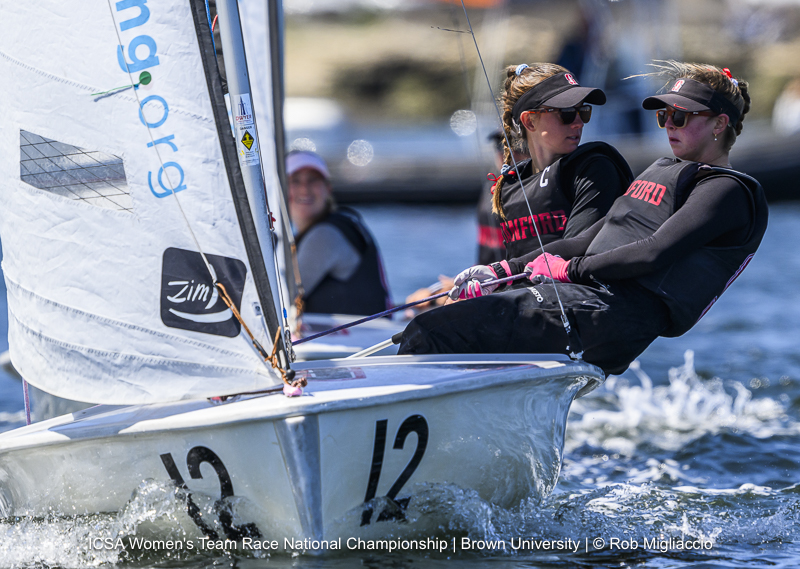
On the women’s side, defending champions Stanford sit at the top of this final edition of the S1D rankings looking solidly set up for another run at the title.
Yale comes in at Number 2 in this edition. Klevan, who is both the Stanford coach and a ranking panel member, pointed specifically to the Bulldogs’ strength in light air. If Nationals turns into a light-air regatta, that could tighten things quickly.
Brown sits third, with Cornell in fourth as the top-ranked team out of MAISA. Cornell’s conference championship performance backs that up. They went undefeated, finishing with 16–0 record.
Dartmouth is ranked fifth and has held a top-five spot all season. Harvard sits sixth, followed by Tufts in seventh and host team Tulane in eighth.
Like the Open fleet, there are multiple teams with a realistic shot at making the final four. It’s going to come down to who puts it together at the right time.
How Nationals Berths Are Decided
Before any of that plays out on the water, the bigger question is how the teams heading down to NOLA for the 2026 Team Race Nationals were selected in the first place.
Unlike the S1D rankings, which reflect input from active coaches, the Nationals lineup is determined by an ICSA selection committee, alongside automatic bids from conference champions. According to the ICSA, the committee is tasked with selecting “the most competitive field” based on “exemplary performance throughout the season,” explicitly not considering geography or results from previous seasons.
From the College Sailing Instagram
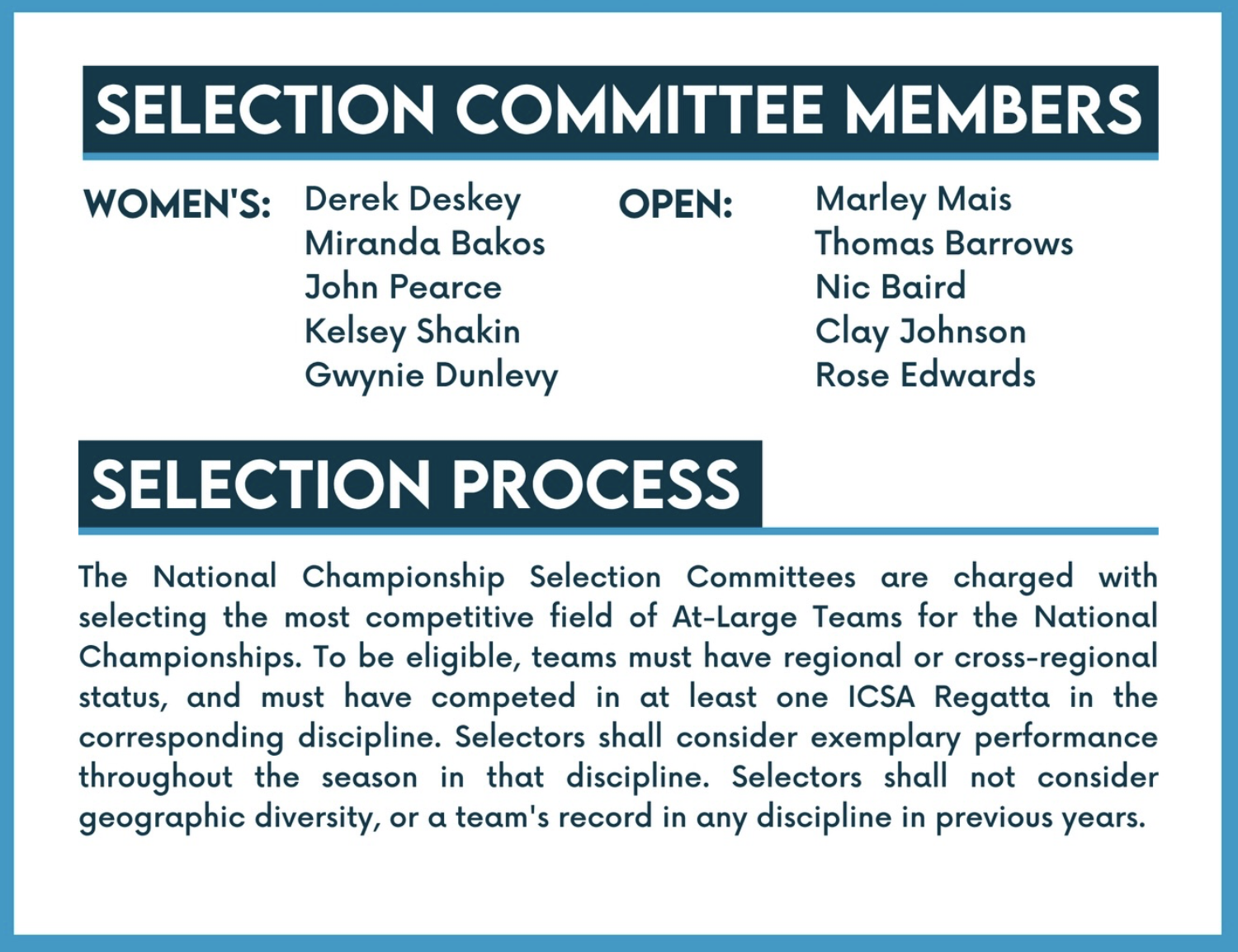
On the women’s side, this year’s committee consisted of Derek Deskey, Miranda Bakos, John Pearce, Kelsey Shakin, and Gwynnie Dunlevy. The open division committee included Marley Mais, Thomas Barrows, Nic Baird, Clay Johnson, and Rose Edwards.
For the 2026 nationals, that process has come under more scrutiny than usual.
On April 15, ICSA announced the selected teams for both Open and Women’s Team Race Nationals.
In the Open division, Navy (MAISA), Northwestern (MCSA), Harvard (NEISA), Stanford (PCCSC), College of Charleston (SAISA), and Tulane (SEISA) earned automatic berths by winning their conference championships. With 16 total berths and six taken by automatic qualifiers, the selection process fills out the remaining spots. That structure can lead to some tough outcomes. This year, teams like Yale (ranked 14th in our final edition) and Miami (ranked 15th) will not be racing.
The Controversy
The women’s fleet is where things get more complicated.
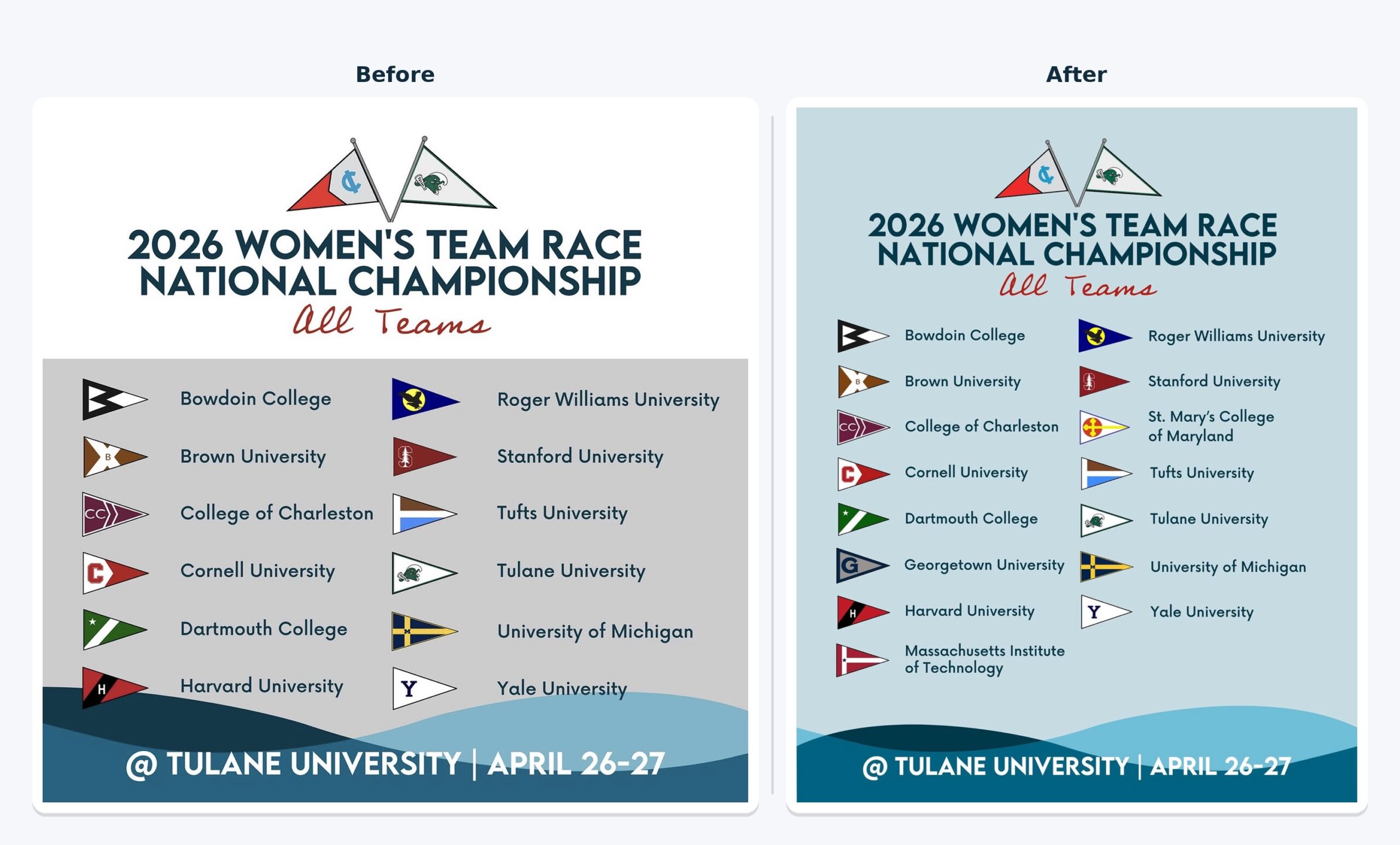
In the initial release, Cornell (MAISA), Michigan (MCSA), Yale (NEISA), Stanfor (PCCSC), College of Charleston (SAISA), and Tulane (SEISA) earned automatic berths, with six additional teams selected to complete the 12-team field.
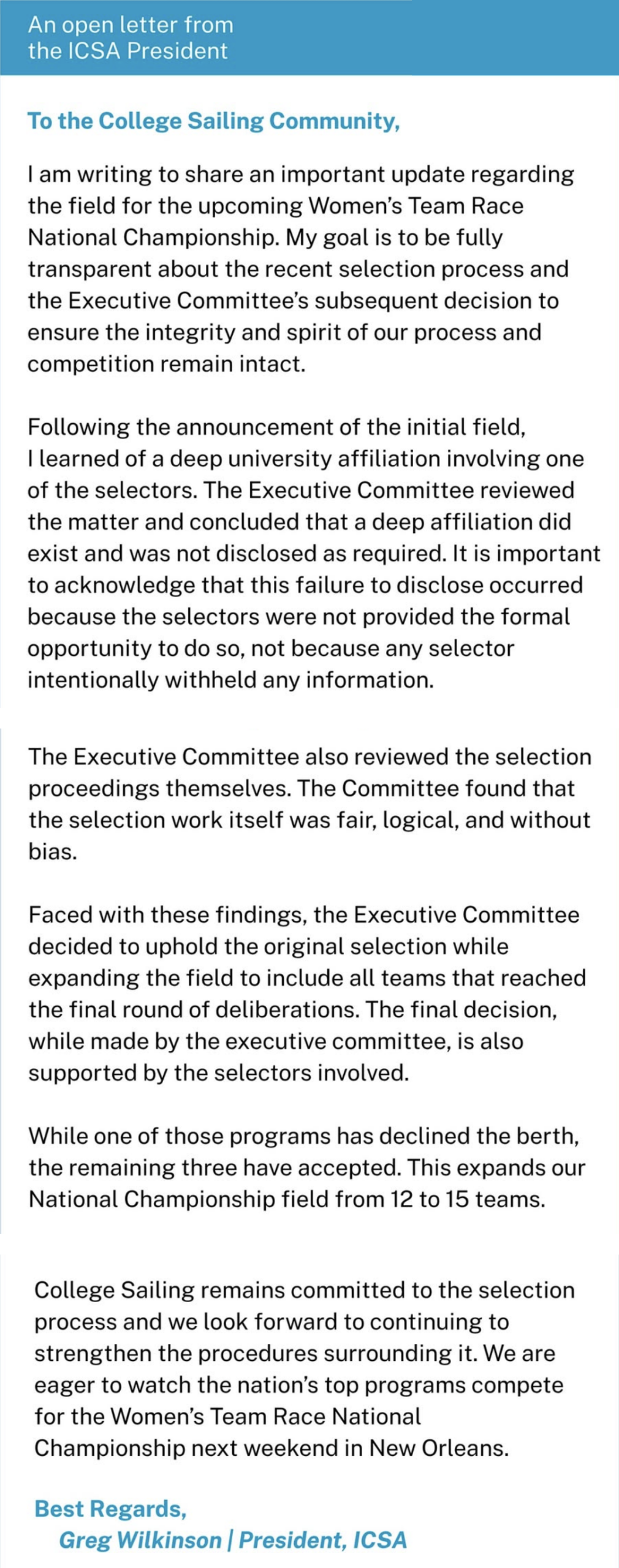
Following that announcement, ICSA President Greg Wilkinson issued an update regarding the selection process (full statement below).
In that statement, the ICSA Executive Committee acknowledged an undisclosed “deep university affiliation” involving one of the selectors after the field had already been announced. While the committee maintained that the original selections were “fair, logical, and without bias,” it still chose to expand the field to include additional teams from the final round of deliberations. With one team declining, the championship will now be sailed with 15 teams.
That decision raises a few immediate questions.
If the process produced the right 12 teams, why add more? And if other teams were close enough to be included after the fact, why weren’t they in from the start?
At a minimum, it suggests the margin between “in” and “out” was anything but clear.
To see how that explanation landed, I went to the comments on the Instagram announcement. The reaction landed somewhere between confusion and outrage.
One user, @mateo_rod.riguez, wrote:
If the selection process was found to be unbiased upon review, then shouldn’t the selected teams remain unchanged? … Saying the selection was unbiased but then still expanding the field is contradictory imo.
That sense of contradiction came up repeatedly. User @augiedale commented:
Rules are meant to be followed not bent. This seems like a slap in the face to the multitude of teams that have been on the bubble the past few years.
Others were more direct. @silenth805 put it simply:
If the process was fair to begin with, then why add teams? Where is the integrity?
There were also a few comments pointing out a potential upside. @diegoscbr noted:
about time Open and Women’s have the same number of berths
While expanding the fleet brings the divisions in line numerically, it also raises a practical question: with the Women’s event still scheduled for two days, can the same level of competitive fairness be maintained for a larger field that would typically be scheduled over three days?
Beyond the official post, the conversation carried into other parts of the sailing community. One of the more visible responses came from @guardians_of_the_monohull on Instagram—a satirical account, self-described as the “New York Times of Sailing,” known for blending humor with pointed commentary.
Their post leaned into the speculation already circulating. In response, one of the selectors clarified in the comments:
Clarification — ICSA Executive Committee changed the selections to add additional teams. Selection Committee did not.
From the College Sailing Instagram
That distinction matters. The original selections and the later expansion appear to have come from different parts of the process, even if they now exist as a single outcome.
As for questions about conference representation, particularly how this could have or should have opened the door for more MAISA teams, the selection criteria are clear: berths are meant to be awarded on merit, not distributed across conferences. Whether that standard is always applied cleanly is a separate conversation, and one that will likely follow from this situation.
Some of the reaction has also focused on where teams sat in the Sail1Design rankings versus where they landed in the final field. Those comparisons only go so far, these rankings are intentionally independent of the ICSA selection process and aren’t meant to directly determine berths.
Still, when rankings, selections, and late changes all intersect like this, it becomes harder to separate perception from process.
The field is set. Expanded, debated, and now final.
Open Team Race Nationals begin April 23rd, with the Women’s event starting April 26th. From here, it’s straightforward: results get decided on the water. That said, the lead-up hasn’t gone unnoticed.
If you want a closer look at how teams stack up heading in, view the final Sail1Design rankings HERE.
As always, the conversation doesn’t stop here. If you have insight, opinions, or context that should be part of the conversation, drop a comment below or reach out at [email protected]. We will be watching how this plays out.
The Greater Long Island Sound Sailing Programs are looking to hire coaches to run programs, especially big boat programs. They are partnering with Oakcliff in Oyster Bay for a Sailing Combine April 24-26.
Come learn, have fun, show off your talent and get a job contract. This is not for learn-to-sail summer camp jobs. Attendee will get the skills to coach learn-to-race programs, be a leader on and off the water, explore their adventurous side and personal career paths and gain skills to run big boat programs.
Arrive Friday evening – for an immediate networking opportunity and orientation. Early Saturday, join Ethan Johnson for a creative workout, specifically customized to suit dinghy sailors, and add in foiling footwork skills and big boat strengths required for tailing and grinding.The rest of the weekend’s topics will include onboard comms, basic inboard & outboard engines, composites, rigging, sail repair. On the water will include, powerboat driving for big boats, safety systems, MOB and injury prevention and as much practice racing on Farr 40s as we can fit in.
Clubs and Colleges are welcome to send their program directors and coaches for recruiting. Standouts from the combine may be offered contracts on the spot and all will receive an evaluation card. This program is available to anyone over 15 but is designed for college age and above.
$550 per person includes all training, coaching, evaluation card as well as bunk housing & food. $50 application fee included so weekend fee is $500
6:00 – Join in the Water Lover’s Mixer for a full speed networking opportunity.
This is a community event hosted by all water orgs in the Oyster Bay area and attracting clubs and sailors and cruisers etc. from City Island to Northport. Coaching Combine Sailors will be issued their Team Shirt to help facilitate the networking.
8:00 – Orientation and bunk assignment
Saturday
7:00 Workout
8:00 Shower and Breakfast
9:00 Meeting
9:30-6:00 – Training
Sunset – BBQ at 2 South and go into town for your own social if you so desire but…
Sunday
8:00 stretching and injury prevention
9:00 Meeting
9:30-4:00 – Training
4-6:00 – Contracts and Connections*
All attendees will receive an Evaluation Card from Oakcliff Coaches. It will be useful for personal use and for assisting in future job hunting.
6:00 depart for airport
Add-on Option: Stay the week and race AYC Spring on the Farr 40 the next weekend.
Optional Curriculum may be added in: Becoming a Pro, Electronics, Legal and Contracts, Marketing, Match Racing Navigation, Nutrition, PR, Rigging, Rules, Tactics, Sponsorship and Fundraising, Short Handed Sailing
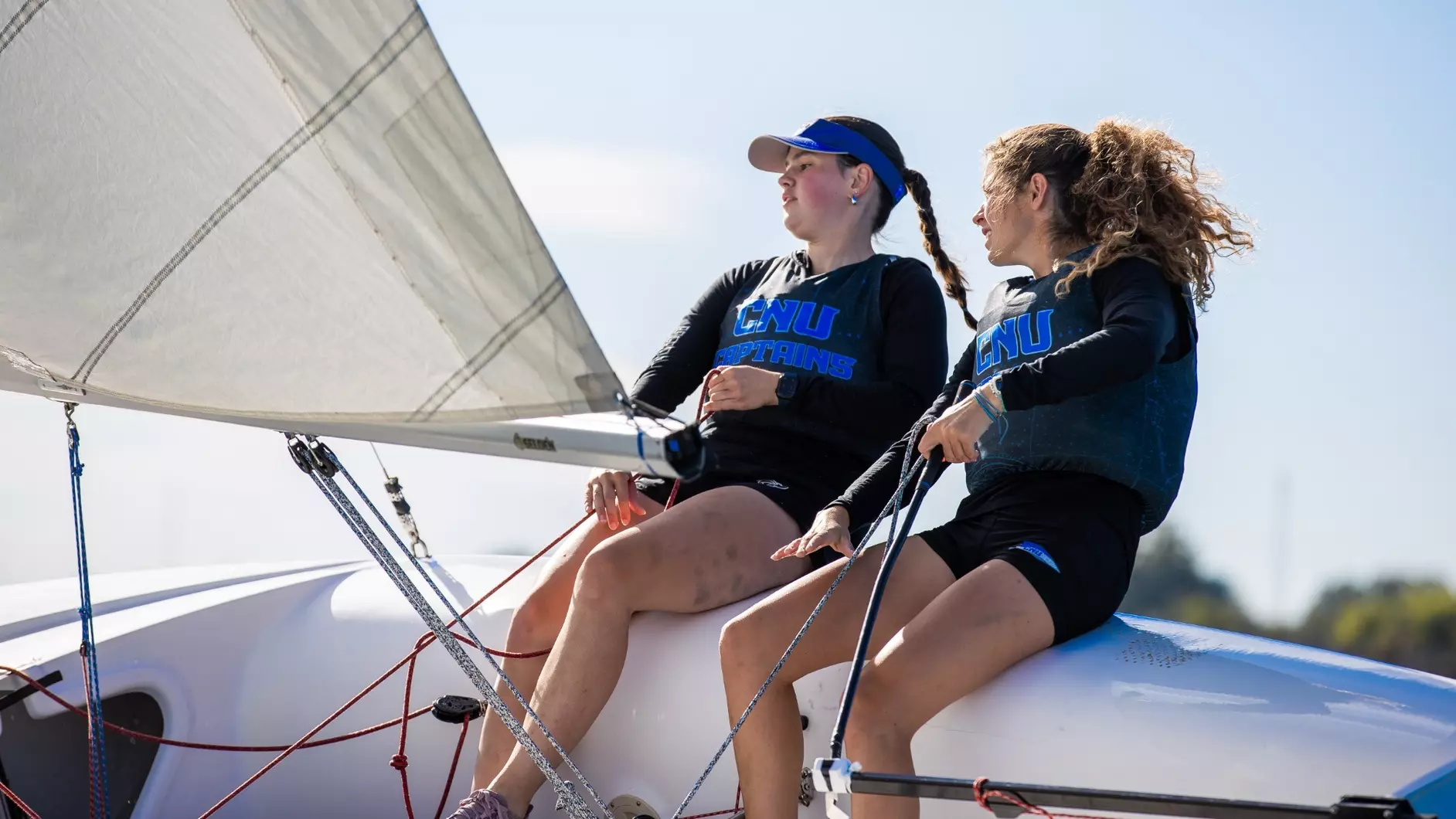
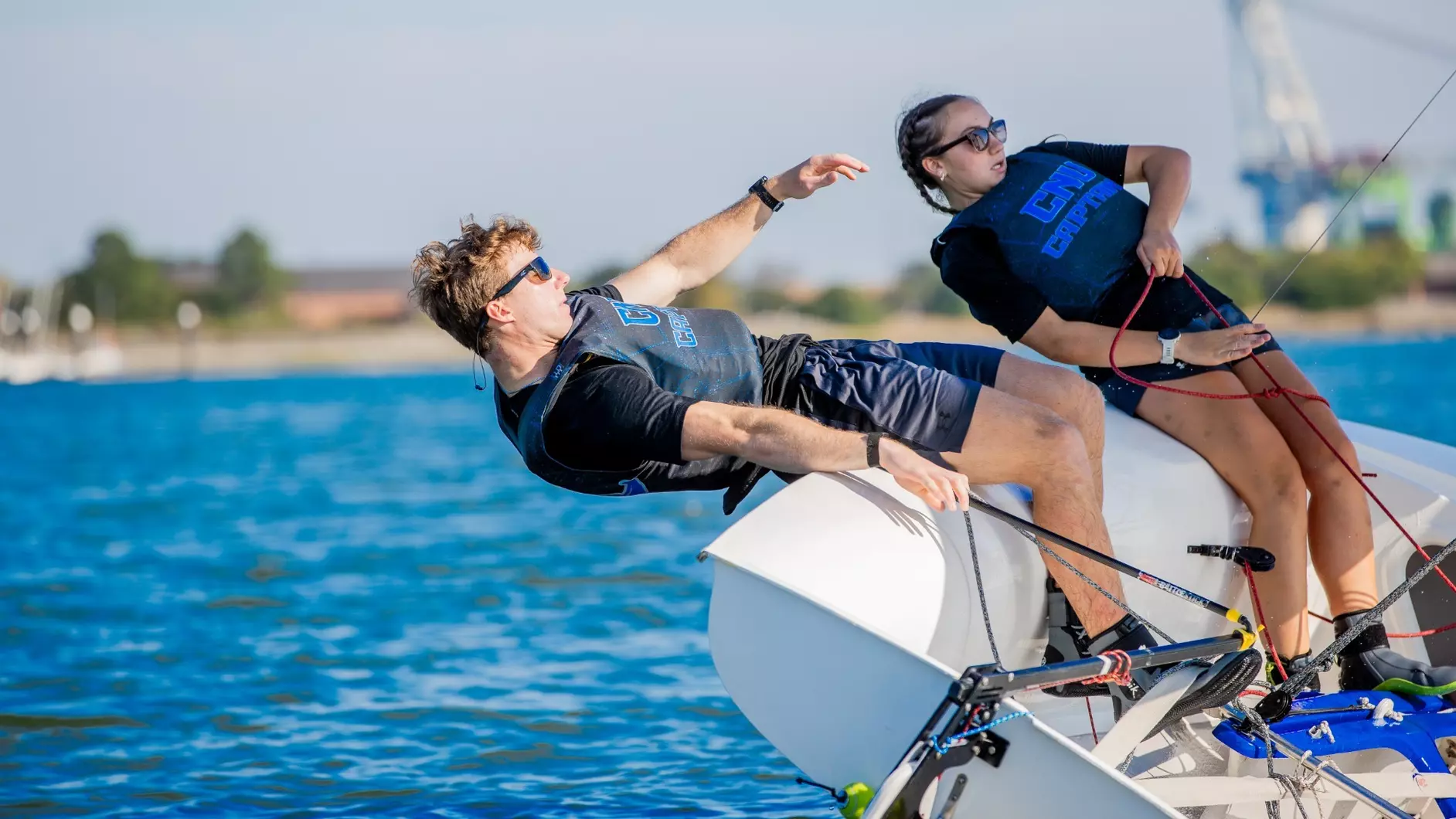
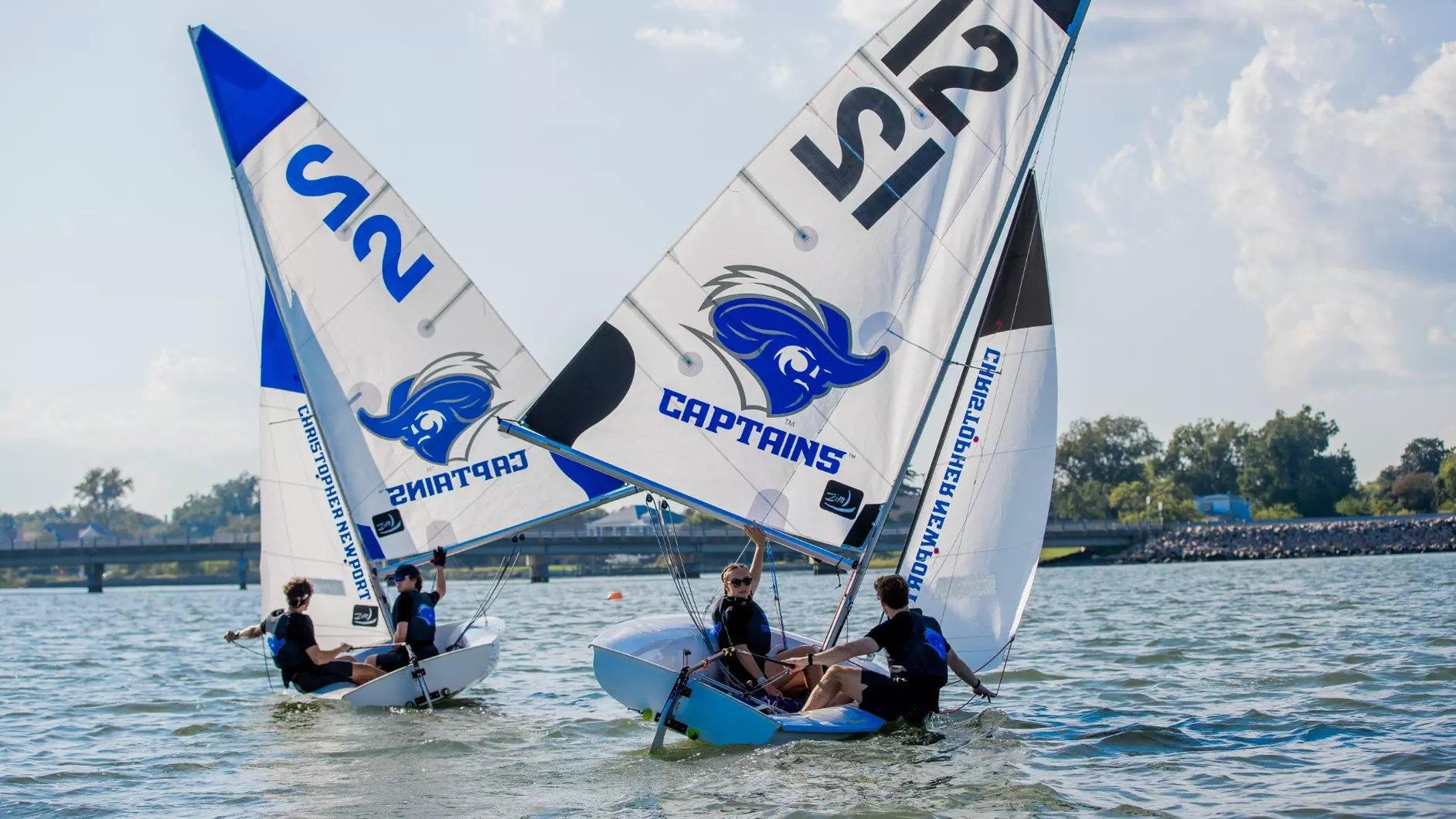
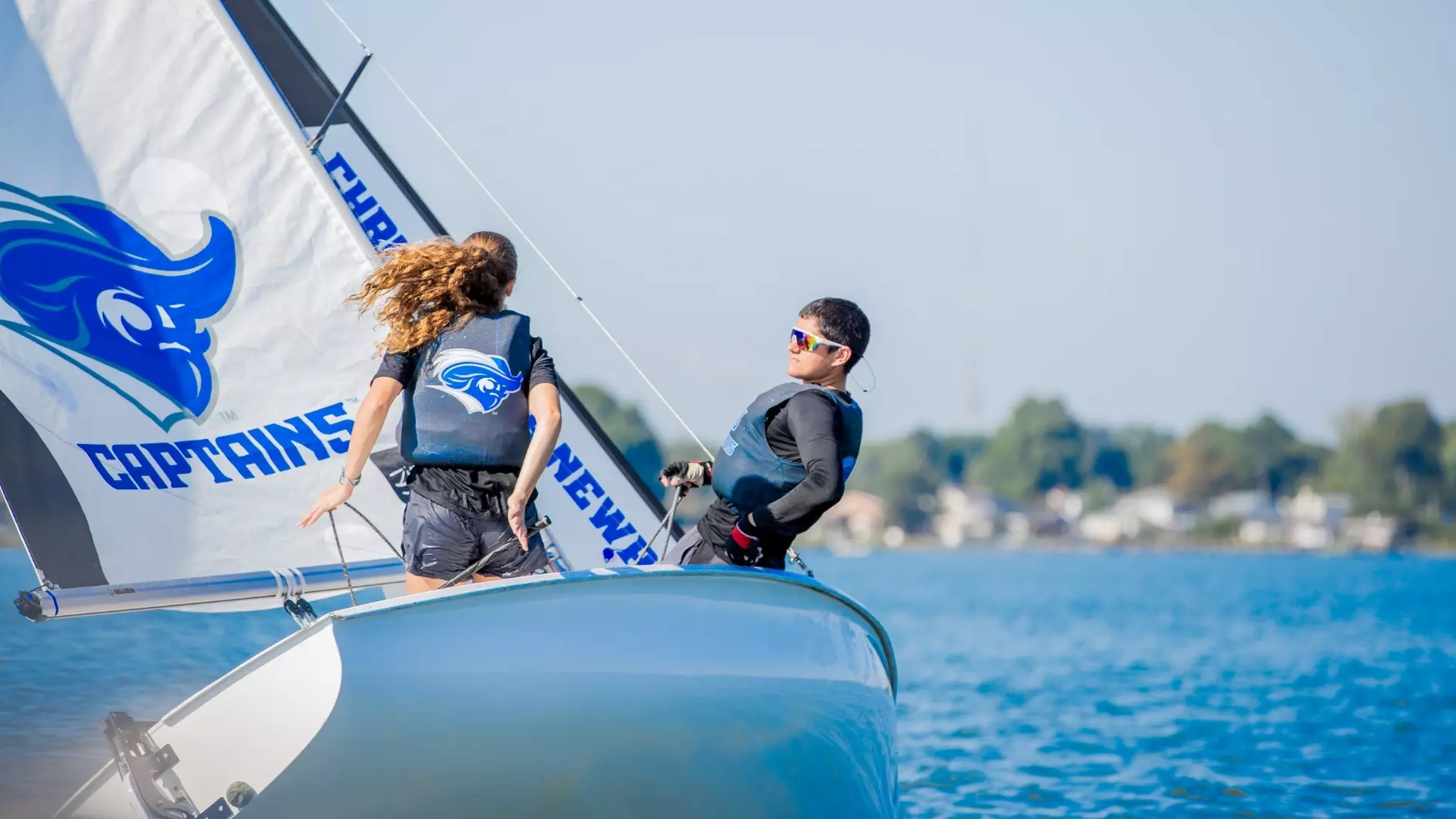
If you saw the results of the William and Mary Spring Open, which took place over March 28-29th, you would have seen the Christopher Newport University Captains at the top of the leaderboard. The team posted 65 points across A and B divisions to beat 2nd place University of Virginia with a 10 point lead after 10 races. It was the kind of result teams work toward all season, built on hours of practice and consistency across both divisions. However, the timing tells a different story.
Just days earlier, the University announced it would discontinue its sailing program at the end of the academic year, ending more than fifty years of competition. For the sailors, the season now unfolds under a different reality.
The decision, described as “difficult”, will bring an end to a program that has been deeply a part of the University’s identity. In a statement, University leadership cited a “full consideration of alternatives” and a need to align resources with institutional priorities.
Sailing at CNU dates back to the early 1970s as a club team before gaining varsity status in 1980. Over the decades, the program established itself as a consistent presence within the Middle Atlantic Intercollegiate Sailing Association (MAISA), producing competitive results and developing well-rounded student-athletes.
In recent years, that success has continued. The team earned back-to-back appearances at the ICSA Women’s National Semifinals in 2024 and 2025, while also producing All-Academic honorees and solid finishes across conference competition.
The decision to cut sailing also lands with a certain level of dissonance. Christopher Newport’s identity is closely tied to its nautical roots. The University’s teams compete as the Captains, a name and brand built around maritime tradition. For many connected to the program, that connection makes the announcement harder to reconcile.
The announcement defines the future of the program. For the sailors currently on the team, it has already reshaped the present.
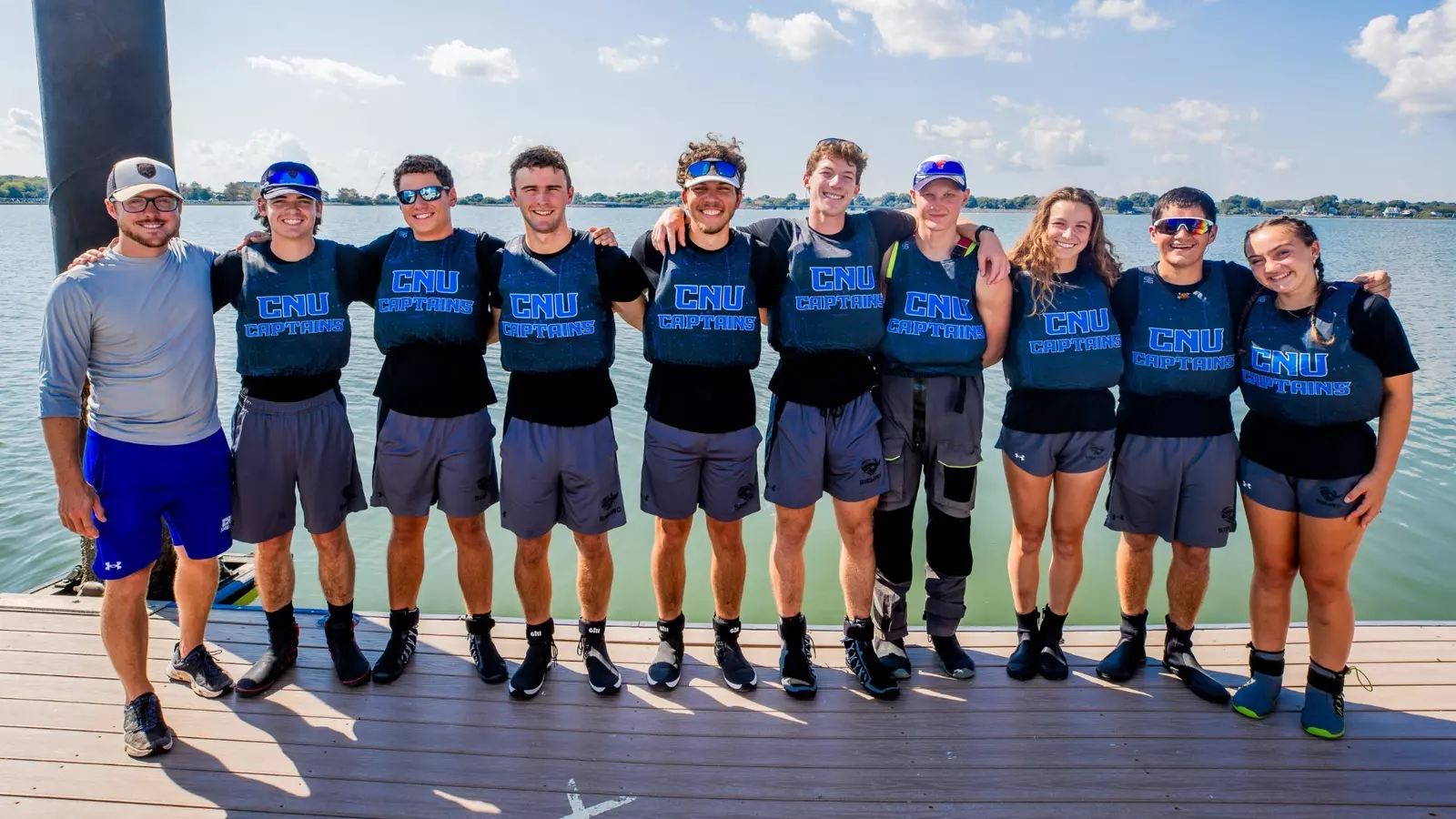
I got the chance to connect with Josh Bendura ’26 about what the past weeks have been like for the team and what the program has meant to him over his four years at CNU.
A Richmond, Virginia native, Bendura grew up sailing out of Fishing Bay Yacht Club, competing along the East Coast in Optis before transitioning to the ILCA circuit. Sailing was a constant throughout his childhood, ultimately shaping his college decision.“CNU was one of the only schools in Virginia where I could compete on a varsity sailing team,” he said. “And a place where I felt like I would be more than just a number.” Over four years, Bendura found both a competitive outlet and a close-knit environment that, in his words, he “would certainly choose again.” He points to the demands of the team as shaping not just his work ethic, but his identity. “It has felt like not just a college sports team to me, but a family and a home at CNU.”
Since the announcement, that sense of stability has been shaken. “To be honest, it’s been hard,” he said. While Bendura notes that, as a senior, he is less directly impacted than underclassmen, the abruptness of the decision has been difficult to process. “It’s really heartbreaking to see all of the work the team and myself have put in disappear in an instant.” What stands out most to him is not just what is ending, but what will no longer continue. “I felt like I’ve been trying to help build a program that would create success for years to come beyond me. Knowing that the younger sailors won’t be able to continue that legacy feels terrible.”
The response from the sailing community has offered a sense of perspective. “The support we’ve received has been nothing short of amazing,” Bendura said. “It truly means the world.” Even as uncertainty surrounds the future of the program, his connection to the sport remains unchanged. With plans to continue racing beyond college, Bendura emphasized that sailing is something he hopes to stay involved in for life.
As the situation continues to evolve, the future of CNU Sailing remains uncertain. What is clear, however, is the level of investment in ensuring that programs like this are not lost quietly.
In conversations with organizers working closely with the CNU sailing community, I’ve learned that the focus right now is clear: turn support into action.
One of the most immediate ways to help is by reaching out directly to university leadership. Supporters are encouraged to send thoughtful, constructive emails that express why the program matters and, where possible, offer ideas or resources. Those involved emphasize that volume matters, and that consistent, solution-oriented outreach can help demonstrate both the level of support and the potential for a path forward.
There is also a push for tangible support. This can include financial contributions, sponsorship opportunities, industry connections, equipment support, or creative ideas that help address program costs. Specific, actionable offers are especially valuable at this stage.
Contact information for university leadership will be included at the end of this article.
Support for the current sailors extends beyond the decision itself. At S1D, we encourage members of the broader sailing community to keep the team members in mind — whether that means offering crewing opportunities, staying connected, or simply showing up in support.
Alumni are also being asked to help quickly organize and strengthen the network. Anyone who sailed at CNU, or knows someone who did, is encouraged to reach out to Justin Ailsworth ‘04 ([email protected]).
For now, the Captains are still racing, working to put together results that reflect everything the program has built over decades. What happens next will depend not just on the decision already made, but on the response that follows.
Sail 1 Design will continue to follow this story as it develops and share updates as information becomes available.
If there’s something happening in the one design sailing world you think deserves attention, we want to hear it. You can reach out to [email protected].
Thanks to Coach Annabel Carrington from the College of Charleston, John Mollicone (Brown), Chris Klevan (Stanford), Charles Higgins (Tulane), and Brendan Feeney (Fordham).
The third edition of the 2026 College Team Race Rankings is live, and while the top spot remains the same, the latest results are starting to add new layers to the conversation.
At #1, Harvard continues to lead the way. “Consistently still the best team… but not untouchable,” according to Higgins. Feeney pointed to the conditions at the Graham: “As expected, heavy breeze presented them with some challenges, dropping races to Navy and Roger Williams and having to work out of losing combos in several others. Their record so far this year: 65 and 5. Nobody else is even close on percentage terms.”
At #2, Stanford is holding steady. Feeney noted, “They can run away from mid-level teams, but as evidenced at the Graham Hall, sometimes struggle to beat the best. They’ll need to find a way to break through if they want to beat the Crimson at Tulane next month.”
Roger Williams comes in at #3 following some challenging results. “Still good. A bit of a collapse at the Graham Hall,” observed Klevan. Feeney emphasized the bigger picture: “A lot hinges on the mental side for this team. Either their senior starters relax, lean on their experience and race with confidence, or they become challenged by the reality that this is their last season, start to feel the pressure and will inevitably face challenging races down the stretch. We’ll have to keep a close eye on them at regattas.”
At #4, the Georgetown Hoyas made a notable jump after strong recent performances. Higgins highlighted their trajectory: “The development over the past few weeks is showing this team to really start to come together at the right time.” Klevan kept it simple: “Good boathandling, good speed. Just good.”
Now ranked #8 after sitting 4th in the previous edition, Brown hasn’t fallen out of the mix. As Higgins put it, “A bit of a slip the past 2 weeks, plenty of talent and ability though to get hot at the right time.”
Ranked at #14, the Miami Hurricanes are trending upward. “Could have a shot at an at-large berth,” noted Higgins. Feeney said, “Much better than many expected and they are committed to traveling North to play against the main field. They have shown well on the results, including a win over Stanford at the Graham.”
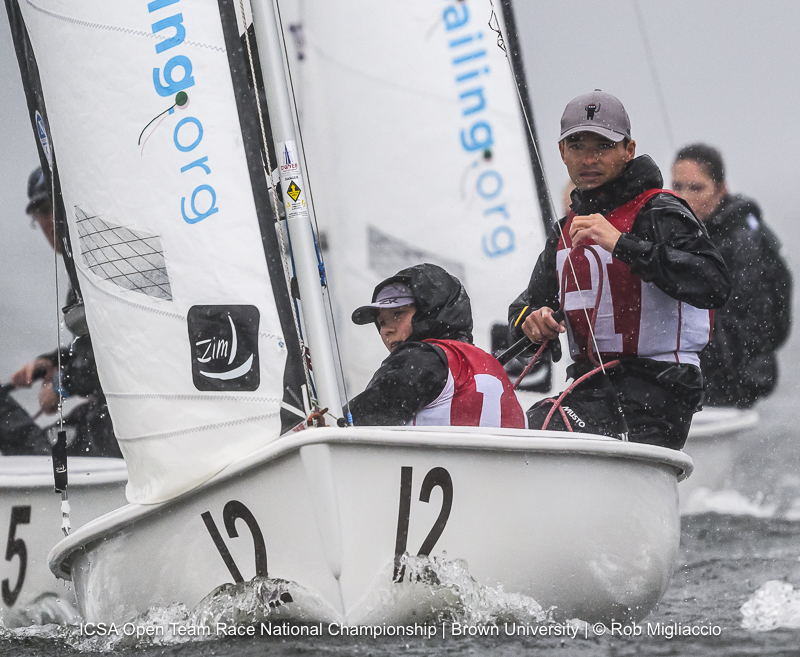
COPYRIGHT 2025 ROB MIGLIACCIO
WOMEN’S RANKINGS
On the Women’s side, a familiar name is holding solid at the top spot. Ranked again at #1, Stanford is continuing to set the pace for the fleet. “Clearly the best team at the moment, regardless of the lineup it seems,” according to Higgins. Feeney added, “The team to beat. They have both depth and experience. I am curious to see who their six sailors will be race 1 of nationals.”
At #2, the Yale Bulldogs women’s team is gaining momentum. Klevan noted, “Their ladies are getting a lot of Open experience. I think this team is definitely a dark horse this year.” Higgins pointed to their progression: “Starting to win at a much more consistent rate, and at the right time. This is a young squad of skippers, and I expect them to keep getting better together.”
Brown comes in at #3 after a strong showing. “One win behind Yale this past weekend. The Bears are a solid pick to come out of NEISA,” said Feeney, while Higgins emphasized consistency: “Consistently closing out regattas near the top of the leaderboard.”
Cornell is #4 and leads the way out of MAISA. Higgins noted, “Looking like a battle with Georgetown for the MAISA championship,” while Feeney added, “Lost some key components from last year, but a winning culture seems to still be present.”
At #5, Dartmouth continues to build. “Like Yale, getting good reps. I expect this team to be solidly top-8,” according to Klevan.
At #7, Tulane is building momentum. Feeney posed the question: “Some nice wins this past weekend. Can they break into the next tier?”
At #11, Charleston leads the way out of SAISA. Higgins noted, “Really hard to gauge. We haven’t seen this team out of conference much. Building depth by splitting this team up between women’s and coed events will likely pay dividends later.”
Another rankings update is just around the corner, with a packed couple of weekends ahead featuring key interconference matchups. Plenty of opportunities for teams to make a statement before the next edition drops.
We’re just getting into the heart of team race season—stay with us as it develops.
We breakdown Rankings #2 HERE. You can view photos from Rob Migliaccio HERE.