NEWPORT, R.I. (December 09, 2015) – The Premiere Sailing League USA, structured after the enormously successful sailing leagues pioneered in Germany and Denmark (www.segelbundesliga.de; www.sejlsportsligaen.dk), announced today that special-edition J/70s and J/88s will be used for the series. The event starts with District Qualification Regattas using J/70s and moves on to the National Finals to be sailed in J/88s. The Premiere Sailing League boat editions are 100% made in the USA, starting with their design by J/Boats (Newport, R.I.); spars by Hall Spars & Rigging (Bristol, R.I.); hardware by HARKEN (Pewaukee, Wisc.); lines by New England Ropes (Fall River, Mass.); and hull and sail graphics by Mac Designs (Newport, R.I.) 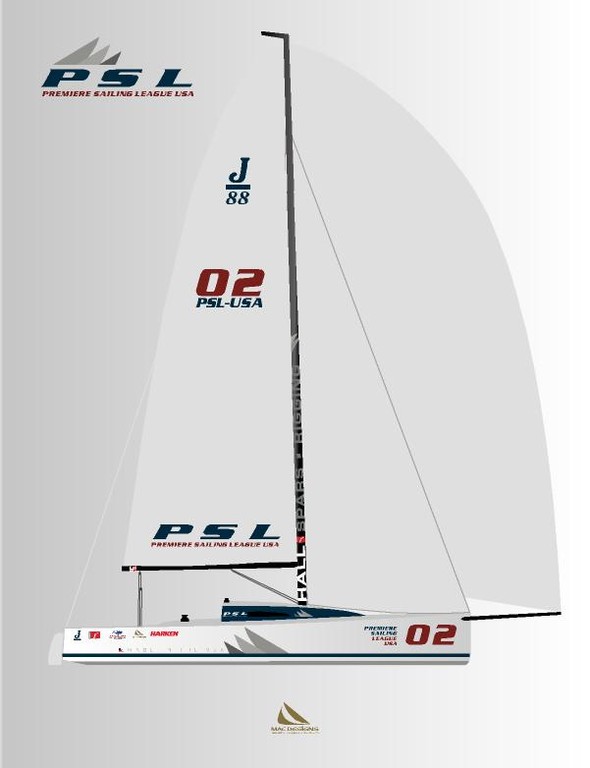 Special “Made in the USA” editions of the J/70 and J/88 will be used in the Premiere Sailing League series. Special “Made in the USA” editions of the J/70 and J/88 will be used in the Premiere Sailing League series.“I am very proud to have on the PSL team companies that are passionate about sailing and have established themselves as leaders in their fields,” said Premiere Sailing League President Benjamin Klatzka. “Support from the marine industry is very important, and with boats ‘Made in the USA’ it will distinguish Premiere Sailing League America from other ‘club-based’ events and also inspire other U.S. companies and organizations to get involved.” At the Premiere Sailing League USA introduction during last year’s Strictly Sail boat show in Chicago, J/Boats President Jeff Johnstone voiced his support for Klatzka’s initiative based on what the overseas sailing leagues have done “to excite and promote grassroots sailing.” Johnstone says the philosophy behind the series is fully convergent with that of J/Boats: “to provide a great platform to promote multi-generational sailing via fun and affordable competition between clubs.” The J/70s and J/88s are built in the U.S. and their rigs will feature Hall Spars for the special-edition Premiere Sailing League USA boats. “Our spars are shipped all over the world and used at the highest levels of competition,” said Hall Spars Vice President Ben Hall, “but we never forget our roots and the importance of keeping the sport fun and accessible to everyone.” Kevin Coughlin, of New England Ropes, shared a similar sentiment, explaining, “As a local supplier, we work closely with all partner companies to provide the best tools and equipment for the sailors and even more importantly to promote sailing and racing, as it is such an essential part of our global business.” Harken, also synonymous with top performance in sailing, supplies hardware to superyachts and racing dinghies alike. “J/Boats, Hall, Harken…we are all international companies,” said Peter Harken, the company’s president. “Our customers rely on our gear to win all over the world. Deep down, I think it’s great something like this is going to happen in the U.S. with American companies represented.” Designer of the new logo for Premiere Sailing League USA and the new “look” of the special-edition boats is Mac Designs, which has provided hull and sail graphics for some of the most memorable racing campaigns in recent history. “Since the regattas will be held close to shore, have a stadium-style atmosphere and utilize the latest social media technologies, the visuals will be integral in allowing the sailing and general public to support and encourage their teams,” said Mac Designs President Bill MacGowan. |
For more information about the Premiere Sailing League USA go to www.premieresailingleague.com or Facebook. Benjamin Klatzka will be available for questions at Key West Race Week and Boot Düsseldorf (Germany). Please contact him at [email protected].

 The
The 
 In recent years, Sippican Harbor has become completely devoted to yachting activities, with no commercial shipping. It is one of the best yachting harbors on the east coast. Today, Marion is a residential community with a winter population of about 5200, swelling to 8000 in the Summer. The buildings of