The Raven is a 24 foot centerboard sloop, a pioneer in planing hulls. Launched in 1948, the first ones were molded plywood, the later ones were manufactured in fiberglass. The Raven has been described as the “muscle car” of sailboats and she can still hold her own against new hotshots. Besides being a performance racing boat, her large cockpit is comfortable for relaxed daysailing and was designed to be family friendly.
Length Overall 24’3″
Length Waterline 21’7″
Beam 7′
Hull Draft 7″
Draft (board down) 5’4″
Weight 1170 lbs.
Sail Area: 300 square feet
Jib: Yes
Spinnaker: Symetrical, 200 square feet
Trapeze: 3
Total Crew: 3-4
Hull Speed: 6.59 knots
Blog
A Scow
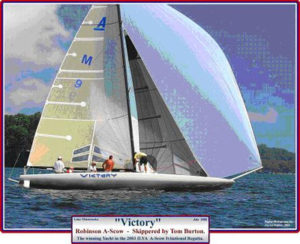 In sailing, the A-Scow is a large sailing scow It is 38 feet long and with reported top speeds of over 25 kts. With its rules of design, also known as scantlings, first being written in 1901, the A-Scow has a significant history. With a large sail area and little keel ballast, the five to seven crew members must work in unison on the A-Scow to keep the boat sailing fast and upright. The boat is mainly sailed in Minnesota and Wisconsin.
Number of crew: 5-8
LOA 11.58 m 38 ft
Beam 2.44 m 8 ft
Hull weight (with fittings) 839 kg 1850 lb
Sail Area of total of Jib 13.94 m² 150 ft²
Sail Area of total of Main 32.52 m² 350 ft²
Sail Area of total of Spinnaker 111.48 m² 1200 ft
Class website:
http://dnn.ascow.org/
C Scow
The one-design C Scow class created by Johnson Boatworks of White Bear Lake, Minnesota began sailing in 1905. Original, the boat and masts were made of wood and the gaffe-rigged mainsails were made of cotton. Through the years, hull shapes and materials have changed, but the critical formula remains the same: One hull, one large sail, two bilge-boards, and one helluva ride!
Until 1981, a total crew weight of 475 lbs during racing was strictly enforced. Today, there are no such restrictions, but the magic number for total crew weight remains around 500 lbs in the heaviest of winds, and less weight in lighter conditions.
Length: 20 feet (6.10 meters)
Beam: 7 feet (2.13 meters)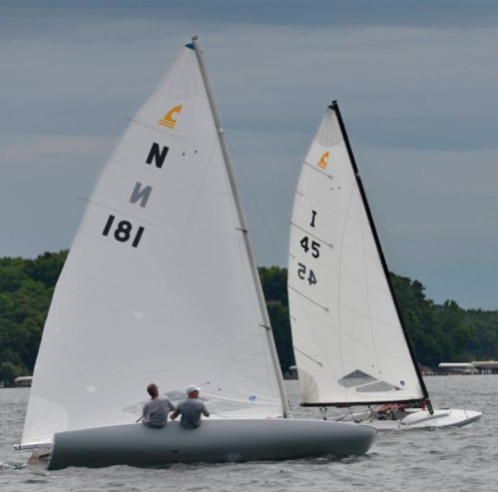 C Scow
Main Sail Area: 216 square feet
Crew: 2-3
Class Site: http://www.cscow.org/
E Scow
The E-Scow is the younger sister of the A-Scow. Its rigging is similar, as well, and their hull shapes are almost identical. The boat is competitively sailed in Minnesota and Wisconsin and recently in many more states around the country, including Michigan, New York, New Jersey, South Carolina and Colorado. Only recently has E-Scow class spread to Europe. There are boats at least in Switzerland, France and Finland. Unlike the A-Scow, the E-Scow has a symmetrical spinnaker. The National Class E Scow Association (NCESA) tested an asymmetrical spinnaker option as a potential change to the design scantlings for two years. The asymmetrical spinnaker was voted down by the class in 2006, but it seems that new vote is around the corner with slightly modified rig and more restricted spinnaker shape.
Class Site: http://www.e-scow.org/
Formula 18
A high performance import this class has one of the most exciting and fastest growing catamaran one-design racing fleets in the world. The F-18 is raced with a crew of two and a spinnaker for down-wind performance. It’s fittings, hull design and sail shape are the results of the latest developments in sailing technology. A strict “box measurement” allows manufacturers to develop catamarans so that they are price competitive, but at the same time give them the freedom to continually develop higher levels of performance. To sum up, weights allow better and fairer racing between crews, with more ladies getting involved, both as crews and helms. The number of manufacturers keeps sailing costs to the minimum, and the ability to buy spares and sails from any manufacturer, as long as they measure, also keeps costs down.
Length: 18′
Beam: 8′ 6″
Mast Length: 29′ 6″
Main Sail Area: 183 Sq. Ft.
Jib Sail Area: 44 Sq. Ft.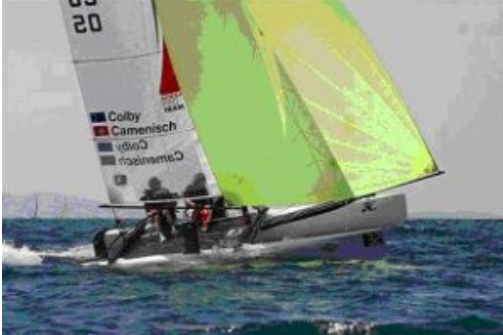
Spinnaker Sail Area: 225 Sq. Ft.
Weight (with spinnaker): 397 lbs.
Hull Construction: Fiberglass/Foam Sandwich
Class Association: https://www.f18-international.org
Fireball
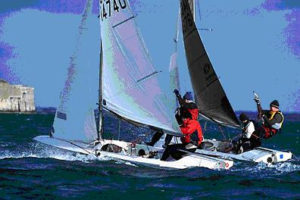 The International Fireball was designed to meet a need – to the bridge the gap between the small “family” centre boarders and the larger more expensive classes. The designer, Peter Milne, an Englishman, had these motives: cheapness, simplicity to build, unequalled performance potential, price and waterline length, individual appearance.
He achieved his aims in 1962 when the fireball was first sailed in England. The remarkable performance of his prototype was seen especially on the plane and to windward. Without any sponsorship the class grew very rapidly, first in the UK and then on the Continent (France, Switzerland, Sweden and Germany especially), in the USA, South and East Africa, Canada, Asia, Australia, New Zealand and the Pacific Islands.
Within a very short time the need for worldwide administration became apparent and “Fireball International” had to be formed. To this body the newly formed National Associations affiliated. A constitution and detailed class rules were adopted.
The first World Championships were held in England in 1966. In 1968 the spinnaker was internationally adopted. The class was recommended by OYRU for International status and was approved in 1970. The class has been a close contender for Olympic selection. It has established a world wide reputation for its high standards of yachting administration and progressive enthusiasm.
For More Information: