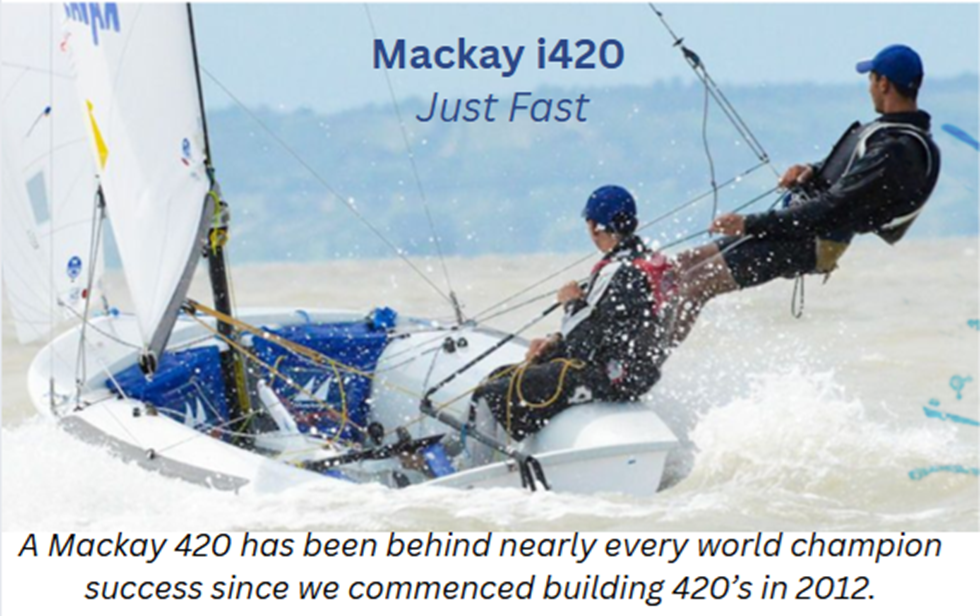
Looking for a new boat, and not only a new boat but a foiling boat? A boat that is fast, fun, durable, and affordable? The Waszp may just be it! Similar to the Moth the Waszp offers sailors with a more durable and affordable boat. Just recently at the end of January, the first Waszp regatta took place in the US. This regatta was part of the Winter Series that the Moth class has held at the Upper Keys Sailing Club for the past couple years. Since the US Waszp class is brand new the president of the US Waszp class Reed Baldridge thought this winter series would be a great stepping stone for the class. The regatta brought 8 sailors with Waszp’s all around the country, it was not only a great regatta but a great learning and brainstorming session for this new class.
 The Boat:
The Waszp is a one design foiler, that was created by Andrew McDougall, designer of the world beating Mach 2 foiling Moth. Recently, it was just named 2017 Best One-Design by Sailing Worlds Boat of the Year Awards. The Waszp and the Moth are similar in their concepts, but for a couple reasons, the Waszp hits a market of different dinghy sailors. First, the Waszp is half the price of the Moth, you can buy a brand new Waszp in the US for $12,500. Unlike the Moth the Waszp is a one design class. With the Waszp you have adjustable wing angles allowing you to adjust for your skill and for storage. The Waszp comes with retractable alloy foils making it an easy boat to launch. With a free standing rig, you can rig up quickly and have a much  easier time getting back into the boat after capsizing.
Blog
Strategy & Tactics in Waves
By Andrew Kerr
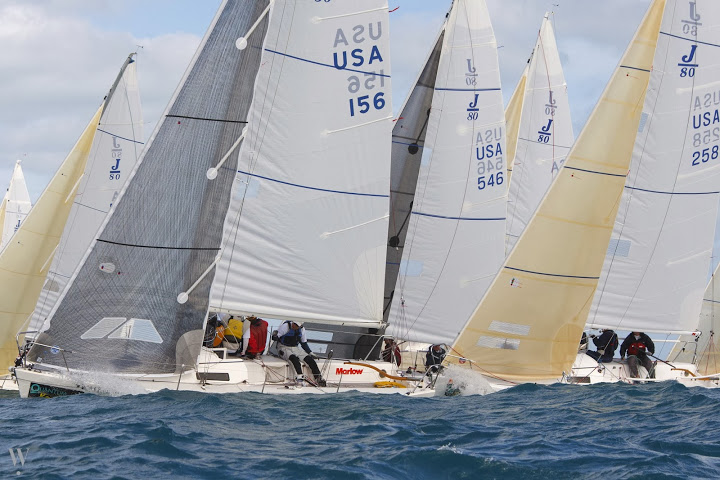
Having recently sailed a 10 race series at Key West Race Week that featured a large part of the regatta with waves and cluster chop. Here is some strategy, tactics and boat handling key elements that can help your team sail a fast and consistent series when the waves are up.
 Pre-Race
Which tack is better versus the waves and is there flatter water on the course?
Go upwind on each tack and get a feel for the wave formations and find out which tack is better versus the waves if there is one, very often they are similar.
Do we need to set the boat up differently from tack to tack?
On the harder tack we have found it better to move the lead one hole forward and ease the Jib/ Genoa and mainsheet slightly to sail the boat more open on the leeches to cope with the waves and the rapidly changing apparent wind angles.
On the easier tack the Jib / Genoa lead is typically a hole further back and the sheets trimmed on a little harder as it is easier to point in the flatter water.
Is there flatter water inshore?
At a lot of venues the waves are smaller inshore – research this when you go upwind in the pre-race period.
Communication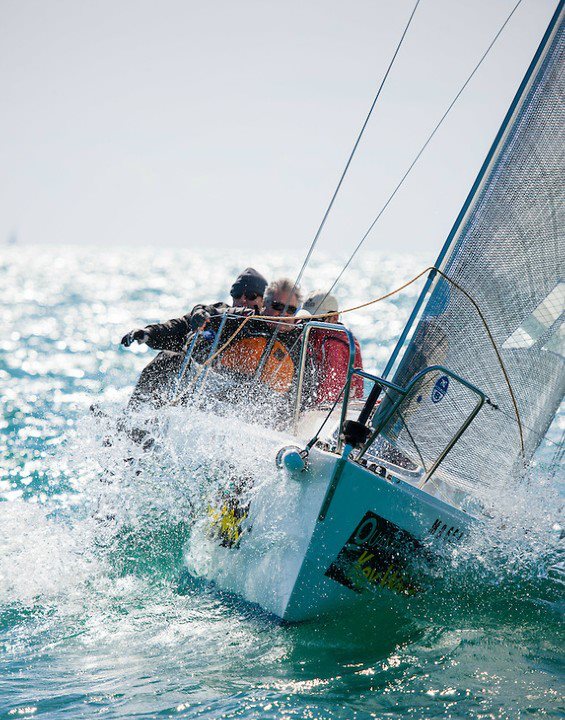
Take time to get the communication flowing from the wave caller in the crucial pre-race upwind leg leading up to the start – if it is constant waves then we have found it is even more critical for the wave caller to call out any flatter water so we can shift gears accordingly – “Flatter water in 3, 2, 1 – now – lasts for 2 boat lengths “is a really important piece of info.
Also be sure to work on identifying flatter spot’s to tack in, “flat spot to tack in 3, 2, and 1 – now “.
Boat speed wise, if possible we would like to get on on the easier tack so we can get off the line and find our space and go – the driver will appreciate this if you can choreograph it that way!
Which jibe is better or more stable downwind versus the waves?
As an example – at Key West we found the wave axis to be better on starboard tack as the boat could plane more consistently.
In the absence of wind and angle considerations – the better Jibe with the wave axis is going to get us going faster or if the wind is lighter and the waves more confused – will keep the boat more stable , is one better than the other? Very often the most challenging conditions are when it is light air with confused waves – is one jibe better than the other for keeping the spinnaker stabilized?
Starting
In decent sized waves it’s really important to get the biggest gap to leeward on the line that you can so that you can go bow down and full speed as long as possible without a leeward boat playing interference .
So strategically we are looking for a low density area on the line, away from crowds and in a place to sail to flatter water on the course or the favored side which at quite a lot of venues is inshore.
Upwind
- Try to sail on the easier tack as long as you can to get best VMG.
- Minimize tacks as much as you can as the loss from tacking can be substantial – be selective when you tack .
- To this end either tack in a flatter spot or if one is not available tack on the top of a wave so you minimize the loss.
- If lee bowing another competitor the adage is that in order to lee bow someone in waves you have to basically be able to cross them as the boat loses a lot of speed and you risk getting rolled over.
- If a lee bow will not work then either duck them for freedom to go fast or tack well early to maintain space and speed, remember the big picture of which side of the course you want and get the dialogue onboard going early .
- If looking for a lane of clear wind – be sure to pick a wide lane so that you can go fast without fear of falling into a boat that is pinching.
- Avoid packs of boats – they are usually sailing a little high and not optimum VMG, go for space.
- Lay lines to the weather mark should be called with a wider tacking angle in mind and slightly over standing is always going to be better than a tight lay line.
Downwind
- In the absence of velocity, current or angle considerations ( which may well be of higher priority ) then take the better jibe versus the waves – either to get the boat going faster and planning/ surfing more consistently or the one which is more stable if the waves are confused .
Leeward Rounding
- If it is planing / surfing conditions then err on the side of taking the spinnaker down a little earlier rather than later so you do not plane past the mark!
- If the wave is picking the boat up and pushing it downwind , be sure to turn the boat early upwind and trim the main in rapidly otherwise you will get pushed to leeward of the mark – sometimes a long, long
- If the waves are confused and slowing the boat down then fly the spinnaker as long as you can into the mark ( practice is key here ) for max speed in and out of the rounding.
- For all the above elements practice and repetition of takedowns and mark Roundings is going to be critical so you can make an informed decision on how long it takes to execute the boat handling and the rounding.
Best of luck in your next race or regatta and May the waves be with you!
Club Profile: Lakewood Yacht Club
News Flash: Lakewood Yacht Club is hiring a full-time Youth Sailing Director
 Located on 38 beautifully landscaped acres on Clear Lake beyond the busy highways of East Harris County, Texas, Lakewood Yacht Club is an exceptional environment for social and water activities with a wonderful story to tell. Lakewood Yacht Club has over 300 covered and open boat slips for any boat aficionado. Lakewood, however, is so much more than just a yacht club for docking your boat; it is a haven for members, their families and guests. There is a sense of peace and tranquility here combined with unparalleled camaraderie that makes Lakewood an escape from your everyday world. Add to that the club’s calendar which is overflowing with a variety of social and water activities for all ages and you have a remarkable package with remarkable value.
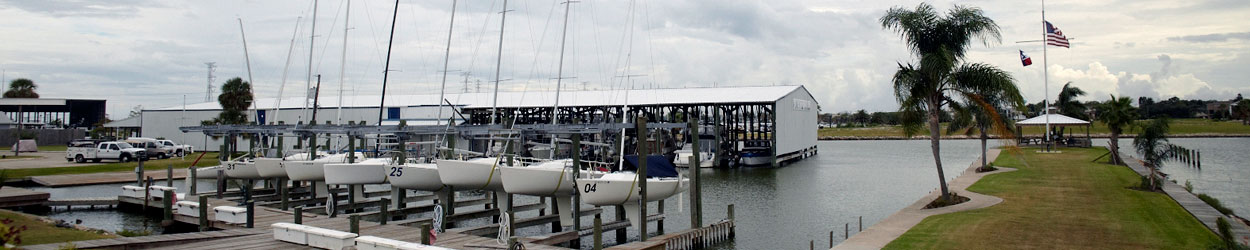 The Bermuda-style clubhouse provides Lakewood’s 500 plus members with harbor-view dining facilities and excellent cuisine. Lakewood has a stunning bar and piano lounge with several large screen televisions. At the other end of the clubhouse is a harbor-view ballroom for monthly holiday/event parties as well as popular Sunday brunches. Children enjoy visiting their friends and playing videos in our supervised Game Room while their parents partake of a quiet dinner meal.
Lakewood has a strong agenda of regattas and cruises organized by Lakewood’s enthusiastic volunteers. An active Ladies Association holds monthly luncheon meetings with a program in addition to a fun group trip every year. Our Youth Program, known as the Seahorses, is recognized as the best in Texas and is guided year-round by the club’s parent volunteers and dedicated coaches. Three lighted tennis courts and friendly but competitive monthly tennis socials and weekly matches add to the allure of Lakewood.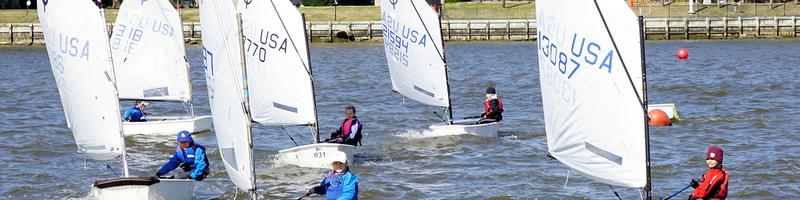
Lakewood Yacht Club offers a unique Youth Sailing Program, with a wide variety of opportunities for children of all ages. Achieving prominence as one of the top yacht club programs in the United States, our youth sailors (the Seahorses) participate in the Texas Sailing Association Series as well as National and International Regattas worldwide. With programs that offer year-round fun for members and guests alike, with our summer sailing camps, Learn-to Sail and Advanced Racing classes there is something for every young aspiring sailor at Lakewood Yacht Club.
Youth Sailing
Under the direction of dedicated coaches, Lakewood Yacht Club’s Youth Sailing Program has grown into being the envy of other yacht clubs all over the country, not just around the Gulf Coast. The Seahorses have brought stellar recognition to the club, influencing our membership growth as families join the club so their children can learn to sail and compete, if they wish. As long-time local racer Charles Milby says of sailing as a child,“Once I learned how to crew, once I learned how to trim a spinnaker and a jib, I could go anyplace. It was a skill I learned. I could sail a 13 foot boat or a sixty foot boat; the principles are exactly the same.”
News Flash: Lakewood Yacht Club is hiring a full-time Youth Sailing Director
First WASZP Class Regatta in the USA! : WAZSP Profile and Regatta Report
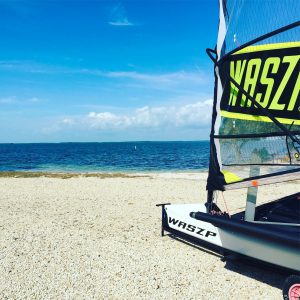
 Looking for a new boat, and not only a new boat but a foiling boat? A boat that is fast, fun, durable, and affordable? The Waszp may just be it! Similar to the Moth the Waszp offers sailors with a more durable and affordable boat. Just recently at the end of January, the first Waszp regatta took place in the US. This regatta was part of the Winter Series that the Moth class has held at the Upper Keys Sailing Club for the past couple years. Since the US Waszp class is brand new the president of the US Waszp class Reed Baldridge thought this winter series would be a great stepping stone for the class. The regatta brought 8 sailors with Waszp’s all around the country, it was not only a great regatta but a great learning and brainstorming session for this new class.
 The Boat:
The Waszp is a one design foiler, that was created by Andrew McDougall, designer of the world beating Mach 2 foiling Moth. Recently, it was just named 2017 Best One-Design by Sailing Worlds Boat of the Year Awards. The Waszp and the Moth are similar in their concepts, but for a couple reasons, the Waszp hits a market of different dinghy sailors. First, the Waszp is half the price of the Moth, you can buy a brand new Waszp in the US for $12,500. Unlike the Moth the Waszp is a one design class. With the Waszp you have adjustable wing angles allowing you to adjust for your skill and for storage. The Waszp comes with retractable alloy foils making it an easy boat to launch. With a free standing rig, you can rig up quickly and have a much easier time getting back into the boat after capsizing.
The Regatta:
Day 1 (Friday, January 27):
The eight sailors were greeted with a light breeze, 5-8 knots. All the sailors varied in their Waszp experience. You had some sailors who had 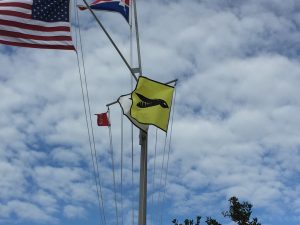 been sailing the Waszp for a couple of months where for some of the sailors it was their first time in the boat. Day 1 was frustrating as it was light with marginal foiling conditions. However, everyone in the class helped each other out as they learned throughout the day. John Wallace had good speed and took the day with a 2, 1.
Day 2 (Saturday, January 28):
The breeze was great at 8 am so before the racing got started some of the sailors made their way out on the water to get some foiling practice 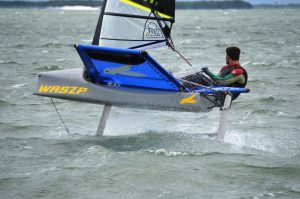 in. Slowly the breeze died off to 5-8 knots again once the racing got started at 11 am. Some sailors were able to get foiling for a little bit, but it was another day of tricky racing. Matt Goetting, “The angles were so crazy on both the upwind and downwind that it didn’t pay to be foiling.” Another slow moving day, but the group was able to get 4 races in with Connor Blouin taking the lead, followed by John Wallace, and Peet Must. The group all headed out after sailing to the local tiki bar where they all chatted about everything from foiling to fruity drinks.
Day 3 (Sunday, January 29):
The breeze was on! The group showed up to 25-30 knots but then dying down to 18-25 knots. It was an exciting day of racing for the group. The speed and angle differences with the Moths made things interesting on the water. Reed Baldridge, “I was actually amazed at how close the top marks were, it reminded me of laser races with the top boats within boat lengths of each other.” The name of the game downwind was staying upright, which proved to be a difficult one in the breeze. Only a few breakdowns for the day, but all in all it was the most exciting day of racing getting in three races to finish the regatta. Connor Blouin took the win, with a total of 11 points, Peet Must in second with a total of 18 points, and John Wallace in third with a total of 19 points.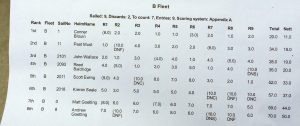
The second series to be held February 17-19th and the third and final on March 31-April 2nd.
Then the weekend of May 20th-21st the Waszp Atlantic Coast Championships will be held at Toms River Yacht Club. More info to come! Contact your local Waszp dealer today to get a boat by the Atlantic Coast Champs.
The learn more about the Waszp check out the website: http://www.waszp.com and Like International Waszp United States Class Association on Facebook for updates on the class in the US. This is only just the beginning for this new exciting class!
Correct Muscles Imbalances Now For A Better Sailing Season Later
Ever notice that you are slumped over or your posture doesn’t seem right? Well, this happens when your alignment is out of whack, creating muscles imbalances. The technical way to define a muscle imbalance would be as an alteration of muscle length surrounding a joint. However, for terms that are better understood a muscle imbalance occurs when one muscle is stronger than its opposing muscle causing compensations to occur.
Why do these occur? There are many reasons that muscles imbalances occur one significant factor is our constant overuse of certain muscles especially in a sport like sailing. For example, in sailing with hiking you are using a lot of core muscles during this action, and your shoulder muscles aren’t used as much. So after a long season of sailing, you could develop upper crossed syndrome which is characterized by a forward head and rounded shoulders. By knowing what muscles imbalances we have and using corrective exercises we can prevent any injuries that could occur and alleviate any pain we may be having. Today you will learn about 3 common postural distortion patterns and how to fix them for a better sailing season.
1. Pronation Distortion Syndrome: This can be defined as flat feet and internally rotated knees or knock knees.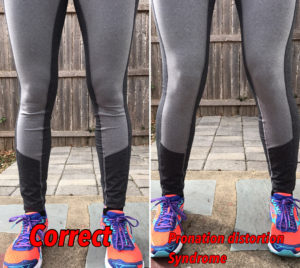
The muscles that are short or tight and need to be stretched:
-Gastrocnemius (Calf muscle)
-Soleus (Calf muscle)
-Peroneals (Outside of the calf)
-Adductors (Inner thighs)
-Iliotibial Head (IT band, outer thighs)
-Hip Flexor Complex
-Biceps Femoris (Hamstring)
The muscles that are lengthened or weak and need to be strengthened are:
-Anterior Tibialis (Shin)
-Posterior Tibialis (Calf)
-Vastus Medialis (Inner Quadriceps)
-Gluteus medius/maximus (Butt)
-Hip External Rotators
Injuries that can occur:
-Plantar Fasciitis
-Shin Splints
-Patellar Tendonitis
-Low-Back Pain
How to fix:
1. Start with foam rolling the tight and overactive muscles. Key areas to focus on would be the calfs, IT band/TFL, hamstrings, and adductors. Hold on tender spot for 30-60 seconds, or longer if necessary.
2. Next step is to lengthen the tight muscles with static stretching. Key areas to stretch would be calfs, TFL, hamstrings, and adductors. Hold each stretch for at least 30 seconds and repeat for 2 sets.
3. Next, we need to strengthen the underactive or weak muscles. You can strengthen your calf muscles by doing single-leg calf raises, and you can strengthen your gluteus maximus by performing floor bridges (hold for 5 seconds for 1 rep). Do 15 reps of each exercise for 2 sets.
4. Finally, finish with an integrated exercise to help improve overall movement quality. Do a multiplanar single leg balance reach for 15 reps and 2 sets.
Check out the video for guidance on all the moves above.
2. Lower-Crossed Syndrome: This can be defined as an arched lower back.
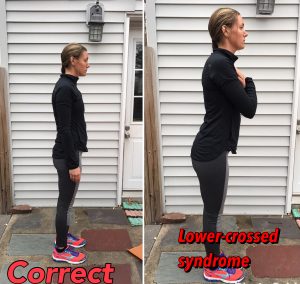 The muscles that are short or tight and need to be stretched:
-Gastrocnemius (Calf muscle)
-Soleus (Calf muscle)
-Hip Flexor Complex
-Adductors (Inner thighs)
-Latissimus Dorsi (Lats/ back muscles)
-Erector Spinae (Back muscles)
The muscles that are lengthened or weak and need to be strengthened are:
-Anterior Tibialis (Shin)
-Posterior Tibialis (Calf)
-Gluteus medius/maximus (Butt)
-Transversus Abdominis (Abs)
-Internal oblique (Side Abs)
Injuries that can occur:
-Hamstring complex strain
-Anterior knee pain
-Low-back pain
How to fix:
1. Start with foam rolling the tight and overactive muscles. Key areas to focus on would be the hip flexor complex, thighs, and calfs. Hold on tender spot for 30-60 seconds, or longer if necessary.
2. Next step is to lengthen the tight muscles with static stretching. Key areas to stretch would be the ones you just foam rolled. Hold each stretch for at least 30 seconds and repeat for 2 sets.
3. Next, we need to strengthen the underactive or weak muscles. To strengthen your gluteus medium/maximus you can use floor bridges (hold for 5 seconds for 1 rep). To help to strengthen your abs you can use bird dogs. Do 15 reps of each exercise for 2 sets.
4. Finally, finish with an integrated exercise to help improve overall movement quality. Use a plank hold for 15 seconds then rest repeat 15 reps and 2 sets.
Check out the video for guidance on all the moves above.
3. Upper Crossed Syndrome: This can be defined as a forward head and rounded shoulders.
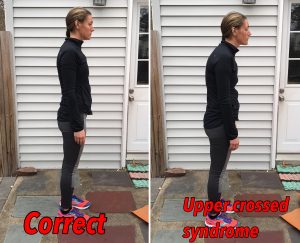 The muscles that are short or tight and need to be stretched:
-Upper Trapezius (upper back/neck)
-Levator scapulae (neck)
-Sternocleidomastoid (neck)
-Scalenes (neck)
-Latissimus Dorsi (lats/back muscles)
-Teres Major (back)
-Subscapularis (shoulder)
-Pectoralis major/minor (chest)
The muscles that are lengthened or weak and need to be strengthened are:
-Deep cervical flexors (neck)
-Serratus anterior (shoulder)
-Rhomboids (shoulder)
-Mid-trapezius (shoulder)
-Lower-trapezius (shoulder)
-Teres minor (rotator cuff)
-Infraspinatus (rotator cuff)
Injuries that can occur:
-Headaches
-Biceps tendonitis
-Rotator cuff impingement
-Thoracic outlet syndrome
How to fix:
1. Start with foam rolling the tight and overactive muscles. Key areas to focus on would be the upper trapezius, levator scapulae, and latissimus dorsi. Hold on tender spot for 30-60 seconds, or longer if necessary.
2. Next step is to lengthen the tight muscles with static stretching. Key areas to stretch would be the ones you just foam rolled. Hold each stretch for at least 30 seconds and repeat for 2 sets.
3. Next, we need to strengthen the underactive or weak muscles. To strengthen your shoulder muscles you can do floor cobras (hold for 5 seconds for 1 rep). Then to strengthen your deep cervical flexors you can use chin tucks (hold for 5 seconds for 1 rep). Do 15 reps of each exercise for 2 sets.
4. Finally, finish with an integrated exercise to help improve overall movement quality. Use a superman exercise hold for 5 seconds repeat 15 reps and 2 sets.
Check out the video for guidance on all the moves above.
We all have muscles imbalances that need to be corrected. By correcting these imbalances sooner rather than later we will improve our sailing out on the water, and avoid any injury in the future. The off-season is a perfect time to fix these problems so when you get back to sailing your body will be ready to perform at a top level. These tools can help you on your way to fixing your muscles imbalances, but I do recommend seeing a personal trainer for a more individualized plan. Fix your muscles imbalances today for better sailing later!
For more information on fitness for sailing contact [email protected]. Also check out Sailorcise on Facebook, Twitter, and Instagram for daily tips on fitness, nutrition, and sailing.
J-Boats to Hold First U.S. J/70 Youth Championship
Win a FREE J/70 for your Sailing Club!
 (Newport, RI)- The first annual U.S. J/70 Youth Championship will take place concurrent with the J/FEST New England Regatta from August 11th to 13th on beautiful Narragansett Bay. The event will be hosted by the famous crew at SAIL NEWPORT, Newport, Rhode Island and hosted at their extraordinary facility at Fort Adams State Park.
Interest has been strong from various youth teams across the country; with crews already gearing up for the J/70 Midwinters in St Petersburg, FL, hosted by St Petersburg YC and also the Helly Hansen San Diego NOOD Regatta, hosted by San Diego YC in San Diego, CA.
The goal of this event is to help develop and build leading-edge junior keelboat sailing programs across America. The winning club of this event will get “free” usage of a fully equipped International J/70 one-design class sailboat, with sails and trailer, provided “free of charge” by J/Boats, to the winning sailing club and its membership for twelve months.
The U.S. J/70 Youth Championship (USJYC) is open to eleven (11) Youth Teams representing US Sailing recognized Sailing Clubs or Organizations. Sailing clubs may enter more than one youth team per event, but may only qualify one team for the USJYC championship in Newport, RI.
The 11 Youth Teams will compete on eleven brand new J/70 Class sailboats with class sails (main, jib, spinnaker) that comply with J/70 Class rules. The boats will be identically rigged and tuned at “base settings” that are recommended by the sailmaker.
In order to qualify for the eleven slots, youth teams must qualify for entry by being the top scoring Youth Team in the J/70 Class at one of the following Regattas:
- Feb 24-26 J/70 Midwinters- St. Petersburg, FL
- Mar 09-11 Bacardi Miami Sailing Week- Miami, FL
- Mar 17-19 Helly Hansen San Diego NOOD- San Diego, CA
- Apr 20-23 Sperry Charleston Race Week- Charleston, SC
- May 05-07 Helly Hansen Annapolis NOOD- Annapolis, MD
- Jun 03-04 Cedar Point One-Design Regatta- Cedar Pt, CT
- Jun 09-11 Helly Hansen Chicago NOOD- Chicago, IL
- Jun 16-18 J/70 Great Lakes- Cleveland, OH
- Jul 07-09 The Newport Regatta- Newport, RI
- Jul 15-16 St. Francis Sportboat Regatta- San Francisco, CA
- Jul 27-30 Helly Hansen Marblehead NOOD- Marblehead, MA
Here is the USJYC Notice of Race. For more U.S. J/70 Youth Championship information, please contact J/Boats at “[email protected]” or refer to the website- http://www.jboats.com/j70-youth-championship