 The International Lightning Get The Best Of Both Worlds
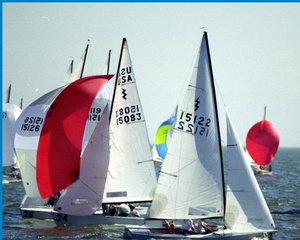
Without Compromising Either One The Lightning, a 19 foot trailerable centerboard sloop, was originally designed by Sparkman & Stephens as an affordable family day-sailor and racing boat. She has evolved into one of the most popular and competitive one-design racing classes in the world. Awarded ISAF International Class status, the Lightning is sailed in more than 13 countries and in the Pan American Games, and the class provides a professionally-managed association that is among the largest in all of one-design sailing. The Lightning’s rig is simple, but offers sophisticated sail shape controls. The hull features a unique hard chine design that combines the stability that provides sail-carrying power, with flat bottom sections that promote planing. The International Lightning Class Association protects the boat’s design and licenses custom and private builders to build boats under its administration. A list of Lightning builders is available from the ILCA upon request.
Dinghy Responsiveness, Sportboat Performance
The Best Of Both Worlds Whether racing or daysailing, the Lightning offers a combination of performance and stability that eludes most one-designs. The Lightning’s hard chine and 130 lb centerboard give her the stability and power of a small keel boat going to weather in strong winds and allow her to carry a very large spinnaker for breathtaking offwind rides. There’s room in the cockpit for two couples or a family to daysail, but the Lightning is easy to ramp launch and light enough to trailer with ease. In the event of a capsize, she can be righted and sailed dry by her crew.
Refined Design, Toda
 y’s Technology
The Best Of Both Worlds Whether you’re more interested in how a boat looks or how it behaves, it’s hard to beat the Lightning. The Class maintains an attitude that promotes conservative innovation, making the boat faster, safer and more maintenance free, while keeping prices affordable. Most Lightnings built in the last 25 years can be made competitive and it’s not uncommon to see them winning races right along with new ones. In fact the 1995 World Champion sailed a boat built in 1969! Modern Lightnings are built in foam-cored fiberglass with stainless steel centerboards and black anodized aluminum spars. The world’s top sailmakers give the class their best efforts. In short, there are enough controls to keep the most technically inclined happy, but it’s good tactics, boat-handling and hiking that win races.
The Best Competition In The World Or A Way To Get Away From It
The Best Of Both Worlds
Ted Turner, Dennis Conner, Ken Read, Dave Dellenbaugh, Dave Curtis, Bruce Goldsmith, Tom Allen, Neal Fowler, Steve Benjamin, Ched Proctor, Bill Shore, Greg Fisher, Andy Horton are just a few of the rock stars who have competed in the Lightning. After more than 60 years and more than 15,000 boats it’s easy to find a regatta when you want to. But whether you’re interested in serious racing or you just want to go for a joyride with the family, you’ll find what you’re looking for in the Lightning. Club Racer Or International Icon
The Best Of Both Worlds
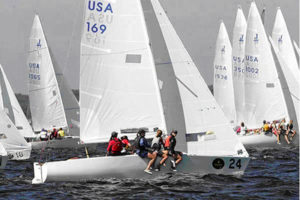
The Lightning truly excels as a racing boat. It requires a wide range of different skills, both tactical and technical. At 700 pounds all up, the boat is tough enough to avoid frequent breakdowns, but light enough to plane wildly on the reaches. A World Championship is held every two years. North American, South American and European Championships are held each year as are innumerable regional and District championships. Major regattas attract some of the finest sailors in the world, but you find class members friendly and the sailmakers’ complete tuning guides helpful at getting you up to speed in a hurry.
The International Lightning Class Association
Welcome To Our World
The ILCA is one of the oldest and best organized class associations in sailboat racing. Its primary purpose is to serve its membership, preserve the integrity of the Lightning and provide high-quality competitive events. In addition, the ILCA publishes a monthly newsletter Lightning Flashes with up-to-date regatta news, boat brokerage and ideas on how to get the most out of your Lightning. An annual Yearbook, containing many illustrated articles, reports on major championships, fleet reports and a complete association mailing list, is also published. The professional ILCA staff is always on hand to assist both current and potential members. If you’re looking for a boat you can be proud to sail, one that offers dinghy handling with the performance of a sportboat, a refined design that’s free of fads, complete with the technology of today for both racing and daysailing
Get The Best Of Both Worlds. Get into a Lightning. See you on the water. David Dellenbaugh, former Lightning World Champion and starting helmsman for 1992
America’s Cup defender America3
The Top 10 Things I Like About The Lightning:
1. There’s Lightning racing almost everywhere.
2. Some of the best sailors in the world sail the Lightning.
3. Lightnings are available from more than one high-quality builder.
4. Lightnings even 20 years old are still competitive.
5. The boat is one of the best crew trainers on the water today.
6. The class is not so strict as to discourage experimentation which makes the boat faster and easier to sail.
7. The Lightning has interested the finest sailmakers in the world so the sails and the tuning guides look great and are easy to use.
8. The Lightning is a very roomy boat for daysailing.
9. Lightning sailors sail hard, but they’re not too cutthroat – someone’s always ready to answer questions.
10. The class management is as good as you’ll find in one-design sailing. For more information about the International Lightning or to arrange a test sail in your area, call or write to the address listed below.
Design: Sparkman & Stephens, 1938
Over 15000 built
More than 500 fleets worldwide
Length: 19’0″ (5.8m)
Beam: 6’6″ (2m)
Displacement: 700 lb (318 kg)
Draft (board down): 4’11” (151.3cm)
(board up): 5″ (12.8cm)
Mast height: 26’2″ (7.9m)
Sail area (main & jib): 177 sq.ft.
(spinnaker): 300 sq.ft.
Crew (racing): 3
Class website:
http://www.lightningclass.org/index.asp
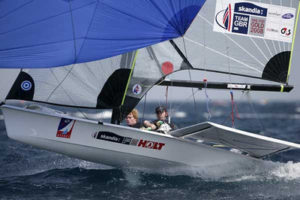 The 49er is a very fast double-handed twin trapeze skiff. Designed by Julian Bethwaite, this is an exhilarating ride, and requires a fair amount of technical skill to sail. The boat is experiencing an increase in popularity due to its selection as an Olympic class starting with the Sydney Olympics of 2000. It features a very large asymmetric spinnaker.
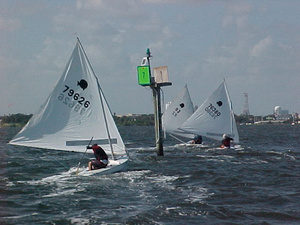 With over 500,000 boats built the Sunfish is a very popular one-design class sailboat designed in the 1950s. As a singlehanded boat, the Sunfish is easy to car-top or trailer. The Sunfish is used as a day sailer or a racing boat, with over 1000 racing events every year worldwide. Key to the Sunfish’s success are simplicity and low cost. A Sunfish can be sailed using only two lines, the halyard and the Sheet. The only other necessary control is the tiller. A Sunfish setup for racing will typically add outhaul, cunningham, a gooseneck quick-release adjuster, and vang lines.
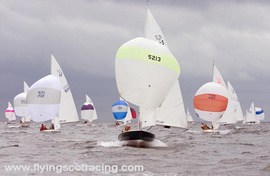 The Flying Scot is a day sailer dinghy used for pleasure sailing as well as racing throughout North America. The Flying Scot was designed in 1957 by Gordon K. (Sandy) Douglass who had already designed the Thistle and Highlander dinghies.
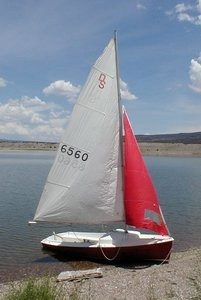 The Day Sailer is a day sailer for pleasure sailing as well as racing; it is sailed throughout North America and Brazil. The Day Sailer was designed in 1958 by Uffa Fox and George O’Day. O’Day envisioned a centerboarder that would have a beam of about 6 feet, flotation fore and aft, a small cuddy cabin, and an aluminum mast and boom. By 1958, the two agreed on the lines and the general layout for the boat that O’Day would call the Day Sailer. The sail area, especially with the spinnaker, is relatively modest, which makes for a fairly “user-friendly” boat.
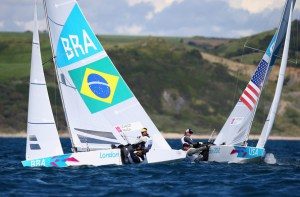 The venerable, elegant Star. This boat for years has attracted the world’s best one-design sailors. The Star is one of the most prolific keelboats in the world for a reason: it is an incredible boat to sail. Designed in 1911 by Francis Sweisguth, it has proven to be a classic in every sense. It is the oldest Olympic class, having first been used in competition in 1932, and still at the heart of that competition today. Supported by a worldwide association the Star as a class is one of the best organized in sailing, with over 7,500 yachts built over its 80 year history, and 2000-plus actively racing today.
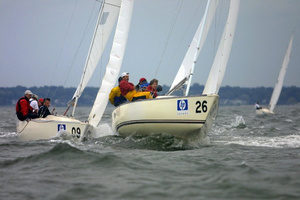 It started when Bruce Kirby’s home club (Noroton Yacht Club, Darien, CT USA) couldn’t find the right boat to get their members involved in club racing; fewer and fewer of its members were participating.
 When the Sonar was designed and orders taken for the first fleet of boats at Noroton Yacht Club, in Darien, Connecticut, the original fleet members recognized a need to create an organization with a Constitution, By-laws and Class Rules that control the growth of the class. Early membership was just a few key people, but these people had a passion for this new and very special boat and their passion spread as new fleets sprang up around North America. Early membership grew at a rapid pace as boats were built. Sonars worldwide now number over 700 with fleets in over six countries.
 The International J/22 is a popular fixed keel one design racing sailboat normally raced with a crew of three or four people (total crew weight is restricted to 275 kg/605 lb).