College sailing has become progressively more organized over the years, largely due to the increased presence of full time coaches. This past week, I sat down with one of the best – Bill Ward of St. Mary’s College of Maryland. Bill’s coaching resume includes five national championships, Team USA at the Beijing Olympics, the BUSA tour, and the Pan Am Games.
You put together yet another great fall season – tell us a bit about the team and how you achieved this success.
Our team is smaller this year and we don’t quite have the depth we’ve had the last two years. Having said that, we do have a talented, motivated group that is hungry for success. We spend most of our time in the Fall building fundamental skills that will hopefully enable us to have improving results throughout the season. We also devote a significant amount of time to preparing for the Fall nationals, with the goal of qualifying for all the nationals.
You had an outstanding spring with last year’s team, and then what I can only assume was a somewhat disappointing nationals. Were you left scratching your head, or can you pinpoint what happened?
Last year’s Nationals was disappointing for our team. We were the defending champions in Women’s and Team Racing and we had really strong results throughout the Spring season. We were in contention to repeat as champs, but had bad last days and ended up 6th at both regattas.
College Sailing is so competitive that you can’t expect to win any particular regatta. We had some injuries leading up to Nationals that really affected our preparation. We also caught a few bad breaks during the competition and that’s all it takes to knock you off the podium. I don’t think it was too much of a mystery to us as to why we didn’t perform up to our expectations.
The Co-ed Dinghy Nationals, however, went well for our team. We were in contention to win up until the very end of the regatta. In this sport, that’s a successful event. So taken all together, last year’s Nationals was still a good result for our team.
Every program has its own culture and identity. How would you describe these in regards to your program? What kind of sailors are a good fit with this program?
We try to be a program that pushes people to excel. We want to improve our sailors in all aspects of the game and not just College Sailing- specific skills. The kind of sailors that are a good fit for St. Mary’s have a passion for the game and a strong desire to improve.
What are some of the biggest adjustments you see that junior sailors need to make to be successful in the collegiate game? What habits do you tend to have to break?
High School Sailing has gotten so big, that many sailors come to College with a lot of experience in the type of racing we do. The boathandling is more refined at this level and team racing is much more advanced. The toughest bad habits to break usually are in fundamental areas like boathandling.
College sailing has evolved a lot – just in the time that you and I have been a part of it. What are the highest impact changes you observed, and where do you think we’re headed?
There are more good teams with funding and coaching. That’s the biggest difference- growth. Hopefully that will continue with more schools deciding that sailing is a worthwhile sport to invest in.
What are you able to take back from your personal sailing to coaching, and vice versa?
I take a lot back and forth from sailing to coaching. I still love to play the game and there is no substitute for experiencing the real thing when you are trying to help other people prepare for competition. As a coach, you see the big picture and that can only improve your sailing.
You’ve coached at a wide range of levels. What are the main differences and how do you adapt? Did the Beijing Olympics feel like just another day on the water?
Different sailors are working on different issues. At higher levels, usually you are trying to solve more complicated problems. We tried to make the Olympics feel like just another day, but it didn’t.
What do you enjoy most about coaching, what drives you?
I like helping people achieve their personal goals and the thrill of competition. I feel like I am always challenged and that drives me.
Thanks for your time Bill, and best of luck in the Spring.
Dan Rabin
Assistant Sailing Coach
Brown University
 The International Lightning Get The Best Of Both Worlds
 y’s Technology
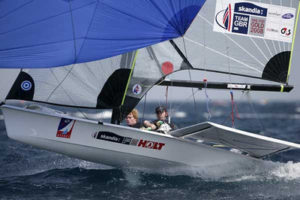 The 49er is a very fast double-handed twin trapeze skiff. Designed by Julian Bethwaite, this is an exhilarating ride, and requires a fair amount of technical skill to sail. The boat is experiencing an increase in popularity due to its selection as an Olympic class starting with the Sydney Olympics of 2000. It features a very large asymmetric spinnaker.
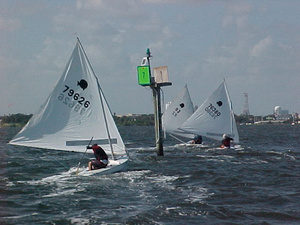 With over 500,000 boats built the Sunfish is a very popular one-design class sailboat designed in the 1950s. As a singlehanded boat, the Sunfish is easy to car-top or trailer. The Sunfish is used as a day sailer or a racing boat, with over 1000 racing events every year worldwide. Key to the Sunfish’s success are simplicity and low cost. A Sunfish can be sailed using only two lines, the halyard and the Sheet. The only other necessary control is the tiller. A Sunfish setup for racing will typically add outhaul, cunningham, a gooseneck quick-release adjuster, and vang lines.
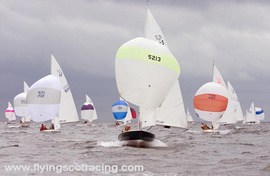 The Flying Scot is a day sailer dinghy used for pleasure sailing as well as racing throughout North America. The Flying Scot was designed in 1957 by Gordon K. (Sandy) Douglass who had already designed the Thistle and Highlander dinghies.
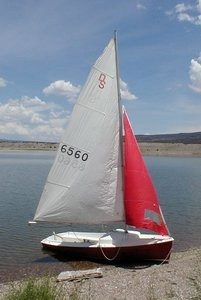 The Day Sailer is a day sailer for pleasure sailing as well as racing; it is sailed throughout North America and Brazil. The Day Sailer was designed in 1958 by Uffa Fox and George O’Day. O’Day envisioned a centerboarder that would have a beam of about 6 feet, flotation fore and aft, a small cuddy cabin, and an aluminum mast and boom. By 1958, the two agreed on the lines and the general layout for the boat that O’Day would call the Day Sailer. The sail area, especially with the spinnaker, is relatively modest, which makes for a fairly “user-friendly” boat.
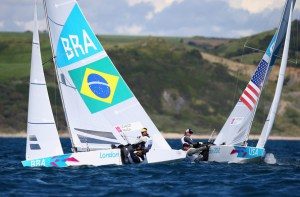 The venerable, elegant Star. This boat for years has attracted the world’s best one-design sailors. The Star is one of the most prolific keelboats in the world for a reason: it is an incredible boat to sail. Designed in 1911 by Francis Sweisguth, it has proven to be a classic in every sense. It is the oldest Olympic class, having first been used in competition in 1932, and still at the heart of that competition today. Supported by a worldwide association the Star as a class is one of the best organized in sailing, with over 7,500 yachts built over its 80 year history, and 2000-plus actively racing today.