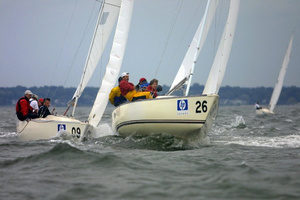
 It started when Bruce Kirby’s home club (Noroton Yacht Club, Darien, CT USA) couldn’t find the right boat to get their members involved in club racing; fewer and fewer of its members were participating.
They studied a great many existing classes of boats but all were considered too expensive, too slow, too demanding to sail, or just plain uncomfortable. So Bruce was asked to design a new boat specifically to meet the requirements of a club racing one-design keelboat fleet.
It had to be exciting to race, but easy to handle by sailors of all ages, strengths and skill levels. It had to be a really good day sailor, spacious and comfortable to sit in all day long. It had to be trailerable, plus easy to launch for wet or dry sailing. Plus a safe, well behaved training boat to help teach new sailors how to sail and have fun doing it. Finally, it had to have a good but uncomplicated set of class rules.
The prototype Sonar sailing off Noroton, March, 1980.
The result was the Sonar. The Noroton Yacht Club got every thing they wanted and more. And the Sonar has been greeted with enthusiasm by individuals and clubs all over the world.
 When the Sonar was designed and orders taken for the first fleet of boats at Noroton Yacht Club, in Darien, Connecticut, the original fleet members recognized a need to create an organization with a Constitution, By-laws and Class Rules that control the growth of the class. Early membership was just a few key people, but these people had a passion for this new and very special boat and their passion spread as new fleets sprang up around North America. Early membership grew at a rapid pace as boats were built. Sonars worldwide now number over 700 with fleets in over six countries.
loa 23’
beam 7’1”
sail area 250 ft²
spinnaker area 245 ft²
hull weight 2100 lbs.
crew 3-4
# of boats built not known
active US fleets MD, FL, CA, MA, CT, RI, VA, NY
Class website:
http://www.sonar.org/
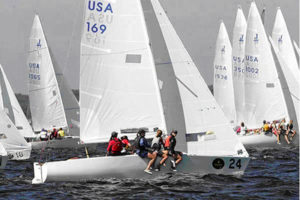 The International J/22 is a popular fixed keel one design racing sailboat normally raced with a crew of three or four people (total crew weight is restricted to 275 kg/605 lb).
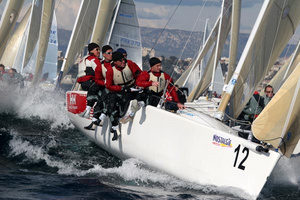 The Melges 24 hitting the scene in 1993, is a one-design class of sailboat commonly used for racing. With a very large asymmetrical spinnaker and retractable bowsprit, he boat is notable for its ability to plane over the water downwind in modest winds, and for its combination of a simple design that is highly tune-able. This is a fairly technical boat and has a very competitive class.
 loa 34.5’
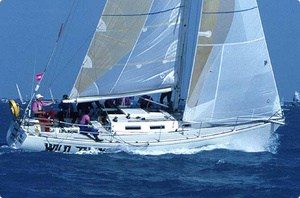 It is probably safe to say that no racer-cruiser in the annals of fiberglass sailboat production elevated the self-esteem of sailors as dramatically as the J/35. When it was introduced in the spring of 1983, it was the closest thing ever seen to instant gratification in an offshore handicap racer and one-design. If it is an exaggeration to say that new owners stepped aboard, raised the sails and began winning races, it is a small one.
 The boat’s greatest impact, however, has been in handicap racing. How ironic that this boat designed with a conscientious disregard for any handicap rule is one of the most successful handicap racing boats ever. It has taken honors in major offshore races around the world, including even the singlehanded transatlantic race. It is the most popular racer-cruiser rated by the IMS. In spite of a challenging PHRF rating more common to 40-footers, the J/35 remains a perennial winner in club racing.
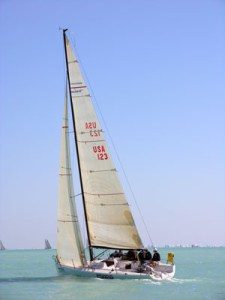 The Melges 32™ is a superior racer with a big, high performance attitude. It is the culmination of the finest in progressive sailboat engineering and design by Reichel/Pugh, the craft and professional talent of Paul Amon at SOCA Sailboats in Trinidad and Melges Performance Sailboats’ incomparable experience and acumen. The Melges 32 takes one design racing to the next level.
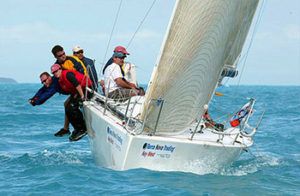 “Our goal in developing the Farr 30 (formerly the Mumm 30) was to create a state-of-the-art offshore one-design that would be fast and exciting, yet uncomplicated and economical. We set about the design of the Farr 30 with a ‘clean sheet of paper’ in that there are no rating rule driven compromises in performance.