Welcome to the S1D College Consultants team. Here it is! Sit back, learn, and enjoy a video that was taken LIVE at our College Sailing 101 Conferences!
ICSA News: Conference Championships!
News Flash: S1D will present a Webcast of our College Sailing 101 Seminar at 5pm on Saturday 03 November! SIGN UP HERE and we will send you the link!! Learn more about S1D College Sailing Consultants!!
By Chris Klevan– There are moments, small and large, that cumulatively define a college sailor’s experience. It is hard to predict when these moments will materialize as something more than a single race or regatta. But if one had to guess, regattas like the War, Schell and Urn tend to hold their own place in the minds of college sailors past and present.
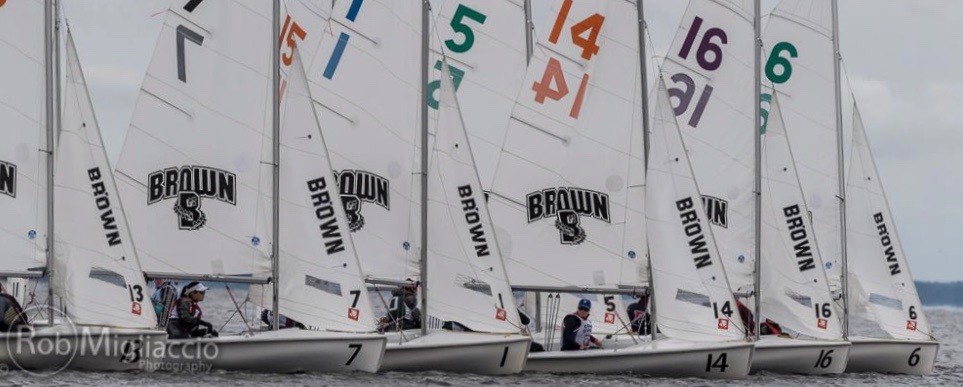
#1 Brown University won the Victorian Coffee Urn Trophy hosted by Bowdoin University. The Brown Bears edged #8 Boston College in the protest room after all other teams had left thinking Boston College won in a tie breaker. The Urn was an event that featured 11 of the top 20 ranked women’s team in the nation.
In the final race of the regatta, Boston College’s A-Division boat, Sophia Reineke ‘21 and Tara Ferraris ‘19 were attempting to protect a 3 points lead against Brown. Brown’s A-Division boat, Hannah Steadman ‘20 with Maxine De Havenon ‘19, Annabelle Hutchinson ‘21 and Emily Ito ‘19 had been sailing extremely well, stringing together all top-3s from race 2 to race 10. However, the tandem had stumbled a bit in the latter stages of the event opening the door for BC to hold a slim lead going into the last set.
BC’s Reineke and Ferraris knew to beat Brown they had to put up a good score. Unfortunately, however, Reineke and Ferraris had to tack in the zone at the top mark to stay in position to hold off Steadman and Brown. They fouled with many witnesses present. After the DSQ in race 14A, BC found themselves 15 boats back from the regatta win.
Though the regatta ended in a protest, Brown’s win came largely due to a 12 point victory in B-Division by Sophie Hibben ‘19, Emma Montgomery ‘22 and Megha Malpani ‘19.
“Our B-division of Sophie Hibben ’19 and crews Emma Montgomery ’22 and Megs Malpani ’19 have been steadily improving all fall and they really executed well at the Urn,” said Brown Coach John Mollicone, “Their starts were conservative but really good for most of the event and their speed and decision making was at the top of the fleet.” Mr. Mollicone continued to say:
“Winning both divisions was a plus, Hannah Steadman ’20 has won her division three weekends in a row (Showcase at Brown and Yale Women’s as well) so she has been really locked in as of late. Great starts and execution as well. She has a great group of crews that she sails with: Maxine de Havenon ’19, Emily Ito ’19, and Annabelle Hutchinson ’21.”
“Right now we have a lot of women’s depth, our other strong women’s boat sailed B-division at the Schell. We are happy about how we have been doing but still lots of room for improvement, particularly in lighter breeze like we saw at Nationals last spring.”
“The entire group really dealt well with the cold, wet, and at times miserable conditions at the Urn. It was total group effort and they were mentally prepared for it and kept a positive attitude at all times.”
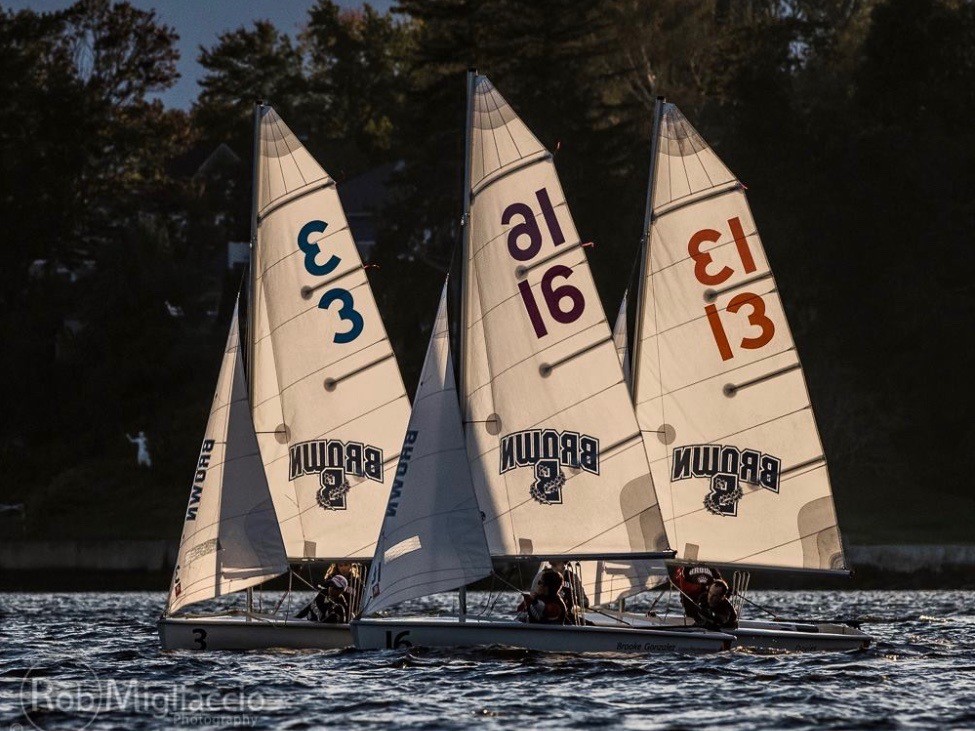 Brown seems to be the top women’s team in the nation as their typical A-Division starter, Ragna Agerup ‘20 and Abigayle Konys ‘19 sailed B-Division for Brown at the NEISA Coed Championship.
#2 Yale finished 3rd with 149 points.
#3 Hobart and William Smith won the War Memorial at Navy. HWS finished the full, 36 race regatta with 170 points, 11 better than #2 Georgetown. “The course was the right length at full 20 minute plus races and the top boats had time to sail to the front of the pack,” said HWS coach Scott Ikle. “It was shifty but not crazy shifty and the top 3 teams had a boat speed edge and did a better job playing the shifts.”
“The conditions were great, beautiful wind, everyone got to sail,” continued Ikle. “It was a great event and Navy did a great job running it. One race could have shuffled the top 3 teams.”
Both HWS boats, Hector Guzman ‘20 with Chase Carraway ‘22 and Maya Weber ‘20 in A-Division and Charles Miller ‘19 with Lindsey Kloc ‘19 and Kyle Easton ‘20 in B finished second, including a 1,2,1 finish by Guzman and Weber to close out the regatta. Miller, Kloc and Easton finished with only 2 races outside the top-8 and Guzman, Carraway and Weber had 3. The B division boat had 9 finishes inside the top 3 while the A division boat scored 7.
The recent emergence of Charles Miller has been a game changer for the HWS team. The third skipper from last year’s team stepped into the starting role as Marlow College Sailor of the year finalist, Greiner Hobbs graduated. Miller, sailing primarily with Lindsey Kloc, has been one of the best in B-Division all year, displayed by a second place finish at the Showcase Finals last weekend. Ms. Kloc is one of the best crews in the nation this year and in their performance this is a team poised to challenge Yale in the spring. Miller and Kloc deserve a lot of credit for how HWS has finished the fall season and will be a major factor as they make a run at the National Championship in the Spring.
#2 Georgetown finished second with 181 points behind a B-Division win by Andy Reiter ‘19 sailing with Calire Mohun ‘19, Caroline Teare ‘21 and Haley Shea ‘19. Reiter, Mohun, Teare and Shea finished the regatta with 10 straight races inside the top-4. It was the effort of the B-Division boat that prevented HWS from pulling away.
#10 Navy finished 3rd with 198 points. Like Georgetown, it was the sailing of freshman Joseph Hermus with Kent Mathes ‘20 and Ana Mier ‘19 that kept the midshipmen in the hunt. Hermus, Mathes and Mier finished the regatta with 10 top-5s in the final 12 races sailed in B-Division.
“I was very impressed with Navy,” said Ikle. “I’m always impressed with Georgetown.”
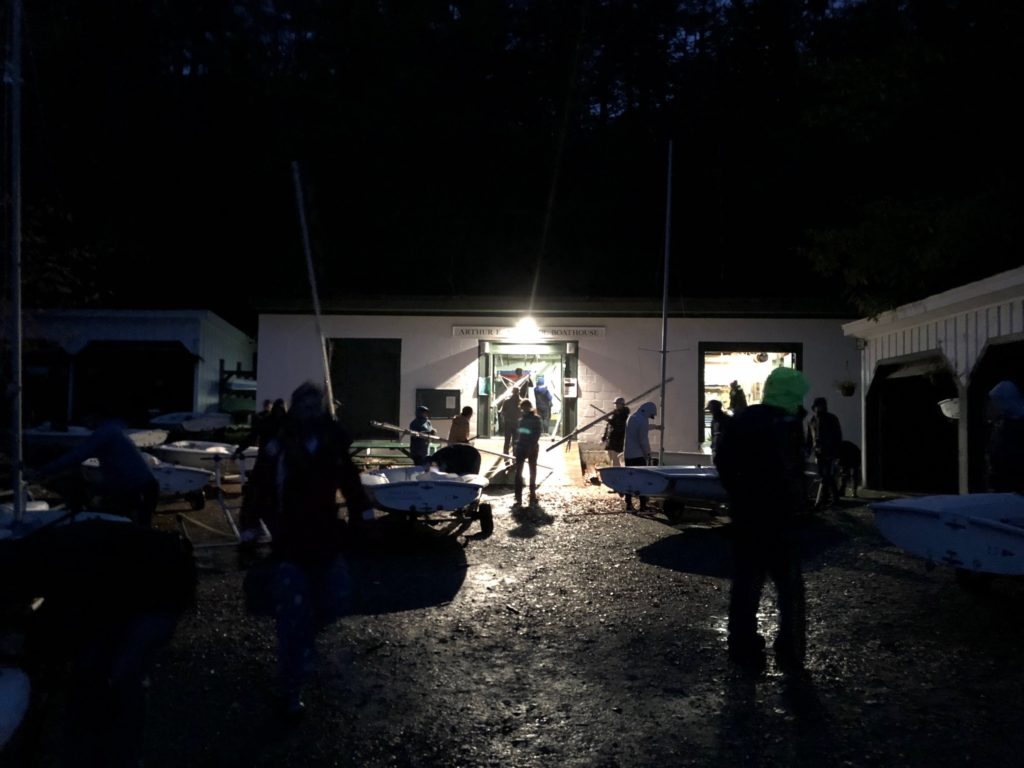
The #1 Yale Bulldogs won the 78th Professor Schell Trophy held at Dartmouth College in a wintry mix. Patchy 0 to 10 knot breezes from various directions dictated the New England Championship as Lake Mascoma rewarded only sailors with refined boat handling and focus. Variable conditions coupled with extreme cold caused racing to develop slowly as races 8A and B were finished in absolute darkness with judge boats with running lights marked the finish line.
After Saturday’s racing it was #6 Harvard that held the lead as Henry Burnes ‘21 and Catherine Tang ‘19 had the day’s low score, finishing with three bullets in the 8 races sailed with and 6 of the 8 races were finished inside the top-3. “They couldn’t make a bad call.” said Harvard coach Bern Noack.
Despite the impressive sailing by Harvard, both Yale and #13 Dartmouth were within striking distance after Saturday at 12 and 6 point back respectively. Dartmouth hung around the entire event as Chris Williford ‘19 and Rebecca McElvain finished with only two races outside the top-7 en route to a second place finish in A-Division. Such consistency was especially impressive due to the instability of the conditions.
The conditions seemed to be getting the best of Nicholas Baird ‘19 and Sonia Lingos-Utley ‘21 as they scored three double digit finishes in the first 6 races sailed, a score-line uncharacteristic for Baird, a serious candidate for this year’s Marlow Coed College Sailor of the year, and Lingos-Utley, one of the best young crews in the game today. However, Baird and Lingos-Utley clearly figured it out after 6A, streaking 7 straight top-3 finishes, helping to spark Yale’s comeback.
 “Graceann went in with Nic B for races 7&8A to end the day on a high note in the Z420’s,” said Yale Coach Bill Healy. “On Sunday with Sonia it was just focusing on the course; wind angle, wind location, fleet behavior, things like that. They had a good understanding of how to get off the line without being immediately at risk of missing the angle and puff that would take a group out of reach of the other group. That’s what hurt them on Saturday.”
If it was Baird and Lingos-Utley catching fire that spurred Yale’s come-from-behind victory, it was the efforts of Nick Hernandez ‘19 and Catherine Webb ‘22 in B-Division that kept Yale in position to win. Hernandez and Webb won B-Division with 70 points in 14 races and nothing outside the top-11. While they only won one race, they managed to finish inside the top 5 in ten of the 14 races sailed, clearly posting the most consistent scoreline at the event.
“Nick H and Catherine were just Steady Eddies’s,” said Healy. “Nothing flashy. They took very little risk and didn’t try and earn something that wasn’t there. Good starts and a VERY GOOD understanding of how to work the shifts and velocity changes on the beats. They were fantastic. That was their strong suit.”
Hernandez is having a sneaky good season in winning his division at the NEISA Conference Champs and the Showcase Finals along with 3 other top-4 finishes in A-Division at interconference events this fall.
Mr. Healy continued, “It was cold and wet and making sure we had the right gear on helped. It was hard for crews to stay warm and I think our crews did a little better than most in that respect. This helped them stay engaged on all races mentally and physically. Dartmouth is a tough place to be consistent against such strong competition. Instead of getting down after a tough race, it was ‘What did we learn from that last race to help in the future’?”
Connor Harding ‘19 and Jen Agell ‘19 of #9 Roger Williams University won A-Division in impressive fashion. Harding and Agell went on a run early in the regatta where they posted firsts in 4 of 5 straight races. Both sailors embody the spirit of college sailing as they’ve proven throughout this fall season that with hard work and a commitment to the sport you can beat anyone regardless of junior sailing resume.
Dartmouth finished second with 165 points, 18 points behind Yale. Harvard finished third with 180.
News Flash: S1D will present a Webcast of our College Sailing 101 Seminar at 5pm on Saturday 03 November! SIGN UP HERE and we will send you the link!! Learn more about S1D College Sailing Consultants!!
College of Charleston won both the SAISA Women’s and the SAISA Coed Championship last weekend. The perennial team to beat in SAISA maintained their impressive record against their conference. The Women’s event took place on Saturday alone and the Coed regatta was started Saturday and sailed primarily on Sunday.
Alie Toppa ‘20 and Annabel Carrington ‘19 won A-Division at the Women’s event handily, winning 6 of the 10 races sailed. The other 4 races were finished with seconds.. Toppa and Carrington have been one of the best women’s boats throughout the fall season. Liza Toppa ‘20 with Caroline Bracken ‘19 won B-Division capping another dominant in-conference regatta for Charleston.
#11 Charleston finished with 39 points in 20 races. Jacksonville finished second with 57 and USF finished 3rd with 62.
#10 Charleston won the SAISA Fall Coed Champs, also winning both divisions. Jack Brown ‘21 and Caroline Bracken won A-Division and Alie Toppa ‘20 and Annabel Carrington ‘19 won B. Brown and Bracken finishing inside the top-2 in 7 of the 9 races sailed and toppa and Carringot sailed with all top-4 finishes.
Eckerd finished second with 80, 36 points behind Charleston’s 44 and USF finished 3rd with 80 as well.
UC Santa Barbara won the PCCSC Fall Women’s Champs with 143 points after 17 races in each division. The Gauchos finished first and second in the combined division event behind the low score by Kerri Luttrell ‘21 and Olivia Beers ‘21, finishing with 65 points. Finishing second was Madeline Kraud ‘20 and Mary Toomey ‘21.
University of Southern California finished second with 211 and University of California at Los Angeles finished 3rd with 263.
While last weekend capped off competition in dinghy sailing. The Men’s and Women’s singlehanded national championship is set to take place next weekend and the ICSA Match Racing Championship will be sailed in two weekends.
Yale’s Nick Baird ‘19 will sail the Men’s Singlehanded championship despite finishing 5th, one spot outside of qualification at the NEISA Men’s Singlehanded Championship. The change occured because Boston University’s Javier De Urdanibia Panos ‘21 is in the hospital. We wish Javier a speedy recovery.
All information on the Intercollegiate Sailing Association can be found at collegesailing.org. All scores can be found at scores.collegesailing.org. Thank you for your support!
ICSA News: Coed Showcase Finals; MAISA Women’s; PCCSC Match Racing
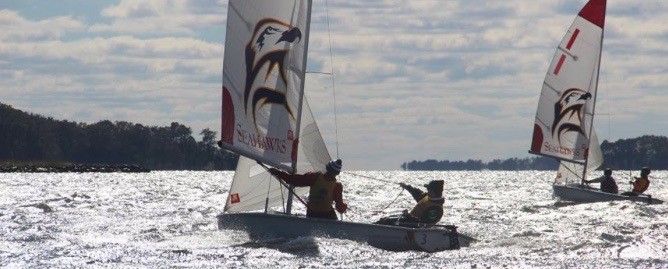
By Chris Klevan The Fiske-Harriman-Sleigh Trophy or the Coed Showcase Finals was a tale of two days. The two extremes that bookend sailing in general, light and breezy. Saturday’s light air rewarded the feather-weight quick and mentally resolute sailors while Sunday pushed the nation’s best to test their mettle against the elements in 18-28 knot winds.
The Coed Showcase Finals is a new rendition of the classic Atlantic Coast Championship. It even carries the namesake of the ACC’s trophy, the Fiske, Harrington, Sleigh. Like the ACCs, the Showcase Finals displayed the best in the nation. However, unlike the ACCs, where each conference on the East Coast gets a set number of berths, the teams at the Showcase Finals are derived from a semi-final format or two 18 team regattas advancing the top-9 from each to the finals, allowing Stanford to get in the mix.
#1 Yale came out on top in an event that was tighter than the results show. Throughout the regatta the Bulldogs fended off a handful of challengers. Defending champion, #7 MIT, #5 Stanford and #11 College of Charleston were all winning the event at some point. While other teams rose and fell, Yale was always in the hunt. Charleston had the lead from race 4A to 7A while MIT wrestled with it early in the find and hung around to grab it as late as race 12B. Even Stanford, who finished in 12th place had the lead towards the end of the day on Saturday. However, ultimately, the Championship belonged to Yale.
Yale’s sophomore, Shawn Harvey split time on the tiller with Nick Hernandez ‘19. When Harvey was driving, Graceann Nicolosi ‘19 crewed from him. This duo is not young anymore as they appear to represent the team to beat in B-Division this year, giving the top-ranked Yale an edge on the rest of the nation.
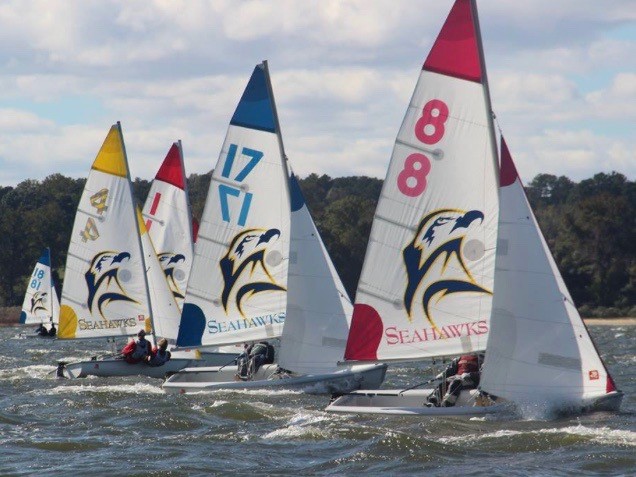
Hernandez took the helm after race 12, as Harvey and Nicolosi were faltering in the big breeze. Harvey and Nicolosi finished the day on Saturday with 13 points in the final 5 races, four firsts and a ninth. However, they started the day on Sunday with two 13s and assistant coach, Martim Anderson didn’t hesitate to make a move. He flipped Harvey to the front of the boat and put in Senior, Nicolas Hernandez in the driver’s seat. Hernandez and Harvey finished in the top-6 in 5 of the final 6 races to close the event for the Bulldogs. Harvey, Hernandez and Nicolosi won B-Division in what was truly a team effort.
“It showed that we have experience in the boats dealing with all conditions. In the lighter stuff we stayed more disciplined than other teams, and in the breeze our veteran pairs were great at controlling the boats in difficult conditions,” said coach Anderson
“The regatta felt more competitive than ACCs of the past,” said Yale senior Nick Hernandez. “Everyone was just as aggressive and competitive as they would be at any other championship.” Hernandez continued so say the following about the win for the Bulldogs:
“Everyone we brought to the event sailed. Having Shawn Harvey crew was great because having two skippers in the same boat let us play to each of our relative strengths and figure out the tricky conditions before other boats. Although our boathandling was not great, he’s a beast crew and our speed/control around the course was unmatched. Our strength coach, TJ Belanger, has been working us hard in the weight room so that certainly helped too.
It’s awesome to have an event where we can show our ability to be competitive in all wind strengths, and that it takes a full team to do so. On my highschool team, we only had four sailors, so when we were out of our breeze ranges for the respective pairs we just had to make do. Getting everyone involved and getting to play to all our relative strengths is what makes college sailing so much more of a team sport.
To come out on top after this event was awesome for the team. It’s a great metric of our progress this season, and that we can be consistently competitive in a wide range of conditions at the national level. Our current team is in a ideal spot. Our practices are as competitive as they have ever been, and having Martim as our third coach is steepening everyone’s learning curve. For fleet racing, we all have things we can improve on, but it is good to know where we stand in our current shape.”
#8 Bowdoin finished second with 275 points, 29 points behind Yale’s 246. Matt Kaplan ‘19 with Louisa Lindgren ‘19 and Matt Safford ‘20 finished second in A-Division to lead the Polar Bears’ efforts.
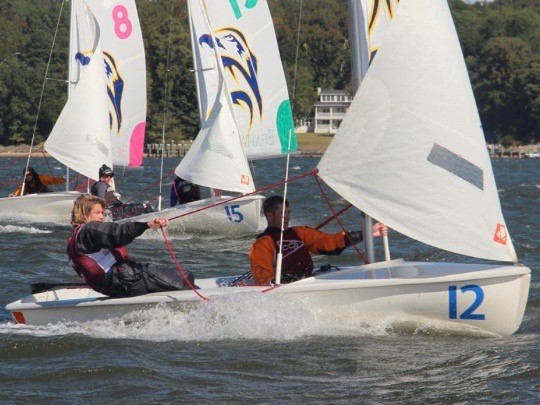
Augie Dale ‘19 with Katherine Lounsbury ‘20 and Carter Cameron ‘19 and Oliver Parsons ‘21 won A-Division pushing Dale’s name into the conversation for Men’s Marlow Ropes Sailor of the Year. Dale, sailing primarily with Lounsbury was one of the top B-Division sailors last year but has yet to make his mark on this fall season as the Cougar’s A-Division boat. Lounsbury and Dale are one of the fastest boats in the nation and they proved it last weekend on the biggest stage.
#2 Georgetown finished 3rd overall with 286 points due to a late charge in the big breeze. Led by Will Logue ‘20 sailing with Andy Reiter ‘19 on Sunday, Georgetown crawled back from 7th overall. Logue had been sailing with Sophomore, Caroline Teare but as sailors were met with winds Sunday morning above 20 knots, Reiter stepped into the front of the boat. The tandem totalled 40 points in 8 races sailed on Sunday, recording the low point score for the day including 7 races within the top-6.
#3 Hobart and William Smith Colleges finished 4th with 288 points and #7 MIT finished 5th with 290.
#6 Cornell University won the MAISA Women’s Championship sailed on the home waters of Lake Cayuga. After a light and variable Saturday where only 7 races were completed, Sunday delivered 15-25 knot, full on conditions. The majority of the regatta’s scores came in the big breeze and the Big Red of Cornell proved at they know how to handle themselves in wind, winning the day on Sunday and the regatta despite an OCS scored.
Cornell had top-3 finishes in 11 of the 20 races sailed and only scored outside the top-5 in five of the races sailed.
“It’s the first conference championship for our program and a great benchmark for us but we still have to stay focused on improving,” said Cornell Head Coach Brian Clancy.
Daisy Holthus ‘21 and Kimberly Wong ‘19 started the event and sailed extremely well in the light air scoring a 1,2,1 in the three races sailed. In the breeze on Sunday Brooke Shachoy ‘22 and Becca Jordan ‘21 stepped in even though their teammates were winning the division showing the strength and depth of the Big Red team. Shachoy and Jordan maintained the B-Division lead, an impressive feat due to an OCS scored. Their effort, coupled with a 3rd place finish by Gabby Rizika ‘20, Diana Otis ‘19 and Miranda Sannino ‘20 in A-Division was enough to squeak out a 2 point win over neighboring #4 William Smith.
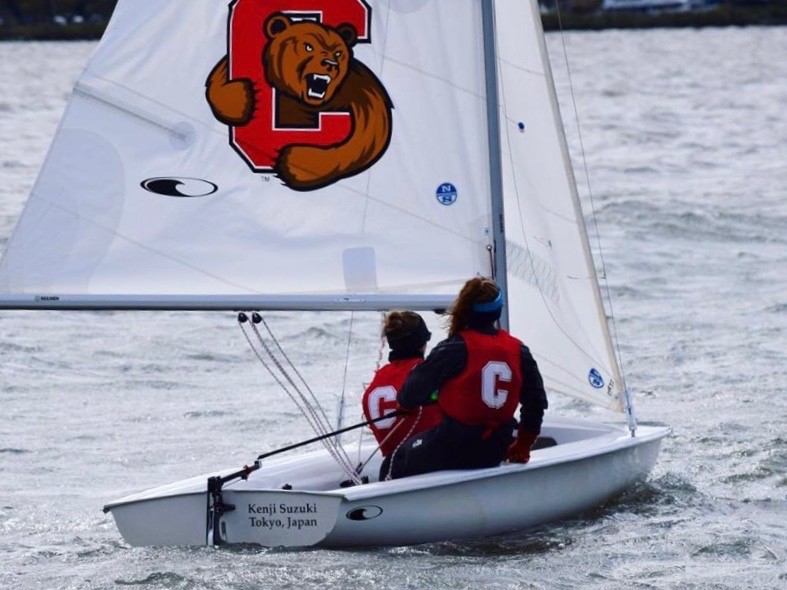
#13 George Washington finished 3rd with 90 points, one point behind William Smith and 3 points behind Cornell. Riley Legault ‘19 of GW won A-Division sailing with Alexandra Fayer ‘19, Emma Mendenhall ‘19 and Sarah Noyes ‘20 by 3 points over Quantum Women’s College Sailor of the Year hopeful, Bailey Carter ‘19. Ms. Carter, who has yet to finish outside the top-3 at a women’s event yet this year, sailed with Sarah Smith ‘22 in the light stuff and Bridget Lawless ‘21 in the big breeze.
The 2018 PCCSC Match Race Championship was a one day regatta sailed out of Stanford University. The Match Race Championship for the Pacific Coast Conference advanced one team to the National Championship held at Balboa Yacht Club, November 16-18. The format for the PCCSC Championship would be a 6 team round robin followed by a best of 3 knockout series. After the round robin, the California Maritime Academy Keelhaulers were 5-0, drawing the 1 seed.
Stanford advanced to the finals as the two seed set to battle the Keelhaulers for a spot at the national championship. The finals went to race 3 and after trailing due to a slow penalty kill, the Cardinal passed Cal Maritime on the second upwind to take the series and compete for the national championship.
Future information on the Intercollegiate Sailing Association can be found at collegesailing.org. All scores can be found at scores.collegesailing.org. Thank you for your support!
How Great Dinghy Crews Drive the Bus: Working Together to Win
By Airwaves high school reporter/writer Abby Tindall
Working together with another person in high-stress situations is not easy, and when it comes to sailing, many skippers take the brunt of the pressure. A good crew can be a great foil, and needs to know how to handle the different reactions and attitudes their skippers display. There’s often the silently-brewing skipper, the temperamental skipper, the whiny skipper, etc. As a crew, dealing with your own stress AND the skipper’s stress (which is often taken out on the crews) is vital to success of both partners and the boat as a whole.
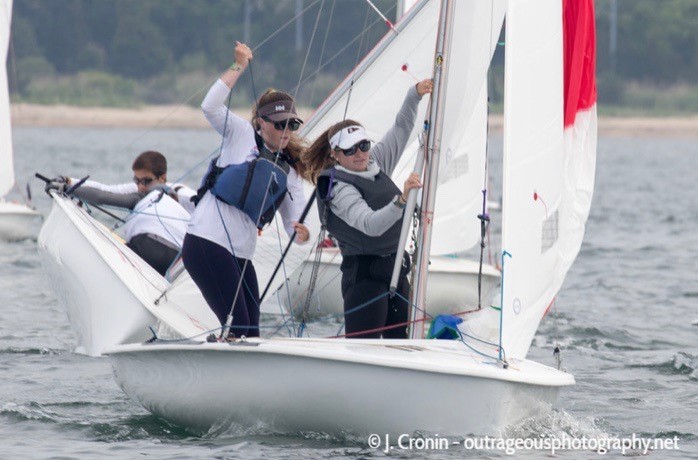
I’ve been sailing in 420’s for 5 years now working together with many different skippers. I’ve sailed on the National Club 420 Racing Circuit for two years and 4 years on a top Varsity High School sailing team. After some time of awkwardly adjusting to different people and situations, I came up with a consistent strategy that has proved successful in my experiences.
Here’s what I do. When I get into a boat with a new skipper I try to get to know them as a person. Knowing who they are hints at what they care about, but also builds a foundation for your relationship. It is important to understand your teammate and especially when you get into tricky interactions, reminding yourself that they are human just like you helps. Talking amongst each other and explicating your role in the team is also a good start. Even if its a skipper you have sailed with before, make sure you clarify the jobs: who will call tactics, pressure, boats, etc. (hint- its probably a combination of both of you).
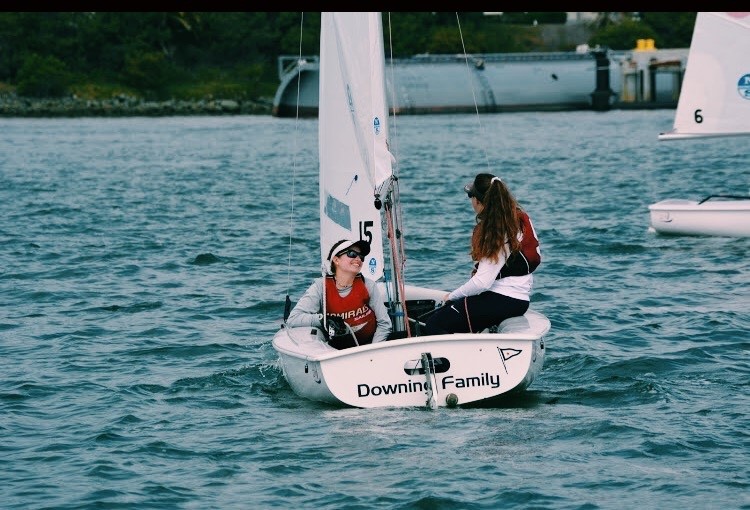
While formalities are nice, the real connection between you and a skipper comes on the water in close situations. It is then that the ideal of a dream skipper often comes crashing down.
It is not uncommon for human beings to blame others when the chips are down. In my experience, many skippers become micro-managers when they feel pressure because they want everything to be perfect when in a tacking-duel or trying to make a mark. Instead of focusing on the task, they habitually focus on the crew. Some skippers will unintentionally boss you around: “up on the rail… jib in more…windward sheet… leeward more… windward!” When in this situation, depending on the severity, it is best to simply wait till the end of the race. If you don’t mind this tendency, you may let it go. For me, it would get to a point where I couldn’t do my own job because I was so intent on doing everything my skipper asked- which wasn’t always the correct command. In this scenario, after the race I would say “I think in the future, when we get to the stressful point, I can help you more if I focus on my own task- which would be easier if you do the same. I’ve noticed that when you get pressured sometimes you tend to pay a lot more attention to me and my job, but that stresses me out. If there’s something you want me to focus on specifically in the race its better to let me know now instead of later.” Approaching a problem in a calm manner using “I” and telling them how you feel increases their openness to what you are saying. In reality, that discussion is very hard to phrase, and is even more uncomfortable to initiate. But when something isn’t working, the crew needs to speak up. Starting that conversation about how to improve communication and relations is a giant step to success.
Micro-managing skippers can be bad…. but maybe not the worst type. Temperamental and angry skippers can be overwhelming and detrimental to overall performance. For teammates that get angry easily, never use the phrasing “calm down.” Its very tempting to quickly state, but too often it has the opposite effect of the intention. Your teammate often simply gets angrier, because (to them) it comes across as though you are blaming them. A better way: instead, its just as easy to say “its okay, lets just focus on _______.” Obviously, this wont solve the problem within the race, but it can allow them to step out of the angry mindset and instead center their energy on an obtainable task such as going fast or thinking ahead.
Another kind of skipper that can be difficult to sail with is the one that constantly whines and complains. They vent their frustrations through you by saying “aww……. why did we tack there” or “how did we get so far back” or “we’re not even going fast.” This defeatist, negative language can affect your own attitude as well and influences your drive to continue. Instead of giving up, its better to reassure your skipper: they need to know that there’s still a way to come back. You can respond to a whiny skipper by saying: “HEY, we can come back from this. There’s pressure coming down on the left. Let’s get to that and then lead across.” This pulls their attention away from their demoralizing attitude to focus on the task at hand. The initial “HEY” asserts your authority in the situation, proving that you are the headstrong one that the moment. Then, add a bit of reassurance and give them hope to continue. Finally, even if its the worst idea you’ve ever come up with, give them a brief plan for HOW to fix the problem. You may be wrong, but it lets them look ahead on what they need to do.
All this being said, these solutions don’t work at all times. This is the way I approach various situations and the ways in which I have become adaptable to changing helmsman. I certainly think they can help you immensely especially if you are relatively new to the sport or simply a quiet crew. There are times when I have met a lot of opposition even with this technique. For instance, I mentioned to a skipper that we should focus on going fast instead of our poor placement in the race, and they responded with anger saying “Well I can’t focus on going fast when we’re literally in dead last!” That was a kind of response that I was unequipped to handle in the race. I chose to not respond to that comment because at the time I figured I would only trigger his/her frustration more. Another option if you’re the type that likes to speak up is to say “I understand we’re not doing well but I think there are ways to catch up and we can pursue those options.” I applaud you if you can manage to get that out in a race because while that phrasing is respectful, if your skippers hears a scent of your own anger and frustration, they will assume you’re mad at them and react poorly. Remember, as a crew YOU are the therapist. You have to respond calm, cool, and collected to avoid worsening the skipper’s stress.
Now, here’s a note to skippers. I understand the amount of pressure that is placed on you. I, as a crew, was asked to substitute skipper because we had a shortage at practice. The amount of stress I took on from that basic switching of roles within the boat was immense. After every race I had to shrug my shoulders to relive the built-up pressure. While, this may have been because I was not used to skippering, I believe it was because of the position. As the helmsman, YOU make the decisions. The crew helps as much as they can feeding information, rolling perfectly, keeping the boat flat and fast, maintaining flow, etc. but ultimately cannot steer. They don’t have to take all the blame if you run into another boat. While the fault may have been theirs for not luffing the jib fast enough, YOU as the skipper has to take the responsibility. That being said, the anxiety that coincides with skippering does not give you a free ticket to be a terrible person. Your crew wants to do well just as much as you and is on your team so treat them with respect. Don’t yell at them when they make a mistake, or blame them when you do. Use them as a resource, work together with them, so that you both can learn and improve to make the best team you can be.
It is vital for crews and skippers to work together harmoniously in order to produce the best outcomes. This is best realized in a relationship that fosters growth and communication. A skipper needs to be wary of their actions, especially towards their partner, and a crew needs to be able to respond well and aid the skipper in any way. A dynamic of trust, gratitude, and compatibility, coupled with a shared desire of success makes for the best teams.
ABOUT THE AUTHOR
Abby Tindall, Airwaves Intern Writer
 Abby’s passion for sailing was fostered during her summers at Edgartown Yacht Club on Martha’s Vineyard. Inspiring her to become more involved in the sport, Abby now participates in the C420 youth sailing circuit and crews for her high school Severn School, in the Annapolis area. Abby is a rising senior and looking forward to sailing in college. You can reach Abby at [email protected]
ICSA Update: Women’s Showcase Finals; NEISA Match Race Champs; MCSA Lasers
October 15, 2018 Written by Chris Klevan
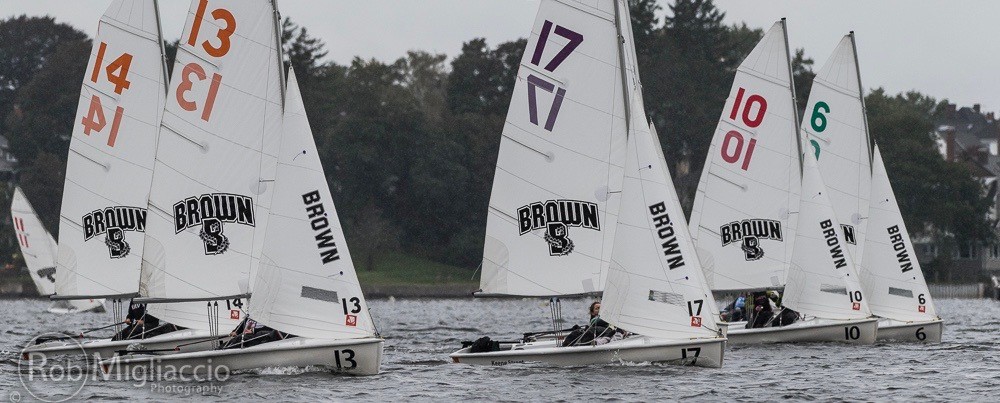
The Brown Bears won the first annual College Sailing Women’s Showcase Final held at Brown. The home team sailed from behind to pass Yale University in the waning stages of the regatta. Yale built an early lead due to a hot start by Christine Klingler ‘20 with Kira Woods ‘19 and Catherine Mollerus ‘21. Klingler and company had no double digit finishes through the first 10 races sailed in B-Division, posting only 3 races outside the top-5. In a regatta designed to be 18 teams deep, such a streak cannot be overstated and Yale found themselves up by 20 points on Brown with only 8 races remaining.
However, Klingler cooled off and Hannah Steadman ‘20 sailing with Maxine De Havernon ‘19 and Emily Ito ‘19 of Brown found her stride, finishing inside the top-5 in the final 7 races of the event, erasing Yale’s lead. Steadman, Havernon and Ito combined to score 9 points in the division’s final 3 races while Klingler, Woods and Mollerus totalled 30 points over the same span. The Bears’ B-Division group won the division by 7 points over Yale..
Louisa Nordstrom ‘20 of Yale, sailing with Graceann Nicolosi ‘20 won A-Division, edging Brown’s Ragna Agerup ‘20 with Magha Malpani ‘19 and Abigayle Konys ‘19 by 5 points. Nordstrom and Nicolosi finished inside the top-5 throughout the last 5 races but Agerup, Malpani and Konys did the same over the final 4 races sailed, allowing Steadman, Havernon and Ito’s late performance to sneak out a victory for the Bears, 158 points to Yale’s 160.
“Really proud of our entire women’s group,” said Brown’s Head Coach John Mollicone. “We rotated 4 senior crews in and out with Ragna and Hannah and really tried to just stay as consistent as possible with our results. The conditions were very challenging with primarily a west breeze and some big shifts and velocity changes – we do not see that direction in practice very often and if we do it tends to be easier to figure out than it was this weekend! Not many beats were the same – some had very broad shifts that could last the entire leg, some were just simple stay in phase and there were 5 or more shifts. We didn’t fully have it figured out so we really focused on conservative, good starts and avoiding the corners and low percentage decisions. Staying in the race was key as things could get really spread out at times and you could be way in the back”
“Yale sailed extremely well and after a few races on Sunday it became a two team battle for first overall, continued Mollicone. “We didn’t really worry about them that much, just stuck to the plan to sailing well and hoped they would make some mistakes. Luckily for us, their mistake came in the last race of the regatta and our B-division finished with a second. Things fell into place but we were very lucky. If we had more races it easily could have gone the other way. Everyone was really vulnerable out there in the crazy conditions we had.”
MIT finished 3rd with 204 points.
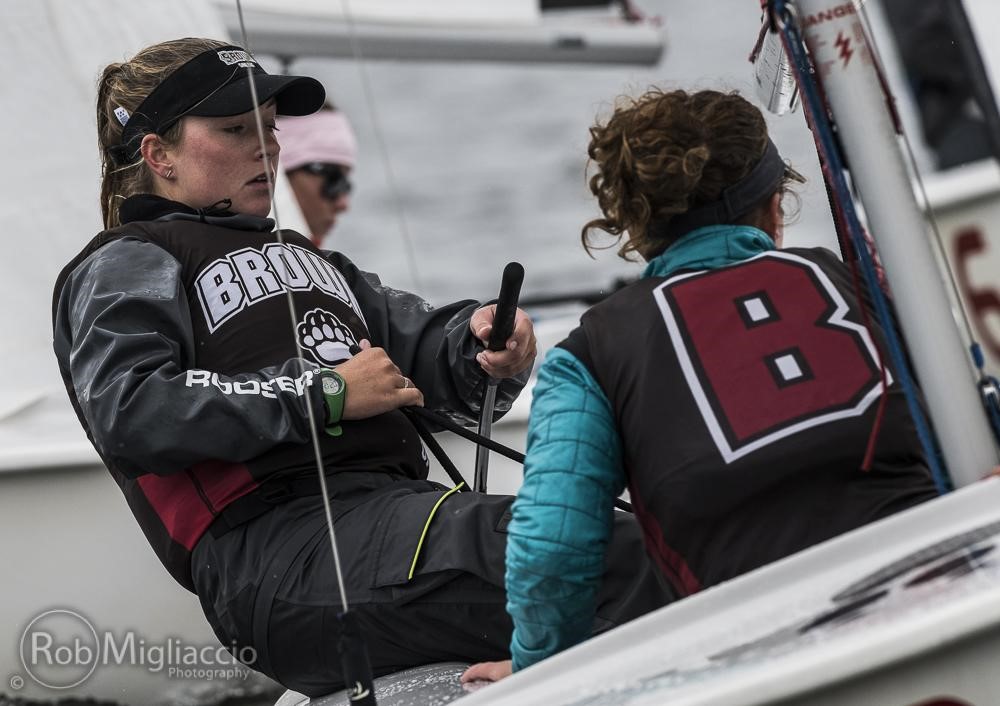
The showcase finals is a new spin on what was once the Women’s Atlantic Coast Championship. Only the qualification system has changed. In past years, 18 berths to the ACCs were spread amongst three conference, New England, the Mid Atlantic and the South Atlantic. Now there are two 18 team regatta, the Showcase Semifinals, used to determine the 18 teams to reach the finals. The top-9 from each semi finals qualify. The goal is to create a more merit based qualification process with Stanford in the mix as well. The result was a regatta with depth similar to the National Championship.
The Coed Showcase finals will take place next weekend at St. Mary’s College of Maryland.
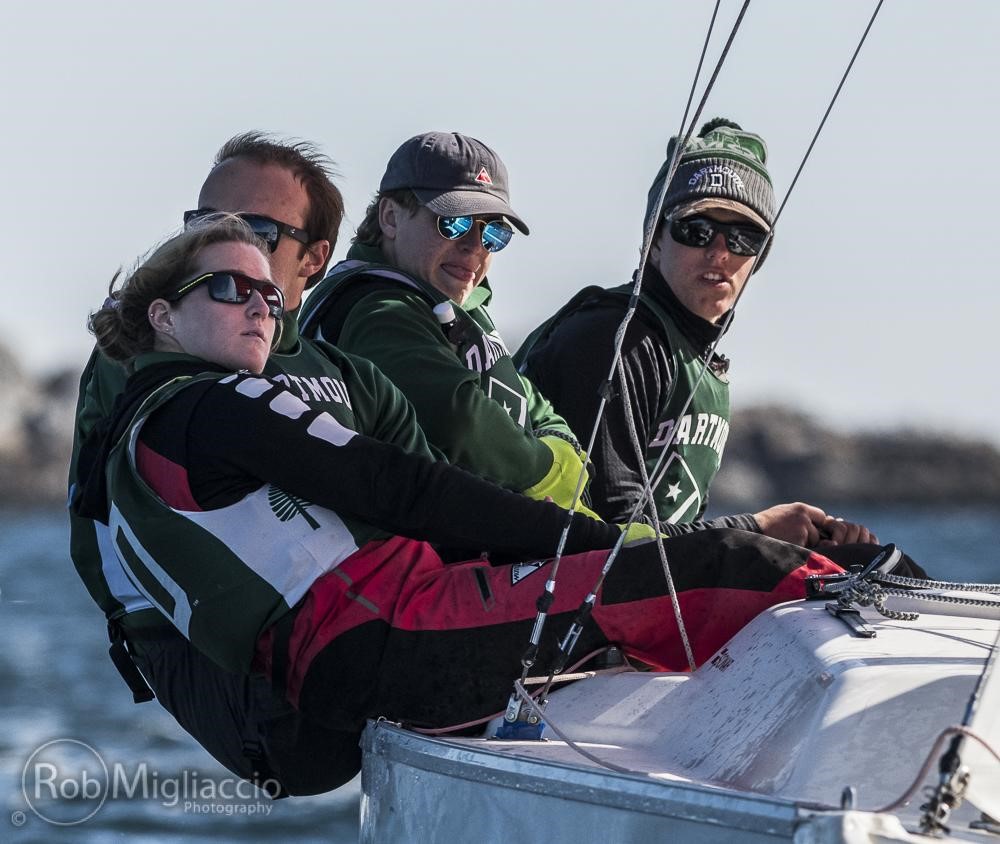
Dartmouth College won the NEISA Match Race Championships, the Larry White Trophy, over defending Match-Race National Champion, Boston College. The New England Match Race Championship was sailed in Sonars out of Corinthian Yacht Club in Marblehead. Saturday started racing in a rainy 8-14 knots.
The format was for a eight team round robin to establish seeding for a eight team, best of 3 knockout series. Boston college won the round robin to establish poll position as the 1 seed. They faced Northeastern and won the first race of the series before racing was suspended at the end of Saturday.
The two seed, Bowdon faced off against MIT and the three seed, Yale drew Dartmouth. Both series were tied 1-1 at the end of Saturday.
The fourth seed Brown defeated the fifth seed, Tufts before Sunday’s racing.
Sunday was lighter, 6-12 knots as the first round of knockout sailing was set to commence. Boston College defeated Northeastern 2-0 to move on to face Brown. Bowdoin defeated MIT and Dartmouth surprised the 3 seed, beating Yale. The final four was set and the winners of each respective matchup would move on to contend for the NEISA crown and advance to the ICSA Match Race National Championship, November 16-18 at Balboa Yacht Club as the top-2 finishers qualify out of New England.
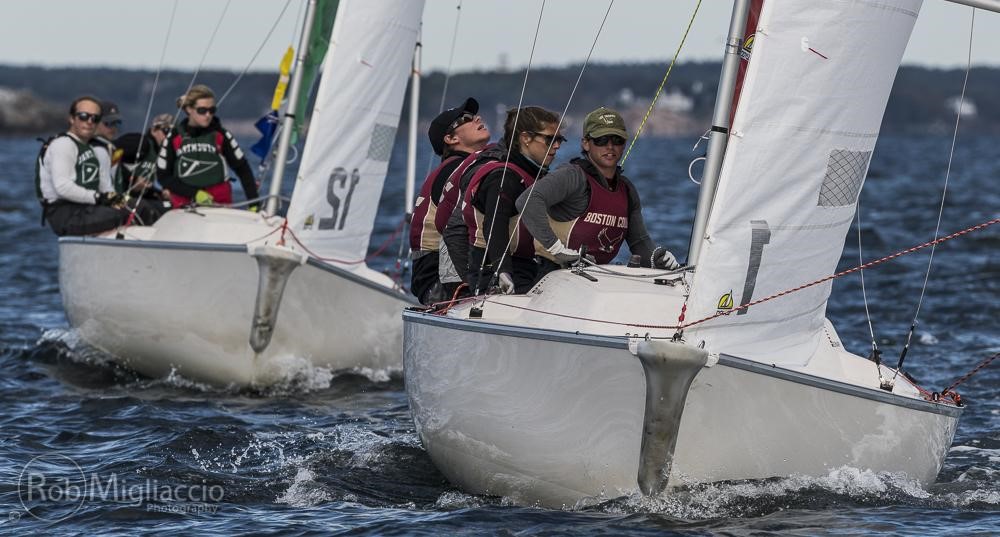
Boston College beat Brown handily, 3-0. The Dartmouth, Bowdoin match-up, on the other hand, was much more compelling.
After 4 races sailed the two schools were knotted up at 2 races each. In the decisive fifth race of the five race series, Bowdoin had taken the lead around the top marks. Dartmouth showed resolve passing Bowdoin on the downwind and finishing less than a boat length ahead of the Polar Bears, qualifying for the Nationals and moving on to face Boston College.
Dartmouth defeated the defending champions, BC, 2 races to 1 in the finals.
The MCSA Women’s Singlehanded Championship was sailed out of Wisconsin, a 10-race series where two of the three sailors entered would move on to the National Championship.
Cailin Considine ‘19 of Wisconsin won 6 of the ten races finishing with two seconds and two redress given scores in the other 4. Considine finished with 12 points in the 10 races sailed.
Rachel Rantanen ‘19 of Michigan State finished second, besting the only other boat in the event, her teammate, Miranda Madden ‘19 by 5 points. Oddly, Rantanen did not start in 6 of the 10 races sailed. Madden only sailed 4 races as well. Rantanen won 3 of the 4 races she started.
Korbin Kierstead ‘19 of Wisconsin won the MCSA Men’s Singlehanded Championship decisively, winning 8 of the 10 races sailed. After winning the first race of the event Kierstead never trailed throughout the qualifier. Kierstead finished with 12 points in 10 races.
Bobby Sessions ‘20 of Marquette finished second overall, claiming the other spot to the National Championship. Starting the regatta with a second, Sessions sailed all 10 races either tied for first or in sole possession of the second and final qualifying spot.
Both the men’s and the women’s Laser Performance Singlehanded Championships will be sailed in Holland, Michigan, November 2-4. All conference births allocations have now been filled.
Stanford won the Captain Hurst Bowl, sailed at Dartmouth College. The Cardinal of Stanford battled throughout the regatta with Harvard, edging the Crimson by 8 points in the end, 188 to 196.
Stanford’s A-Division boat, Romain Screve ‘21 and Sammy Pickell ‘22 edged Yale’s Nicolas Hernandez ‘19 and Catherine Webb ‘22 by 2 points. After a slow start by Screve and Pickell, the tandem won 4 of the final 5 races and totaled 11 points over that span. The effort by Stanford’s A-Division was enough to overcome Hernandez and Webb, who sailed very solidly throughout the regatta, posting only two scores outside the top-8.
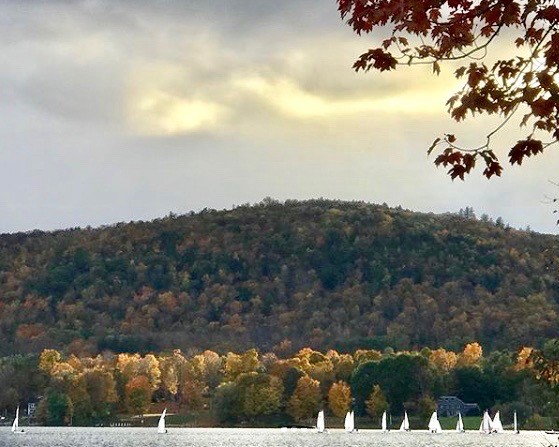
Stanford’s B-Division boat, Wiley Rodgers ‘22 and Victoria Thompson ‘21 dominated B-Division, besting Hector Guzman ‘20 and Maya Weber ‘20 of Hobart and William Smith by 20 points in the 11 race series. Rodgers and Thompson finished with 6 bullets and only 2 races outside the top-3! Rodgers is now undefeated in his college sailing career, notably winning A-Division at the Danmark Trophy. Rodgers sailed with Thompson for both division wins.
College Sailing Update: Showcase Semifinals display ICSA’s best; Also Women Interconferences
By Chris Klevan
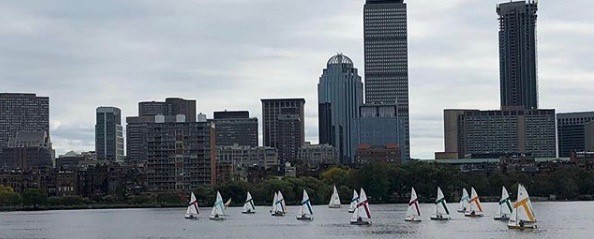
The Brown Bears have won the MIT side of the two-part Coed Showcase Semifinals, the qualifying regatta for the Showcase Finals to be sailed at St. Mary’s College in two weeks, October 20-21. The top-9 teams from the event will advance to the finals. Another 18 team regatta, held at Harvard, took place simultaneously to decide the other 9 team that will sail in the Showcase Finals.
According to Fran Charles, Sailing Master at MIT, “Light winds from the ENE to SE at 3-7 knots made for trickly, slow sailing on the Charles [Saturday]. The Brown Bears were extremely consistent with light and variable SW breeze which eventually clocked all the way into the NE today [Sunday].”
As Mr. Charles pointed out in the regatta report, Brown finished second in both divisions due to consistent sailing from Patrick Shanahan ‘19 with Julia Reynolds ‘21 and Ragna Agerup ‘20 with Abigayle Konys ‘19 in A and B Division, respectively. Despite extremely uncertain conditions, especially on Sunday, Shanahan and Reynolds only had 2 races outside the top-10, Agerup and Konys did the same. The effort was enough to beat Hobart and William Smith Colleges 182 to 194 after 16 races sailed in each division.
“Our entire Brown team has been working really hard and we have 16-18 boats at practice everyday pushing each one another on a daily basis,” said Brown University Head Coach, John Mollicone. “I think hard work and discipline on the river in light and tough conditions were important to achieve consistency. We have been trying to preach consistency to our sailors on a regular basis, avoiding the low percentage decisions, and staying in the race and it worked at MIT.”
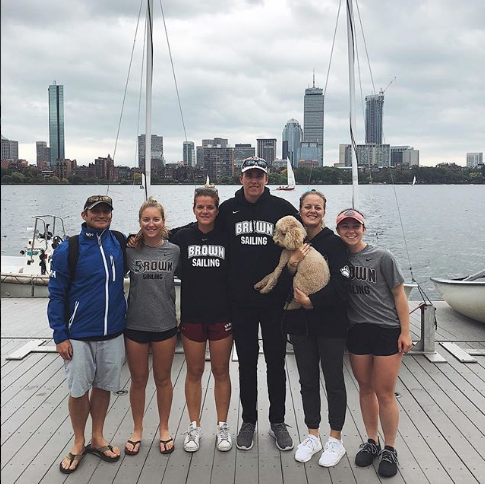
“[The win] gives our coed team a lot of confidence and is also a decent barometer of where we stand if we sail well,” continued Mollicone. “We can be a strong coed team if we sail well and are disciplined. There’s also a long way to go so you can never be too complacent, there are too many good teams in college sailing that can turn it on any given time.”
Matthew Kaplan ‘19 of Bowdoin continued an impressive start to the season, sailing with Louisa Lundgren ‘19, getting the A-Division win with 77 points. Jacob Rosenberg ‘20 and Kathryn Booker ‘19 of Stanford won B-Division with 86 points.
Mr. Mollicone went on to say, “With the new schedule, the Showcase Semifinals makes the season feel a little bit shorter. I am still not sure how we feel about the change from the Schell Trophy being the qualifier for ACC’s in past years, but it still feels good to qualify for the fall finale.”
The regatta at MIT qualified teams for the Showcase Finals, a revision on the former fall season doublehanded finale, the Atlantic Coast Championship. The top 9 teams from each of the two Showcase Semi-finals will advance making, perhaps, for a more merit-based championship. The Showcase Finals will also, after their qualification last weekend, include Stanford, a perennial top-10 team.
The qualifying teams this year will be, in order of finishes, Brown, Hobart and William Smith, MIT, Bowdoin, Stanford, Tufts, Charleston, Dartmouth and Coast Guard.
From the Coed Showcase Semifinal 2, held at Harvard, sailing alongside the regatta at MIT, Yale, Georgetown, Roger Williams, Harvard, Navy, Jacksonville, Boston University, Boston College and Old Dominion qualified, finished first through ninth, respectively.
Yale ran away with the 20 race regatta, winning both divisions and beating Georgetown by 26 points, 87 to 113. Despite racing only a course-length away from the event at MIT, this regatta completed 12 races less than the other qualifier.
“At least we got racing in,” said Yale University Head Coach, Zack Leonard. “We’ve been plagued by light air all fall so we were just happy to get to sail.”
“Mike O’Connor refused to let marginal races off and though there were 16 or so races started in each division, we ended with 10 tasteful races in each because so many races were called off,” said Leonard.
Nicholas Baird ‘19 and Sonia Lingos-Utley ‘21 of Yale won A-Division, posting only one race outside the top-9. Baird is the early frontrunner for the Marlow Ropes College Sailor of the Year.
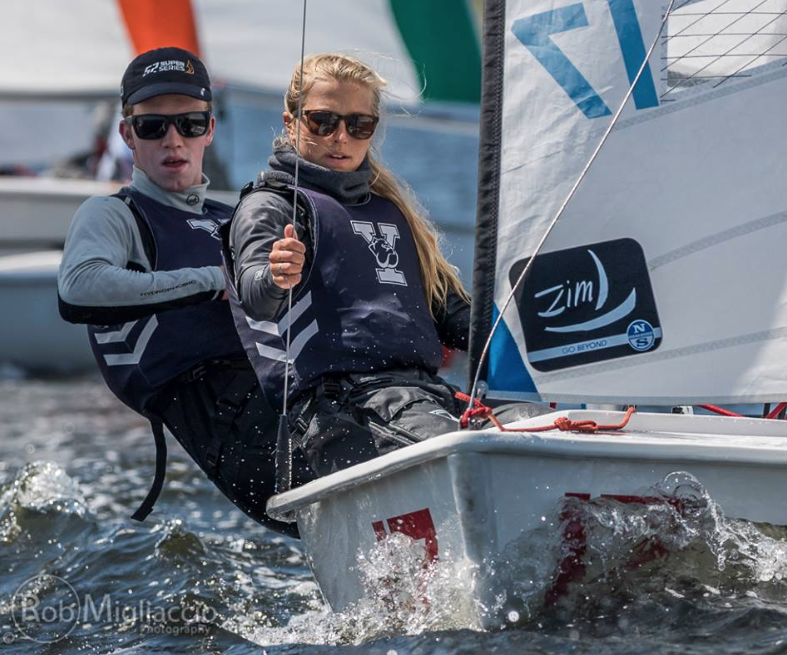
But, perhaps more impressive was Sophomore Shawn Harvey ‘21 and Junior Graceann Nicolosi’s performance in B-Division. The tandem posted no races outside the top-8 and won 3 of the 10 races sailed. With Harvey and Lingos-Utley improving, what seems like, every weekend coupled with Baird and Nicolosi’s experience and talent, this Yale team could be the team to beat in college sailing.
“I don’t watch other teams,” continued Mr. Leonard. “We were rational, unwilling to take unnecessary risk and patient.”
In women’s sailing there were two interconference regattas sailed over the weekend, the Susan Rogers ’75 Memorial Regatta at Cornell University and the Stu Nelson sailed at Connecticut College. Once again the best women in the nation were divided by geography as anticipation grows for next weekend’s Women’s Showcase Finals.
Cornell University won the Susan Rogers on home waters. The Big Reg sailed impressively, beating neighbor and rival, William Smith. The combined division event was headlined by William Smith senior, Bailer Carter, one of, if not the best women’s sailor in the nation. However, it was Daisy Holthus ‘21 and Brooke Shachoy ‘22 sharing the helm behind senior leader Kimberly Wong ‘19, who stole the show, winning the regatta by 35 points over second place finishing Carter.
Holthus sailed the first 6 races with Wong, winning 4 and finishing with all top-3’s. Shachoy picked up where Holthus left off with 3 bullets in 9 races, and only one race outside the top-3. Cornell won the regatta by 21 points, 115 to 136 due to such a dominant effort by Holthus, Shachoy and Wong.
Yale University edged College of Charleston by 8 at the Stu Nelson at Conn College. Despite Junior Alie Toppa and senior, Annabel Carrington’s impressive win in A-Division, Yale proved more consistent, finishing second in both divisions sailing Christine Klingler ‘20 with Kira Woods ‘19 in B-Division and Louisa Nordstrom ‘20 with Claudia Loiacono ‘21 in A.
Toppa and Carrington showed why they might be the best women’s boat in college sailing this year, winning the division by 13 points finishing with only 2 races outside the top-3 in the 9 race series.
Sophie Hibbem ‘19 and Megha Malpani ‘19 of Brown won B-Division. Brown finished 3rd overall with 85 points.
College Sailing: Match Racing; Women qualify & Interconference sailing; NWICSA fills singlehanded slots
By Chris Klevan
William Smith College won the Women’s Showcase Semifinals at St. Mary’s College of Maryland decisively over second place MIT, 56 to 82 points respectively. William Smith, the third place finisher at last year’s Gill Women’s National Championship, is led by A-Division skipper and senior, Bailey Carter. Ms. Carter, who walked away with the regatta, winning A-Division by 30 points after 9 races, finished with 17 points. Carter, sailing primarily with a freshman, Sarah Smith, bested Isabella Loosbrock of Boston College and Louisa Nordstrong of Yale which puts Carter at the top of the extremely premature watchlist for this year’s Quantum Women’s Sailor of the Year.
Carter finished with only one race outside the top-3 and finished first in 4 of the 9 races. Her average finish was less than 2 points per race.
Emily Haig ‘21 of MIT, sailing with Sarah Caso ‘19 won B-Division finishing with 29 points in 9 races, helping MIT squeak a narrow edge over third place finishing Yale, 82 to 83 points.
The top- 9 finishing teams at this regatta will move on to the Showcase Finals at Brown University, October 13-14. Finishing 4th through 9th respectively, after third place Yale, was the University of Pennsylvania, University of South Florida, Boston College, George Washington University, Stanford University and Tufts University- the ninth and final team to qualify for the finals.
Neighbor to William Smith, Cornell University won the Jen Harris Women’s Regatta, held at the Naval Academy. The other half to the Semifinal Regatta held at St. Mary’s, this regatta was sailed to decide the other 9 team moving on to the Showcase Finals at Brown.
The Big Red of Cornell surprised many in beating preordained contenders Brown, Dartmouth and College of Charleston. What was clearly a team effort, Cornell sailed with the disciplined consistency of a team who was been here before, finishing 3rd in A-Division with two different skippers splitting the regatta and first in B-Division the same way, splitting Saturday and Sunday between two different helmswomen. Saturday’s choice for B-Division skipper, Daisy Holthus ‘21 sailed seven races, none of which were outside the top-6 and 5 races inside the top-3.
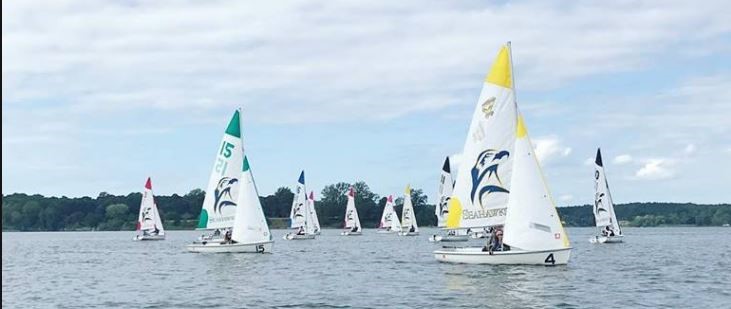
“It’s a big event,” said Cornell Head Coach, Brian Clancy “The leaders of the ICSA put in a lot of energy to change the scheduling format of the fall. They call these events the showcase regattas, putting a lot of emphasis on them, taking the place of the major interconference event of the past”.
“To win the showcase semifinals this early in the season gives us a lot of confidence moving forward,” continued Clancy. “We finished 7th at Women’s Nationals last year with the same group and they clearly care about each other. They work well together and are extremely supportive of one another. Our two senior crews, Diana Otis and Kimberly Wong, who sailed the entire event, are unbelievable crews and their input cannot be overlooked as they play a critical role getting through challenging events like this one.”
A-Division skippers Gabby Rizika ‘20 and Sebby Turner ‘20 sailed with Diana Otis ‘19. B-Division winners, Daisy Holthus ‘21 and Brooke Shachoy ‘22 sailed with Kimberly Wong ‘19.
“Winning such an event is always fun,” continued Mr. Clancy. “But we have larger aspirations moving forward so we must continue to work hard.”
Brown University finished second with 97 points (9 points behind Cornell) and Dartmouth finished with 108.
The remaining teams moving on to the finals are University of Rhode Island, College of Charleston, whose Alie Toppa ‘20 and Annabel Carrington ‘19 won A-Division with 27 points in the 10 races, Navy, Boston University, Coast Guard and Harvard finishing 4th through 9th respectively.
Notably, Toppa and Carrigan’s A-Division win starts to affirm what many suspect will be a great season for the Cougar as she joins Carter atop the far too early shortlist for Quantum Women’s sailor of the year.
Stanford University won the Danmark Trophy, a ten race regatta sailed in light and variable conditions at the United States Coast Guard Academy. The Cardinal sailed impressively despite starting a freshman and a sophomore in A-Division and two freshmen in B (The majority of Stanford’s experience was split between the Women’s Showcase Semifinals at St. Mary’s and the US Sailing Hinman Team Race National Championship in Cleveland, Ohio.)
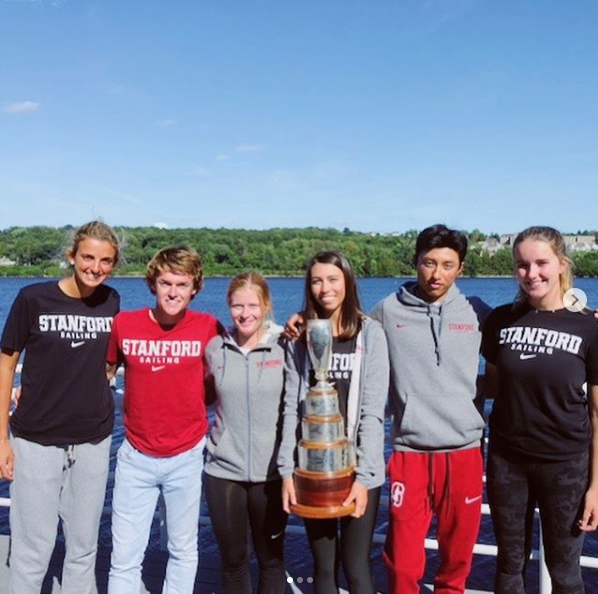
Despite the group’s inexperience at college sailing events, Stanford’s team showed incredible depth, winning the regatta by 5 points over Yale, 63 to 68. The Bulldogs of Yale sailed what is presumably their top team, Nicholas Baird ‘19 and Sonia Lingos-Utley ‘21 in A-Division and Shawn Harvey ‘21 with Claudia Loiacono ‘21 and Anisha Arcot ‘22 in B.
Stanford’s Wiley Rodgers ‘22 and Victoria Thompson ‘21 won B-Division with 17 points over Baird and Lingo-Utley’s 32 points. Rodgers and Thompson finished in the top-3 in 4 of the 5 races sailed in the division.
Connecticut College finished 3rd with 78 points.
Nicholas Karnovsky ‘19 and Jessica Williams ‘20 won B-Division with 26 points.
SUNY Maritime College and University of Pennsylvania will represent the Mid-Atlantic at this year’s Match Racing National Championship held in Marblehead, November 2-4. The two qualifiers finished the regatta in a four team tie with Hobart and Williams Smith and Georgetown on the outside looking in.
Light winds dictated the MAISA Match Race Championship, held at the Merchant Marine Academy at Kings Point as postponements forced much of the daylight hours to be spent on shore. While all four tied teams finished with a record of 5-4, the eventual regatta victors, SUNY Maritime College finished with a 2-1 record against the tied teams. University of Pennsylvania also finished with a 2-1 record against the three other tied teams but lost to SUNY. Both HWS and Georgetown were 1-2 against the two eventual qualifying teams.
SUNY’s boat saw Kyle Comerford ‘19 at the helm and Kaitlin Brzostek ‘22, Christian Neuman ‘21 and John Lawless ‘19 serving as crew.
UPenn was skippered by Porter Killian ‘22 with Tanner Probst ‘21, Kelly Hanlon ‘21 and Nicholas Floyd ‘19 serving as crew.
College of Charleston won the SAISA Match Race Championship held at the University of South Florida in St. Petersburg. Despite tying with University of Jacksonville, the Cougars of Charleston managed to sail well when it counted, beating the up-and-coming Fins 2-0 in their two head to head matchups. Charleston’s effort was led by William Curtiss ‘20 at the helm and Oliver Parsons ‘21, Robert Porter ‘19 and Laura Masterson ‘20 in the front of the boat. Charleston finished with a 7-2 record.
Jacksonville University finished second with the same record as Charleston, capturing the second a final qualifying slot allocated to the conference. Critically, the Fins stepped up at defeated 3rd place Miami in both head to head matchups. Jacksonville sailed Alfonso Garcia Bringas ‘20 as helmsman and Andre Duaragna ‘20, Telmo Basterra ‘21 and Ana Carrasco ‘21.
Gabriella Savage ‘18 of the University of British Columbia won the NWICSA Singlehanded Women’s Qualifier with a total of 14 points in 13 races. Ms. Savage dominated the 4 boat regatta and, in doing so, earned a spot at the Laser Performance Women’s Singlehanded Nationals.
Michael Levy ‘19 of Oregon State University won the NWICSA Singlehanded Men’s Qualifier with 25 points in 15 races. Mr. Levy won six of the first seven races to build a lead that the competition was unable to overcome.
Now all but the MCSA berths are spoken for despite what was posted in last week’s press release.
2018 Hinman Team Racing Championship Results & Report
From our friends at USSailing:
2018 U.S. Team Racing Championship – Final Report
CLEVELAND, Ohio (September 30, 2018) – Cleveland’s revamped and re-energized waterfront was fully realized this weekend, and the sport of sailing, team racing to be specific, was the featured attraction. The 2018 U.S. Team Racing Championship for the historic George R. Hinman Trophy, hosted by The Foundry, Cleveland’s Community Rowing and Sailing Center, came to an exciting finish on Sunday after three days of intense competition in Cleveland Harbor and Lake Erie.
The winning team, Boss, composed of mostly Hobart and William Smith Colleges alumni sailors stole the show on Sunday to capture the elusive Hinman Trophy. Boss featured Greiner Hobbs (Terra Ceira, Fla.) and Miranda Bakos (Beverly, Mass.); Brian Clancy (Ithaca, N.Y.) and Catherine Riedman (Conshohocken, Pa.); and Johnny Norfleet (New York, N.Y.) and Chris Klevin (Westerly, R.I.). The three skippers, Clancy, Norfleet, and Hobbs are Hobart and William Smith alumni. Clancy is now the head coach at Cornell, Norfleet is the head coach at Fordham, and Hobbs was a finalist for the ICSA Sailor of the Year award in 2018. Boss last raced for the Hinman in 2016 where they placed third.
Boss sealed the title on Sunday afternoon with a thrilling 3-2 win over a team representing the College of Charleston in the Final Series. Boss jumped out to a quick 2-0 lead in the best of five series. The College of Charleston bounced back to win the next two matches to force a decisive fifth and final match to determine the winner. Despite lessening sailing conditions and oscillating winds in the afternoon, Boss pulled through in the end to capture their first Hinman Trophy. Boss and College of Charleston went head-to-head eight times this weekend with Boss going 5-3, including 2-1 in the Round Robin and Gold fleet races.
As the #3 seed entering the Semifinal Knock-out stage, Boss reached the Finals by defeating #4 Aquadisiacs, 3-1. They were perfect against Aquadisiacs in the previous rounds, 2-1.
College of Charleston was the #1 seed entering the Semifinal round and they selected #2 Jet Lag as their opponent. Jet Lag, the defending champion from 2017, was knocked-out, 3-2, after leading, 2-1. College of Charleston was 3-0 against Jet Lag in Round Robin play.
Placing second overall was the College of Charleston and they are composed of Augie Dale (Pewaukee, Wis.) and Katie Lounsbury (Charleston, S.C.); Christophe Killian (Newport Beach, Calif.) and Elizabeth Pemberton (Osterville, Mass.); and Stefano Peschiera (Lima, Peru) and Grace McCarthy (San Diego, Calif.).
Aquadisiacs beat Jet Lag in the Petit Finals for third place, 2-0. The sailors representing Aquadisiacs includes Conner Harding (Naples, Fla.) and Mike McBrien (East Patchogue, N.Y.); Martim Anderson (Bristol, R.I.) and Marina Cano Sostre (Boston, Mass.); Mackenzie Bryan (Cos Cob, Conn.) and Jennifer Agell (Orient, N.Y.).
Jet Lag’s team is composed of skippers Mateo Vargas (San Francisco, Calif.), Oliver Toole (Menlo Park, Calif.) and Kevin Laube (San Francisco, Calif.) and crew Samantha Steele (San Francisco, Calif.), Carolyn Kelly Ortel (Menlo Park, Calif.) and Yuri Namikawa (San Francisco, Calif.).
Sunday’s racing featured stable 8 to 10 knots with gusts up to 15, and flat water for most of the day. However, the breeze was shifty. The breeze was blowing in over the land masses in the area making it difficult to read on the water. The pressure was down at the bottom of the course and up at the top marks.
Friday and Saturday Racing
Friday’s racing was set up nicely with cooperating wind directions from the south, southwest. The start line was organized about 100 yards offshore. Breeze ranged from 8 to 15 knots on mostly calm waters. The 12 teams tallied 132 races through the Round Robin 1 and 2 stages, and 77 races on Friday alone.
Saturday’s racing included a similar number of races after finishing the Round Robin 2 stage and nearly all of the Gold and Silver fleet races. Teams raced in less predictable conditions with fluctuating wind direction and speed (10 to 12 knots, gusts up to 15). The breeze shifted considerably throughout the day, especially in the afternoon.
The top six teams from the Round Robin stages advanced to the Gold Fleet, while the bottom six moved on to the Silver Fleet. Wins in the Gold Fleet were worth 1.5 points and the wins in the Silver Fleet were valued at 1 point. The top four teams with the most points from the two fleets advanced to the Semifinals. Points carried over from the Round Robin stages to the Gold and Silver fleet round.
Teams with exceptional boat handling, foot work in the boat, and overall speed faired well in the shifty conditions.
First held in 1981, the U.S. Team Racing Championship remains one of the hottest events in the country. This year’s Championship features an impressive list of accomplished teams and experienced team racers, many of whom have competed in and won this Championship in years past. From top-notch one-design sailors in fleet racing circles to current and former high-level college sailors and coaches, this US Sailing National Championship attracts a wide range of sailors, both men and women.
This year’s entry list featured active college sailors, coaches and alumni from major programs including, Old Dominion, College of Charleston, Stanford, Roger Williams, Yale, Brown, Virginia, Dartmouth, Hobart and William Smith, and others. Jet Lag, composed of Stanford alumni, returned all six of their sailors from last year’s team that won the title in Oyster Bay, N.Y.
This premier team racing event in the United States is an invitational event. Interested teams applied by resume and international teams are invited to compete. The Championship is raced in three-boat/six-person teams (three skippers and three crews). Teams raced the 420E from Zim Sailing. The 420E features enclosed deck technology ideal for high school and college sailing.
Team racing is one of the most popular disciplines in sailing. Over 100 races can be sailed in just a few days. Races, or flights, are shorter than traditional race courses and are raced on a “Digital N” course. Three flights can race simultaneously with teams swapping out after each race with each team wearing a unique identifying pinny or bib.
The regatta was initiated by Sailing World magazine, and after years of growth and popularity, the event was adopted by US Sailing and became known as the U.S. Team Racing Championship for the George R. Hinman Trophy. The trophy was donated in recognition of George R. Hinman’s many years of service and contributions to sailing.
The 2018 U.S. Team Racing Championship is sponsored by Gill North America and Hobie Polarized.
US Sailing Media Contact: Jake Fish, [email protected]
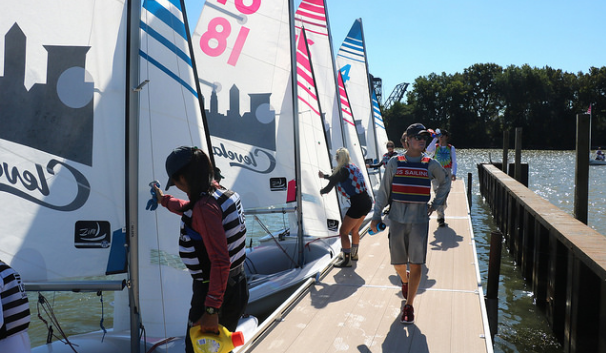
Photos by Katie Williams. (click on photo to see album)
About US Sailing
The United States Sailing Association (US Sailing), the national governing body for sailing, provides leadership, integrity, and growth for the sport in the United States. Founded in 1897 and headquartered in Portsmouth, Rhode Island, US Sailing is a 501(c) (3) non-profit organization. US Sailing offers training and education programs for instructors and race officials, supports a wide range of sailing organizations and communities, issues offshore rating certificates, and provides administration and oversight of competitive sailing across the country, including National Championships and the US Sailing Team. For more information, please visit www.ussailing.org.
Devon Yacht Club is Hiring!
The Devon Yacht Club is located on Gardiner’s Bay in Amagansett, NY and is currently seeking a Sailing Director. For more specific information this opportunity, and to apply, click HERE.
he Sailing Director will oversee all Adult and Junior sailing activities and report directly to the Club’s General Manager; he or she will also manage a team of sailing instructors and interface with the Fleet Captain and Sailing and Junior Yacht Committees. 
This is a leadership position and the Sailing Director will be highly visible and engaged with the Club’s members; he or she will be accountable for driving participation among experienced sailors and recruiting and instructing new adult sailors. The Sailing director will also be responsible for oversight of the Club’s Junior Yacht summer sailing instruction program and regatta participation, adult dinghy, Alerion and PHRF racing and race committee, recruiting, training and scheduling of sailing instructors, oversight of the maintenance of the Club’s fleet of Optimists, 420’s, Sunfish, and Lasers and will provide input on the potential selection of additional Club boats.

Annapolis Yacht Club, with Brand New & Expanded Facilities, is Hiring!!!
 Annapolis Yacht Club is looking to hire a full-time High School/c420 Program Manager. This position is a year-round, full-time, salaried job, working with the other full-time coaches and Jr Sailing Director. For more direct information, and to apply, click HERE.
AYC is moving into an exciting phase in their long standing history as a world-renowned yacht club. Three years ago, AYC suffered a devastating fire in the main clubhouse and the clubhouse has finally been rebuilt and opened. Along with the new clubhouse, AYC has a 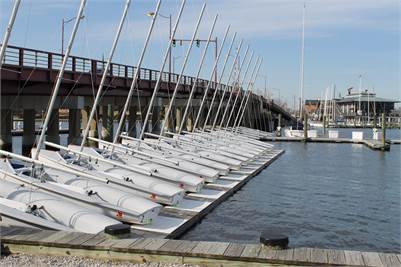 brand new, state of the art Sailing Center that will become the hub for all sailing activities has classroom space on the second floor that can seat up to 200 people. The club’s other new building, the Activity Center, has a dining room with seating up to 125 people with a fire pizza oven. The new building also has a pool, fitness center, fire pit area, outdoor bar area and flex meeting space to serve the club’s 1600 regular members and their families.
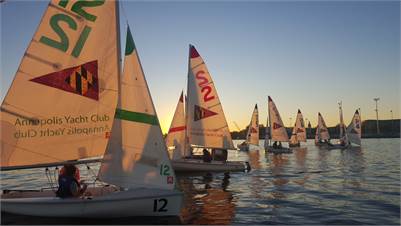
AYC is looking for the right candidate with proven history of strong coaching and communication skills to manage and coach the club’s High School and c420 Program…. The High School/c420 Program Manager is the primary point of contact for the High School and c420 programs and works with the Jr Sailing Director to set those program schedules.
History of AYC
Humble Beginnings
In 1904, the first records of meetings indicate a membership of 30. In 1910, the first wharfs were built, and the first club manager was hired in 1911 at a salary of $15 a month. Members began to acquire small sail boats and organize club regattas. These were uncomplicated affairs held on Memorial Day and Labor Day. Shell and canoe races started up Spa Creek at Old Woman Cove and ended at the Eastport Bridge. There were also swimming races and diving competitions. The club owned several single and double shells, two four-oared shells, and was given an eight-oared shell in 1911 by the US Naval Academy.
A Post-War Renewal
World War I and the depression slowed boating activities until the mid-30s. A hurricane damaged the clubhouse and the wharf was reduced to pilings in 1933 and it was difficult to keep the club’s quota of 100 resident members. By 1936, there seemed to be little interest by members in the club and changes were needed. With renewal in mind, in 1937 the Annapolis Yacht Club was incorporated and the first formal regatta (Annual) was held that year. The Fall Series first year was in 1940 with five boats competing. World War II interrupted organized racing, but in 1946 the Spring Series was started with three classes – 30 Square Meters, Stars and Chesapeake 20s. By 1948, Moths, Comets and Hamptons were also taking part. The Annapolis to Newport Race (Newport to Annapolis back then) started in 1947 and has been run every two years since. A dining room was added to the club in the late 1940s and in 1948, the first Smoking Lamp newsletter appeared as a single page mimeographed sheet.
The Junior Fleet
The junior fleet started in 1948, and the first junior trophy was presented in 1953. The first junior boat, Dolphins, were replaced by Penguins, which were next followed by 420s which the junior fleet still races.
Wednesday Night Races: An Annapolis Tradition
Wednesday Night Races were the brainchild of P/C Gaither Scott. After seeing the Wednesday Night Races at East Greenwich YC in Rhode Island in 1958, Scott inaugurated midweek racing at AYC in 1959. No race committee, no prizes, no scoring but there was a picnic supper after sailing. “S” boats, H-23s, 5.5 meters, Bermuda One Design and Rainbows raced, but interest waned in the mid-60s. To correct this, smaller classes of boats were invited and in 1965 35 boats entered the series. By 1967 112 boats were taking part.
Frostbite Racing
Frostbite racing began in the winter of 1962-1963. Seven Rainbows were the inaugural class with five short races a day, starting and finishing at the club. Gladiators joined Frostbite racing in the fall of 1963 and MORC made the third class in 1964. The first Hangover Bowl (New Year’s Day) was on Jan. 1, 1966.
A Need for Growth
By 1959, membership had risen to 1000 and a new club building was badly needed. This was opened in 1963, with the first deck left unfinished due to lack of funds. Frostbite and Wednesday Night Racing soon demanded more club social space, and the Skipjack Lounge was finished in 1969.
The land across the Eastport Bridge where the junior fleet building is now (Holden Property) was purchased in 1969. The junior fleet was established there and a new building for them was completed in 1995. In 1989, women were welcomed as members, and the White Rocks Marina property (now the Harborside Sailing Center) was added in 1990. The club’s first official one-design fleet, the J/22, was started in 1991 with a crane added to Harborside for launching of the boats. The clubhouse again underwent a major renovation in 1995.
More than a Club…
In December 2015, Annapolis Yacht Club’s Main Clubhouse at 2 Compromise Street suffered a fire. A temporary clubhouse was then opened, located at 12 Dock Street, where operations continue until the completion of the rebuilding of the Main Clubhouse. Simultaneously, work is happening on the Eastport side of the bridge to create a new Sailing Center and a Family Activity Center. Today, AYC is at full membership (1600 regular members) with very active social, racing, and cruising programs. Large international events such as the Star Class World Championship, Rolex International Women’s Keelboat Championship, and many North American championships are hosted every year at AYC. AYC is known worldwide thanks to the members who are prominent in participating in, promoting, and organizing the sport of sailboat racing, as well as those who opt to leisurely cruise the waters of the Chesapeake and beyond.
Watch Hinman Team Racing Championship Live!
Watch the 2018 U.S. Team Racing Championship for the Hinman Trophy on Facebook Live!
ATTENTION ALL CURRENT AND ALUMNI COLLEGE SAILORS – The 2018 U.S. Team Racing Championship will be broadcast on Facebook Live, Saturday, September 29 and Sunday, September 30 from The Foundry in Cleveland, Ohio! Follow US Sailing on Facebook to watch the action live.
Twelve accomplished teams will battle it out on the southern shore of Lake Erie for the historic Hinman Trophy. This year’s slate of competitors includes current college sailing teams from Dartmouth and Stanford as well as alumni teams from Hobart & William Smith, Roger Williams University and an Ivy League mixed team from Brown and Yale. Other colleges represented on mixed teams include Georgetown, George Washington University, Tufts, BC, BU, Fordham and University of Virginia.
Also competing for the title is the 2018 ICSA LaserPerformance Team Race Champions from the College of Charleston, and returning to defend their Hinman title, “Jet Lag”, a Stanford Alumni team representing the Cardinal.
This year we have a special treat as college head coaches from Cornell, Roger Williams and Fordham as well as assistant coaches from Dartmouth, Stanford and Coast Guard Academy join the regatta to compete against some of the best team racers in the country.
So, whether you are at a regatta, hanging out at school or home, or just spending some time with the family, make sure to tune into US Sailing on Facebook for the U.S. Team Racing Championship on Saturday, September 29 and Sunday, September 30 to catch all the live coverage of this historic US Sailing National Championship and cheer on your favorite current and alumni college sailors!
College Sailing Update: MAISA, SAISA, PCCSC claim last spots @ Singles; Doublehanded Sailing Heats Up
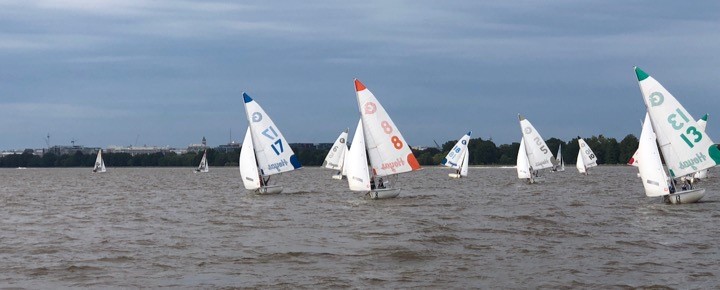
The Mid-Atlantic Conference single handed championship, the Carl Van Duyne Trophy was held at the US Naval Academy in provided boats. The top five finishers of the 18 boat regatta would move on to sail the national championship in Michigan, November 2-4.
A freshman, Leo Boucher of St. Mary’s college took the event in the late stages of Sunday, edging Thomas McCann ‘22 of Georgetown and Charles Carraway ‘22 of Hobart. Boucher started slow with 23 points after the first 3 races. However, Mr. Boucher recovered impressively, finishing in the top-5 in 11 of the final 12 races sailed, including three first place finishes. Boucher finished with 51 points. McCann and Carraway finished with 55 and 56 respectively.
Vir Menon ‘20 of Christopher Newport finished fourth and Carrson Pearce ‘21 of King’s Point finished fifth, capturing the final qualifying spot for the nationals. Notably four of the five sailors representing MAISA are underclassmen and career performers at the top of the laser class in America. Vir Menon is neither a underclassman nor a familiar face on top of the laser scoresheet. He has been trending up, finished 6th last year and 9th his freshman year and finally qualifying for the first time last weekend. It is clear that Mr. Menon has been working hard to be able hold his own with the likes of Boucher, McCann, Carraway and Pearce.
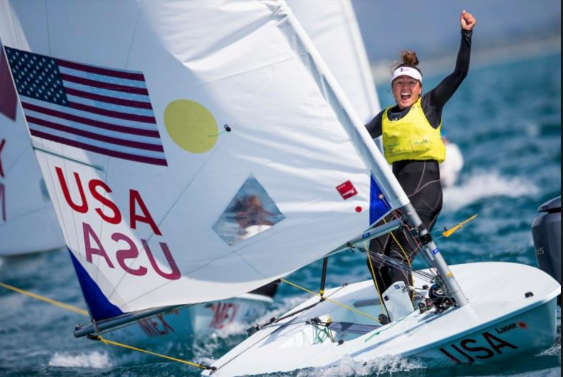
Charlotte Rose ‘22 of Jacksonville University finished first at the SAISA Women’s Single-handed Championship, besting Kelly-Ann Arrindell ‘20 of Charleston in the 5 boat, 10 race regatta. Ms. Rose is world class, the gold medalist at the 2018 Girls’ Laser Radial Youth World Championship. Last weekend’s regatta was Rose’s college single-handed debut and most would peg her as the favorite at the national championship in November. Rose won six of the ten races sailed and finished with 19 points to Arrindell’s 22. Both women advance to the national championship. College of Charleston represented 80% of SAISA Championship.
Gerald Williams ‘19 won the SAISA Men’s Single-handed Championship in dominant fashion, winning eight of the ten races and finishing second in the other two races. Mr. Williams of College of Charleston finished second behind his teammate and eventual Marlow Ropes Coed Sailor of the Year, Stefano Peschiera, at last year’s national championship and finished second behind Boston College’s Scott Rasmussen at the same event in 2016. This year, however, Williams looks poised to take the championship in Michigan.
Malcolm Benn Smith ‘21 of Charleston finished second with 33 points and Jack Gower ‘20 of Jacksonville finished 3rd. Williams, Smith and Gower will represent SAISA at the national championship.
Christina Sakellaris ‘21 of Stanford won the PCCSC Women’s Singlehanded Championship over her teammate Sophia Sole ‘21. Sakellaris finished with nothing but top-2 finishes and Sole was close behind with top-2 finishes in all but one race in the 10 race regatta. Sakellaris finished with 14 points and Sole 18, 14 points ahead of 3rd. The two Stanford Women will represent the PCCSC at the women’s single-handed championship.
John Kirkpatrick ‘22 of Stanford won the PCCSC Men’s Singlehanded Championship with 14 points through 10 races, winning 6 of the ten races and second in the other 4. Upamanyu Dutta ‘20 from University of Southern California finished second and captured the final qualifying spot. Dutta had all top-3 finishes and won the 4 races that Kirkpatrick didn’t win.
Harvard University won the Sherman Hoyt Trophy, New England’s premier coed regatta last weekend. The Crimson finished with 137 points, 24 points ahead of second place Bowdoin. A puffy, shifty event sailed all but one of the 11 races on Saturday. Harvard started Eli Burnes ‘21 and Lena Episalla ‘19 in A-Division and Henry Burnes ‘21 with Catherine Tang ‘19 in B-Division. The twin brothers sailed very similar regattas, finishing with 69 points in A-Division and 68 in B, both finishing with only 3 races outside the top-10.
“Saturday went through a few different phases of successful strategies, so we had to be on our toes and ready to adapt,” stated Eli Burnes. “First set was oscillations of about 1 to 2 legs long, the next couple sets had longer oscillations so most beats were persistent shifts. Next it got a bit lighter and getting favorable current on the far left side was the winning move,” continued Burnes.
“We had a few tough races (one race I fell out of the boat), but we stayed optimistic and knew everyone was up and down because of the tricky conditions. First half of the day we focused on getting on the lifted tack as soon as possible, even if we had to take some sterns. For the rest of the races our game plan was to go left, often going far past port layline led to big gains,” said Mr. Burnes.
“We had a great time at the event, and thanks to the race committee for getting off a lot of races on Saturday before the unfortunate conditions Sunday. Races were quite competitive and exciting given the tricky conditions. Thanks to Brown for hosting!”
Bowdoin finished with 161 points, led by a B-Division Alden Grimes ‘21 with Elijah Berger ‘21 and Alissa Chen ‘22 for the Polar Bears. Roger Williams had 165, rounding out the top-3.
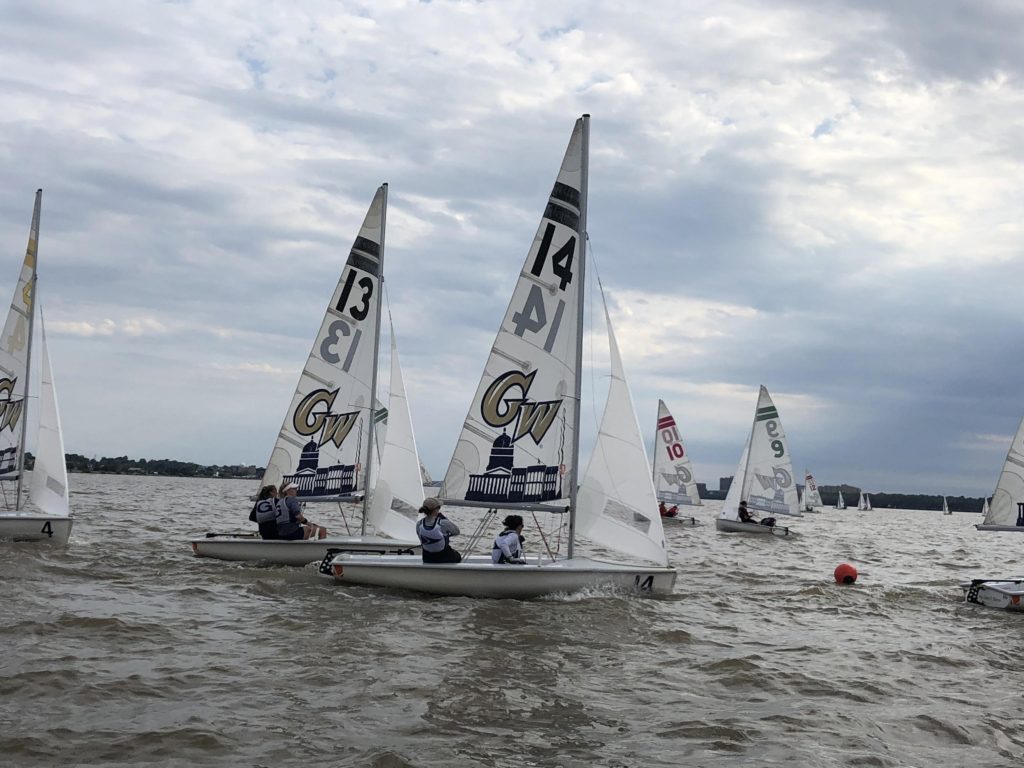 Georgetown University dominated the Top-9 Regatta Coed at home, posting 130 total points after 14 races sailed in each division, over 100 points better than second place Fordham University. The placed first and second in the combined division regatta as Andy Reiter ‘19 with Claire Mohun, Haley Shea and Jack Hogan bested teammates Will Logue, Caroline Teare and Rebecca Fung, 60 to 70. Reiter, Mohun, Shea and Hogan won 7 of the 14 races sailed.
“The top 9 regattas, I think, were a success,” said Georgetown Head Coach, Mike Callahan. “I had hoped other teams would have sent their best sailors but the competition was good and we got a lot of racing in over a shorter amount of time.”
The Top-9 Regatta Women was sailed simultaneously and the other home team, George Washington University came out on top there, beating Cornell University 142 to 166 respectively. Aitana Mendiguren ‘20 and Sarah Moyes ‘20 of GW were the low point earner with 59 points in the combined division event. Mendiguren and Moyes finished in the top-5 in 11 of the 13 races.
The Seahawks of St. Mary’s finished 3rd with 226 points.
“My hope is that teams give the fall season a chance before we decide if its good or bad. At the end of the season we can all sit down and talk about what worked and what didn’t and hopefully we can work with each other to innovate,” continued Mr. Callahan
“There are many goals for the new schedule. One goal is to create some order to the schedule. The first part of the year is in conference and qualifiers – the second part of the year is interconference and the third part is post season – National Championships.” Mr. Callahan went on to say the following:
“The goal of the in conference season is to look inward and create better competition within your conference. MAISA has done that and the hope is more conferences will do the same. Instead of having the top sailors go to MAISA and NEISA for an interconference event, in MAISA we have tried to do this through new events like the top 9 which has the top 9 coed and women’s teams competing on the same course – allowing one coach to coach both events. We are also experimenting with having more boats per team sailing. The end result will be more sailing from more sailors over a shorter time with less travel. The goal for the interconference season is to have great interconference events. Interconference regattas had become so commonplace that the level of competition was watered down. On a given weekend there would be a few top teams at one event, a few at another and then a few would have qualifiers in their own conference. The new schedule has showcase events which will have the best teams in the country competing and the hope is the level of the regatta is better than a normal interconference. There will also be regular interconference events. The season will end earlier due to the 18 week season limit so the for MAISA and NEISA the season will end with the conference championship. The post season will be only the Singlehanded and Match Racing National Championships. Some conferences will continue to sail regattas or at practice but the main part of the season will be over the last weekend of October.”
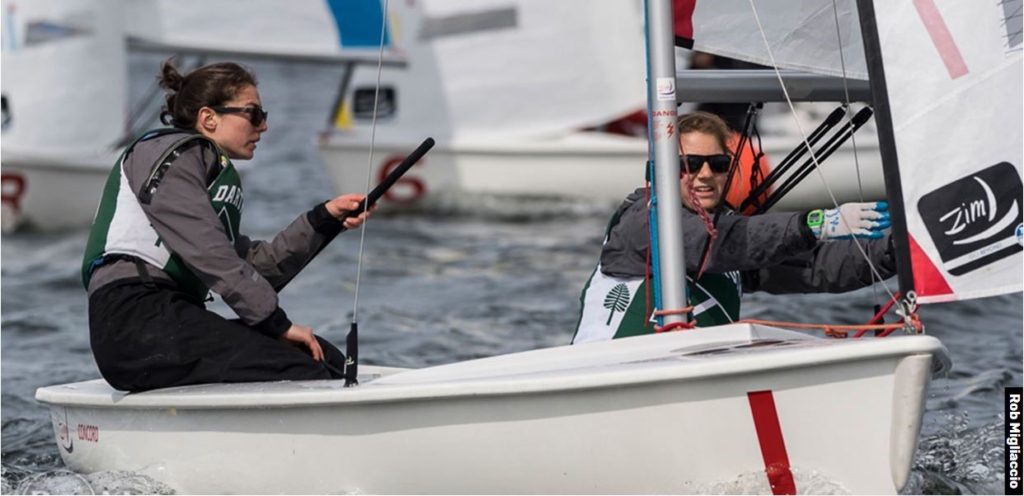
Dartmouth won the Mrs. Hurst Bowl, sailed the weekend after the regatta namesake, Mrs. Hurst’s 93 birthday. The Big Green impressed on home waters beating the field by more than 50 points as second place Brown finished with 127 points to Dartmouth’s 74.
The spread was largely attributed to a dominant performance in B-Division by Emma White ‘19 with Lisa Genther ‘19 and Paige Clarke ‘20, who won their division by 19 points in only 11 races sailed. White, Genther and Clarke only scored 2 races outside the top-3, two fifth place finishes which was especially impressive given the extremely shifty conditions, natural to Lake Mascoma.
Head Coach, Justin Assad had this to say of the victory:
“We have had consistency in our women’s team players for two full years now, with some small changes in the crew positions. These women have bought into the process and pushed themselves hard to be where they are. They know their potential is great, but expectations can impede their progress so they do a great job of focusing on the steps of improving every day. Most importantly, they recognize that the year is young and to keep improving we will need to turn this year’s weaknesses into strengths. Of course, it is special to win at home, and especially the day after Mrs. Hurst turned 93!”
Sophia Reineke ‘21 and Tara Ferraris ‘19 of Boston College won A-Division with 41 points, followed closely by Audrey Giblin ‘20 and Mary Amis ‘19 of Dartmouth.
MIT finished 3rd overall with 130 points, 3 points behind Brown.