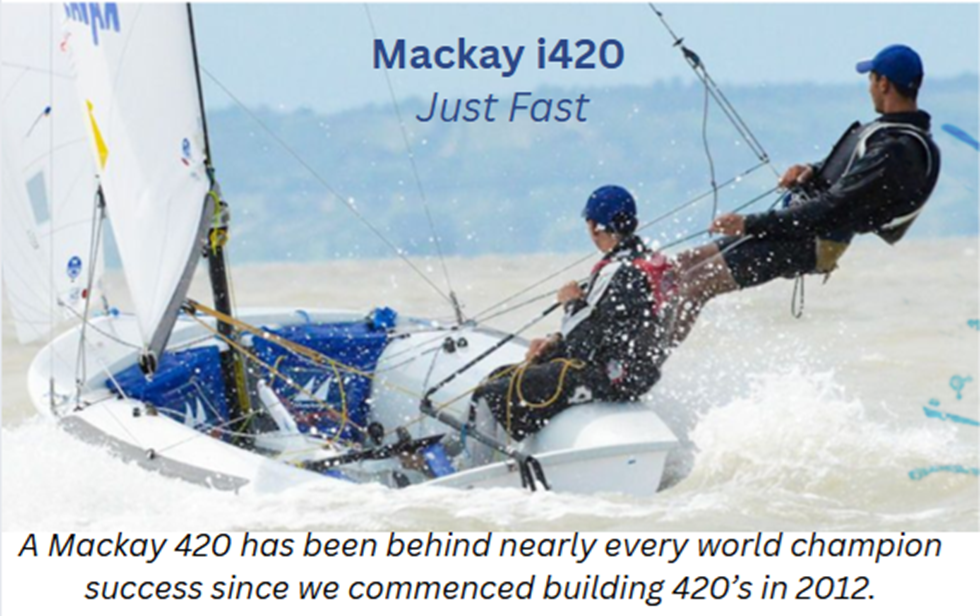
The Viper 640 is a high-performance one-design sport boat. At 21 feet long and only 735 lbs, it combines the stiffness of a keelboat with the acceleration and planning abilities of a dinghy.
 The design mandate was “Simple, Clean and Effective”. The Viper has a precise and exhilarating feel on the helm, a spacious cockpit for 3 people, strict one-design class rules and ease of launching by ramp or hoist.
Check out Sail1Design’s One-Design Class Profile on the Viper 640!
Class website:
http://www.viper640.org/
Flying Junior
The “Flying Dutchman Junior” was originally designed, in Holland, by Van Essen, a well-known Dutch boat designer. Listed as codesigner was Conrad Gulcher, Dutch Olympic sailor. (Gulcher and Van Essen also collaborated on the Flying Dutchman Conrad Gulcher served as International Class Secretary for both classes for many years, and was a main driving force behind both the International Flying Dutchman, and International (FJ) Flying Junior classes until his death in 1989.
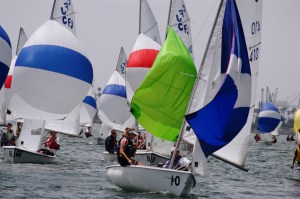 The first FJ was built of coldmolded wood, and was tested on the water in December, 1995.
The original purpose of the “Flying Dutchman Junior” was to serve as a junior trainer for the then new Olympic Flying Dutchman (FD). The FD is a much larger( 19’10”), faster, and more physical class than its younger sister. The FJ rules also allowed (and still allow) many of the same technical innovations as the FD, and the boat was (and still is) ideal to teach newer sailors the intricacies of tuning, mast rake and bend, etc. so important to top-level competitive sailing.
The Class’ name was quickly changed to “Flying Junior” as the class developed on its own, and the Flying Junior Class Organisation was free and independent of the Flying Dutchman organisation by about 1960.
FJ Gets IYRU International Class Status
By the early 1970’s, the Flying Junior was accorded the status of an International Class by the International Yacht Racing Union (IYRU)- pre-cursor to the ISAF.
This prestigious status is applied only to sailing classes with strict one-design rules, that are sailed the world over, and that regularly have international competition- such as World and Continental Championships. The International Sailing Association (ISAF) (replacement organisation for the IYRU) currently governs the Class Rules of the International FJ Class. As an International Class, rights and control of the boat design rest with the International Sailing Federation (ISAF).
Today (2000), the International FJ is sailed in Japan, Germany, Italy, Belgium, The Netherlands, and the USA.
The Class Rules of the FJ allow any deck design; Dusseldorp FJs utilised a doublebottom design, especially suited to open-water sailing. Note the open transom, allowing large amounts of water to escape almost as fast as it can enter the hull. These hulls were the fastest FJs for at least the first 15 years of the Class’ existence. They are still competitive today.
From the beginning, the Class Rules of the FJ allowed any individual, or company to build the boat.
Class Rules Evolution- a summary of major revisions made to the Class Rules
- Early 1960’s, the Class Rules were modified to lengthen the mast, providing more speed, and clearance under the boom.
- Early 1970’s, the Flying Junior became the International Flying Junior. Accordingly, FJs built since 1972 must carry the IYRU “Builder Fee Paid” metal plaque permanently affixed in the cockpit, signifying that the IYRU royalty has been paid. These fees are the only source of income for the International Class.
- In 1980, recognizing that the name “Junior” did not accurately describe the current usage of the boat, the International Class changed the name to “International FJ”. 1980’s included a larger spinnaker (from 80 sq. ft. to about 88) and allowed shape cut into the sail (the original spinnaker rules required it to be two flat planes of cloth). Under the new rules, the bigger size, plus spherical cutting of spinnakers give a much faster sail.
- In 1990, the International Class added the trapeze for the crew, (added for the U.S. class in 1994). Officially, the crew must be at least 12 years of age to use the trapeze.
Under consideration, as of 1/1/00:a larger spinnaker, slightly larger main.
Class website:
http://www.cfjclass.org/
Flying Dutchman
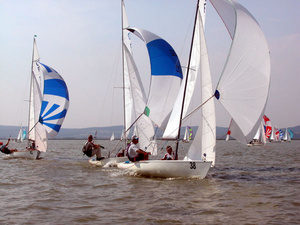 It was in the late 40’s that the IYRU (now ISAF) instigated a new modern 2-man international dinghy, the Tornado. She was not a success as there was no leap forward compared to the existing pre-war classes.
The Royal Loosdrecht Yacht Club, Conrad Gulcher’s club, obtained half a dozen Tornados and found them very uninspiring to say the least! Conrad had always been very interested in dinghy sailing and had collected any documentation connected with it. Pre-war he had enjoyed some international sailing in Germany and the UK and he had made many friends in the dinghy sailing scene. He imagined that with modern construction methods, moulded ply, a better boat could be constructed.
Being an Insurance Broker and not a designer he enlisted the help of Uus Van Essen, a naval architect and measurer for the Dutch Yacht Federation. They made a preliminary design and early in September 1951 it was sent to 30 top class helmsmen in Europe including Bossom (Z – SUI), John Cahmier (K -GBR), Charles Curry (K – GBR), Manfried Curry (G – GER), Ferry Laagwater (H – NED),Stewart Morris (K – GBR), Morits Skaugen (N – NOR) and Shorty Trimingham (KZB – BER), with the request to comment within two weeks.
The measurements were similar to the 15m2 Wanderjolle of mid-European lakes and popular Flying Fifteen. By the end of September 23 responses had been returned with sufficient new and sound ideas to redesign the boat.
Mr. Loeff, chairman of the CBC, was prepared to discuss the boat at the November meeting of the IYRU, only when he had seen her sail! This was hardly feasible but Conrad had the mould and hull built in one week and the boat finished in another! Complete with the Tornado rig it took to the water against the 12m2 Sharpie and Tornado at Loosdrecht one week before the IYRU meetings and Mr Loeff took the plans to the IYRU for discussion.
Then it was decided to hold trials in the summer of 1952 in Holland and the name the “Flying Dutchman” was born, suggested by Sir Peter Scott, the then president of the IYRU.
The trials were held on the Loodrecht lakes and on the open water of the Zuiderzee at Muiden. 17 boats participated, some especially designed like the Osprey and Typhoon, others were existing classes including Hornet, Caneton, Thistle, Sharpie, Rennjolle etc.
The results were clear and the FD was adopted however with the limitation “for continental lakes only” and another set of trials was set up for 1953 at La Baule on the open sea.
In the mean time the small job was replaced with the Genoa and a trapeze was added.
At La Baule there were again specially designed boats such as the Coronet, a smaller version of which later became the 505. Off the wind the Coronet with her bigger spinnaker and mainsail was faster (this is not just a recent problem!) but on the wind the FD won.
It was clear that the FD did very well on the open sea and the “lakes” limitation was lifted. The Class started to blossom thanks to the promotional activities of Conrad through the Bulletin and a well structured Class Organisation.
By the 60’s there were fleets in all sorts of places such as the Lebanon, 25 in Morocco, 20 in Portuguese East Africa, Argentina, Venezuela, Thailand, apart from those in Europe, North America, South Africa, Australia and New Zealand.
In 1956 the FD participated (Conrad and Bob Boeschoten) in the cross- channel race from Folkestone to Boulogne and was the fastest two-man dinghy in the race!
In 1957 the FD was selected to replace the Sharpie at the 1960 Olympic Games in Naples. In 1959 The Class President Slotty Dawes was presented a cup for the FD Week. The Week, with its unlimited number of boats were allowed from each country, this proved very successful. The Week was very competitive whilst remaining friendly, competitors lent each other sails! (no equipment limitation in those days!) and was well supported, in 1965 126 boats from 24 nations took part.
The FD rules were tailored to have one design speed factors i.e. hull shape and weight, foil shapes and sails restricted and the rest left open to encourage development. As new ideas have evolved they have often been taken up by other classes e.g. trapeze, spinnaker chute, double floor construction, windows in sails and numerous developments in fittings and even personal sail numbers.
The one design was guaranteed by the very simple, and consequently cheap and easily repeatable measurement system defined by Uss van Essen and born of his experiences as professional KNWV measurer.
Many well known yachtsman have had a spell in the FD for example Mark Bethwaite, the Diesch brothers, Paul Elvstrom, Hans Foch, Ben Lexcen, Cam Lewis, Peder Lunde, Stewart Morris, Keith Musto, Andre Nelis, Yves and Marc Pajot, Rodney Pattison, Ralph Roberts, Bruno Trouble, Ted Turner, Mike Macnamara, John Loveday, Jo Richards, Roger Yeoman, Will Henderson, Peter White, Pat Blake, Jon Turner and David Wilkins to name but a few.
Following the loss of Olympic status soon after the 1992 Olympics, the “Olympic circuit” regattas ceased to be available to FD sailors and there was a decline in the amount of international competitive sailing. However the FD became a realistic option for those without Olympic ambitions and numbers at World and European Championships when held in Europe remain high. At the 1995 FD worlds, 123 FDs raced from the same start line on Lake Garda, a stunning spectacle.
Class website:
http://www.sailingsource.com/sailfd/
Martin 242
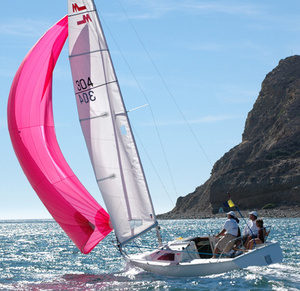 The M242 is a 24-foot, high performance, family-oriented day racer and weekender. Over 250 have been built since 1981, and there are large fleets on the West Coast of Canada and the U.S. The M242 Class is unique in that it has very rigid class rules to control expense and ensure even competition.
The total sail inventory consists of a main, jib and spinnaker. The roller-furling jib dramatically simplifies boat handling and encourages family crews.
They are currently being built by MG Marine, Inc 310-645-0196,
class website (fleet 1)
http://www.m242.bc.ca/
Olson 25
The Olson 25 was designed in 1984 by George Olson as a dry-sailable sport boat. A cross between the radical Olson 30 ultralight and the traditional designs of the day, the Olson 25 can perform better than cruising boats much larger, and yet is capable of comfortable family weekending. Manufactured by Pacific Boats and Ericson Yachts there were approximately 130 built.
The 2007 Olson 25 One Design season gets underway over the April 13/14th weekend with the four race “Resin Regatta” sponsored by the San Francisco Yacht Club. Twelve boats are expected to compete in this invitation only series.
Class website:
http://www.olson25.org/
Buccaneer 18
Comet
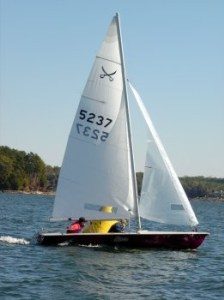
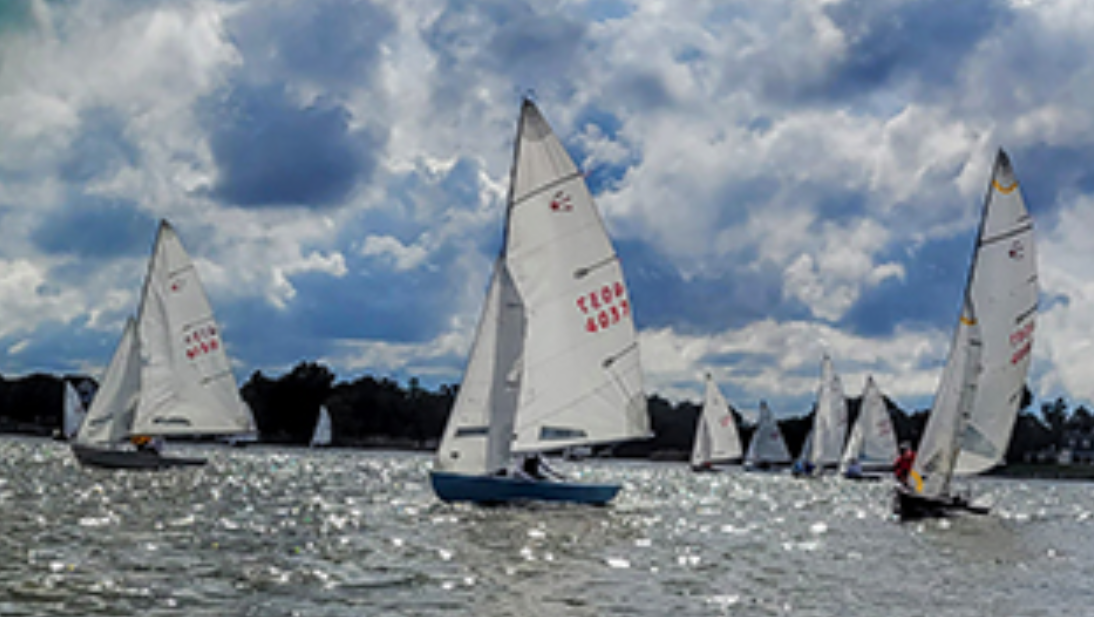
The Comet is a lively, hard chime, non-spinnaker, sixteen foot racing sailboat. Her light weight (260-295 lbs.), generous sail area (140 sq. ft.) and semi-flat bottom, make her easily driven to weather and can be planned off the wind in breezes of only 10 to 12 knots. The Comet carries a sloop rig (mainsail and jib), the mast stands twenty feet five inches above the deck and is supported by a fully adjustable three stay rig.
The hulls are available in either fiberglass or wood, and since 1972, fiberglass Comets have been fully self rescuing. They feature watertight side tanks or false bottoms which are self bailing in the event of a capsize. The boat has evolved greatly since it’s 1932 design by C. Lowndes Johnson and has kept pace with the times.
The modern Comet sports such nifty “Go Fasts” as vang sheeting, mast benders and depending on the skipper’s appetite for complexity, ball bearing travelers, and magic boxes for mast rake control. All sail adjustments may be placed on the cockpit coaming, to be at finger tip control from a fully hiked position.
Class website:
http://www.cometclass.com/
Read Elizabeth Dudley’s great piece on the Comet!
Beneteau 36.7
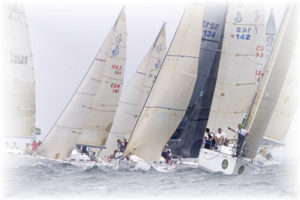 With over 200 boats sold in North America, the Farr designed First 36.7 has become the fastest growing One-Design Class in North America. A graceful balance between quality, performance and value it is no wonder so many sailors proudly sail her and smile. Whether you race One-Design events, beer can races or just enjoy cruising fast the First 36.7 is the boat for you.
Class website:
http://www.beneteaufirst367.org/
Byte
 Bytes
Bytes
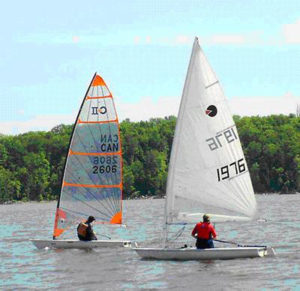
The Severn Sailing Byte Fleet is looking for Byte sailors to race and Bytes available for sail. Bytes are welcome to race or participate in a clinic on May 19 (demo with the CII rig), May 26 (race), June 30 (race), 8-5 (clinic and race), and 8-25 (race).
Please contact Rosemary Foltis at 410-263-1941 or Briget Barr at 410-263-2132 if you want to sail or sell a Byte.
Specifications:
Length: 12 ft
Beam: 4 ft 3 inches
Sail Area: 58 sq ft
Weight: 100 lbs.
Construction: glass reinforced polyester/foam sandwich
Class website:
http://www.byteclass.org/
Shark 24
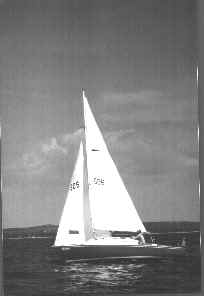 THE SHARK – from “A Touch of Class” by Judy Kingsley (#606 Windrift)
published in Canadian Yachting, June 1994:
Windrift
Judy Kingsley’s “Windrift” off Coboug in 1981
When George Hinterholler designed the Shark in 1959, he was looking for a boat that would “go like hell when the wind blew.” Growing up sailing in Austria’s Salzkammergut region, Hinterholler was used to light displacement finkeelers; fast, responsive and exciting.
The few sailboats he found on Lake Ontario when he immigrated to Canada in 1952 had heavy displacement hulls. They were ponderous and had a bad habit of hoppy-horsing in the rough Lake Ontario chop.
The young boat builder/designer was bored by their performance. Announcing that he could build a boat that would sail circles around the rest, he retired to the shed behind his Niagara-on-the-Lake home and built Teeter Totter, a hard-chined 22-foot sloop made of plywood. It was the forunner of the Shark. And when the wind blew, it did go like hell. Its designer loved it and so did his friends.
There was an immediate demand for the nimble little boat 35 years ago, so that winter Hinterholler increased the length to 24 feet and began building plywood Sharks in his shed. Hull number 5 was for a customer by the name of Bill O’Reilly who demanded that his boat be built of a substance relatively new to boat building; fiberglass. He even offered to teach Hinterholler how to use it. With fiberglass it took 18 man-hours to produce a hull instead of the 128 hours devoted to a wooden hull, and fiberglass was virtually maintenance free. That made his boat the affordable yacht and Hinterholler and Shark were on their way to International success.
Since then, more than 2500 Sharks have taken their place in the fleet, both on the North American continent and in Europe. It rapidly became the biggest one-design keelboat fleet on the Great Lakes and today their are active groups on the east and west coasts and in the Montreal and Ottawa areas. About 500 Sharks sail the large lakes of Austria, Switzerland and Germany and the waters off the Swedish archipelago.
There have been changes since Hinterholler first designed it, but they have been cosmetic. The sleek hull, straight stem, and long flat run at the stern, fin keel and spade rudder made it a racer that climbs easily over its bow-wave to achieve speeds in excess of 10 knots. The six-foot beam and doghouse accommodate a V-berth, two quarterberths with sink, stove and coldbox, making it a pocket cruiser with sitting headroom. It draws less than four feet, making it an ideal boat to tuck into anchorages denied deeper draught boats.
The Shark’s prompt success was due in no small part to its early racing record. In 1960, Hinterholler crewed for George Steffan, later President of Mirage Yachts, in the Freeman Cup. They cleaned up with three 1sts using brisk 18-knot winds to put a leg them and their nearest competitor in the race. In the 1963 Freeman Cup the Shark did it again. For small boats, the course was from Niagara-on-the-Lake to Rochester NY, 80 nautical miles along the south shore of Lake Ontario. There were no spinnakers and no genoas on Sharks in those days and the race was sailed with main and working jib only.
“We thought our biggest competition would be the “Thunderbirds,” Hinterholler said “but after the first surf, we knew that there would be no contest. We barreled down the course in seven hours and 44 minutes.”
In 1963, using a spinnaker on a close reach across Lake Ontario, Sid Dakin, one of the first to own a Shark, sailed the blockhouse Bay race from Toronto to Olcott, NY, with an adrenaline pumping average speed of 10.2 knots, beating the 56-footer Innisfree on a boat-for-boat basis. That sort of speed boggled the minds of sailors unaccustomed to semi-displacement hulls.
Racing boats come and racing boats go, but the shark remains. With its flexible rig and planing abilities, it is as up to date as anything on the market today. And, with its low-aspect, 7/8ths rig and heavy keel, it has a sea-kindliness and seaworthiness to match its speed.
Hinterholler admits that the Shark’s scantlings are better suited to a tank, but the proof of his wisdom in overbuilding the boat has been in its longevity. Virtually each of the 2,500 Sharks built in the last 35 years is still sailing and many of the first hulls off the line are still winning their share of races.
The Shark is seem sailing happily in all major Canadian cruising waters, but some owners have taken them much further afield. In 1972, Clive O’Connor, his wife, two year old baby and their guitar sailed their Shark from Niagara-on-the-Lake to Melbourne, Australia. They arrived in good form, still speaking to each other and their Shark, at last report, was still being used for research on Australia’s Great Barrier Reef.
Randal Peart sailed his Shark from Windsor and then crossed over to England, cruised the French canals, and then sailed BACK across and cruised the Caribbean for a year. He’s still alive and well and eccentric. If you’d like to correspond with him, he’d be happy to hear from you at: [email protected]
(Editor’s Note: The text of the above paragraph has been changed from the original, to reflect new information from Randal’s wife, Patricia, received on Sept 11, 2000)
On his return, he reported no structural damage and no bulkheads adrift, but he did ask for a new set of gudgeons to replace his worn ones.
More recently, Bob Lush added a foot to the stern of his Shark to bring it up to a minimum 25-foot size for the OSTAR single-handed transatlantic race. His biggest problem crossing the Atlantic was getting stuck in the doldrums and listening to empty sails slap for too many mind-destroying days.
The Shark is a forgiving boat which makes it appealing to novices, but with 14 separate lines to tweak, it is as technical as any sailor could wish. An active class association defined the Shark’s measurements and specifications as early as 1966 and in 1984, the association adopted a more formal measurement form patterned after a number of international one-design classes. The fact that all Sharks, both new and old have been built to these specifications has kept the racing fleet viable and maintained the market value of the boat.
The association is active at the international, national and regional levels giving Shark owners who are not part of a local fleet a point of contact and an active racing program. In addition to regular club races, there are regional, provincial and national Shark Class regattas. The highlight of each year is the Shark World Championship, a seven race series held for two consecutive years in North America and, in the third year, in Europe.
Host for the 1994 Shark Worlds, won by Don Ruddy in #268 Dartos, was the Niagara-on-the-Lake Sailing Club, the club Hinterholler helped found. Fifty-six Sharks competed in the 1994 event The World Championship in 1995, won by John Clark/Don Ruddy was held in Freidrickshaven on Lake Constance. Several Canadian Shark sailors competed in this event.
(Editors note: The host for the World Championship in 1996, won by Jeff Mitchell in #336 Frankly Scarlet, was the Kingston Yacht Club and in 1997, won by Don Ruddy in #268 Dartos, was the Buffalo Canoe Club. In 1998 the Championship, again won by Don Ruddy, was sailed June 6 – 12, at the Yachtclub Breitenbrunn, Neusiedlersee, Burgenland, Austria. The 1999 Championship was sailed at the Royal Canadian Yacht Club in Toronto, Canada and won by Sid Dakin in #1456 “Duck Soup”and the 2000 Championships at Parry Sound on Georgian Bay, in Ontario, was won by Don Ruddy in “Dartos
“. The 2001 Championship also won by Don Ruddy, was held at Yacht-Club Kreuzlingen in Switzerland and the 2002 Worlds is scheduled for Toronto,Ontario at the Mimico Cruising Club)
Class website
http://shark24.org/
Kirby 25
Objectives Of The Kirby 25 Class Rules
To maintain the K-25 as a one-design class with the object of providing fair competition between equal boats as well as providing a boat suitable for handicap racing and cruising.
To protect the owner’s investment and keep the cost of ownership as low as possible.
To maintain the high performance characteristics of the K-25 by permitting improvements to be adopted by the procedure for changing Class Rules as specified in the Class Constitution.
To have clear and precise rules which will be essentially self-controlling.
Class website:
http://www.kirby25.com/
C&C 27
 On Deck and Below
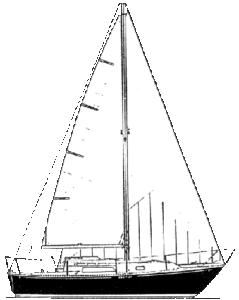
The C&C 27 has all the C&C hallmarks: a springy sheer, attractive bow profile and a well integrated cabin trunk. Thank you, George Cuthbertson, for the gracious lines of the C&C 27. The C&C 27 also enjoys a generous beam, reasonably high topsides, short overhangs, and a wide transom. Her keel is vintage C&C, with a sharply swept back leading edge. The Mark I and II have the scimitar-shaped rudder, which is long in the chord and shallow in depth. The Mark III and IV have a high-aspect-ratio rudder, with constant chord length, and greater depth.
On Deck
The foredeck is spacious, with the mast set well back. The raised coach roof comes up at a low angle from the high, cambered deck. Sloping side decks are of reasonable width, running out at the cockpit coamings, and the cockpit is big enough to handle a post-race victory party. The overall feeling from the deck is of a comfortable, well proportioned sailing yacht.
Below Decks
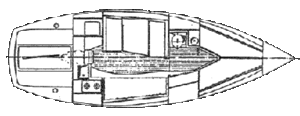
As you descend through the main companionway, you’d swear she’s a much bigger yacht. The 27 has all the creature comforts. The galley is both to port and starboard. This layout makes for plenty of counter space. The stainless sink and stove are to starboard, and a large icebox is to port under the counter. Lockers, drawers, shelves and storage space abound. The roomy main saloon offers standing headroom. To port the dinette seats four, and at night the table drops down to form a large single berth. A six-foot-plus single settee berth is to starboard. The head is forward and to port, with a large, open hanging locker opposite. A full length door separates the head from the saloon. The spacious V-berth will comfortably sleep two adults, and there is a folding door to close this area off from the head.
Performance Characteristics
The C&C 27 has always been a performer. Thirty-plus years after the first boats were built, 27’s continue to race (and cruise) on all the Great Lakes, and they enjoy any condition the lakes can provide. In the PHRF racing circuit, the C&C 27 has been a competitor for many years. Any 27 which is well sailed can be a club champion, and many are. Several clubs on western Lake Ontario actually have enough 27’s to have their own one-design fleet for club racing (see Links).
Between races, the 27 is a very comfortable and trustworthy cruiser. The Marks I and II are very stable boats, able to carry maximum sail area in stronger winds. George Cuthbertson originally designed the Mark I for ocean sailing. By comparison, the Mark III and IV move smartly in lighter airs, which the Great Lakes are afflicted with in July and August, when many other boats this size simply do not have enough rig to sail acceptably. All the 27’s reach very well. They easily keep up with the fleet from port to port, and usually lead the cruising sailboats under 30 feet.
Commercial Notes
The C&C 27, a Canadian classic, represents a low-cost alternative for those wishing to buy a moderately-sized, high-performance racer-cruiser. They are an excellent example of how long a properly built fibreglass boat can last, with a proven reputation as strong, well-designed and well built boats. The fact that these boats continue to race successfully at both club and interclub levels, is testimony to their heritage.
The C&C 27 is also one of the reasons many yacht manufacturers have gone out of business. With nearly 1,000 hulls produced, most have shown no serious signs of aging. There are neglected 27’s (a condition that often shows up as delamination of the deck, but any potential purchase should be inspected by a competent surveyor), but most of the hulls are in a well maintained state, and have no foreseeable retirement.
New sailboats of similar size cost approximately $60,000 to $80,000, and depreciate rapidly in the first year. Currently (in the late 90’s), it is possible to buy a well-kept C&C 27, 12 to 25 years old, for about a third of the replacement cost. As many new owners on a budget will agree, a well equipped 27 can be acquired for under $20,000, ready to race and/or cruise. Later model 27’s in pristine condition list for $25,000 plus.
Despite the variations in the four different C&C 27 versions, all boats race together without handicapping. To equalize these variations, the Association has developed maximum permitted sail measurements for each of the four different rigs (see below). It has been “generalized” that the Marks I and II place higher in heavy air races, and that lighter winds bring out the best in the Marks III and IV. These generalizations are usually put to the test each season by the performance of certain skippers. To clarify the differences in the four different versions, and the adjustments made to equalize their performances, the following tables can be used.
Class Overview
The C&C 27 has always been an affordable one-design racer/cruiser. To keep things both friendly and affordable, the 27 Association has adopted the following sail material regulations.
- Mainsails – laminated materials and loose-footed mainsails are permitted.
- Genoas – no material restrictions.
- Spinnakers – restricted to nylon.
The flexibility in genoa materials keeps the boats competitive for club racing, and has not been a problem within the Association. Frankly speaking, there are no millionaires lining up to buy a C&C 27 championship, and many 27’s sail competitively with well seasoned canvas.
Class association website:
http://www.cc27association.com/