Sail1Design would like to welcome new High School Reporter Paige Hoffman to our team, as our Northeast High School Sailing Airwaves Reporter. Paige started sailing at age ten at Duxbury Bay Maritime school. By age twelve, she was competing in Optis and transitioned to 420 sailing when she was fourteen, becoming a member of the Duxbury High School sailing team as a freshman in high school and racing through club programs at Duxbury Bay Maritime school in the fall and summer seasons. In the summer, she works as a Junior Sailing Instructor at Duxbury Bay Maritime school, teaching younger sailors the fundamentals of sailing. In 2016, she helped her team win the Mass Bay League Team Race Championship and was named co-captain of her team for the 2017 spring season.
With much of high school and college sailing concentrated in New England, there are significant number venues in the Northeast hosting regattas throughout the spring season. In this article, we will take a closer look at some of the venues commonly used for high school sailing, and what to expect when racing there.
Cape Cod Academy senior Meg Wilson had a lot to say about Wianno Yacht Club in Osterville, home to CCA’s varsity sailing team. “The wind conditions generally settle around 5-12 knots in the spring but there are always lighter days. It is easy to understand the patterns of oscillations of the wind here and use them to our advantage on the race course. Cape Cod Academy owns both a fleet of c420s and a fleet of FJs.”
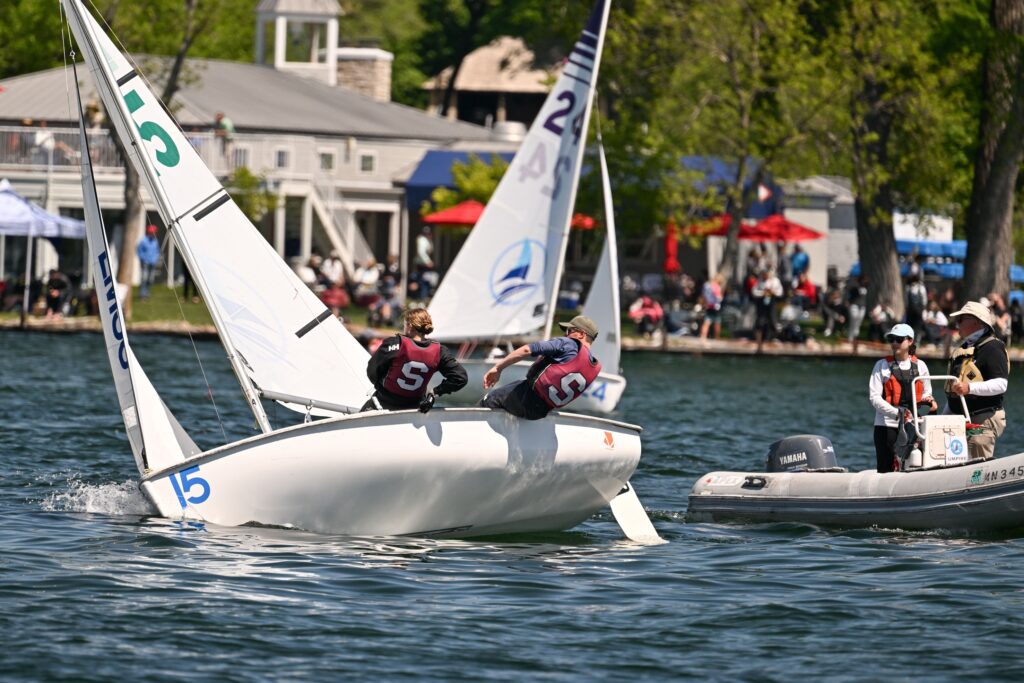
One of Tabor Academy’s senior crews, Max Williams, had similar knowledge to offer about sailing conditions there. “Buzzards Bay has a history of being a windy venue. When the wind is blowing from the south, the southeast, or coming from the mouth of the harbor, one needs to protect the right especially because righties always come in. Even if the puffs are to the left, the ones who get right often fair better. The wind this year was very strange, there were many pressure drops and crews had to be extra careful not to over flatten during tacks because there are so significant ones even in big breeze.” Having sailed at Tabor myself, I can definitely attest to Max’s experiences there. At this year’s O’Day Qualifier at Tabor, wind conditions were so extreme that there were capsizes and breakdowns occurring every race.
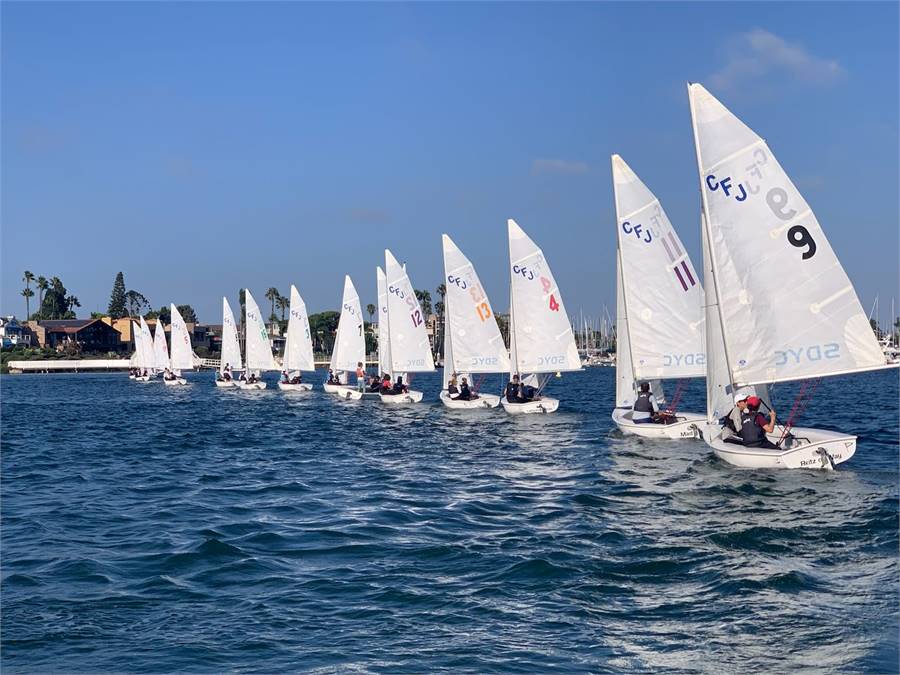
Another venue that many high school or junior sailors will race at is Scituate. Scituate Junior Regatta, which is hosted by Scituate Harbor Yacht Club, has run for 28 years, and is a very popular racing destination for summer sailors all over the region. In the spring season, Scituate harbor is an ideal destination for sailing with the absence of summer moorings. The range of wind in Scituate is very sporadic. The current in the channel can be a significant factor when racing, causing the current and wind to move in opposing directions.

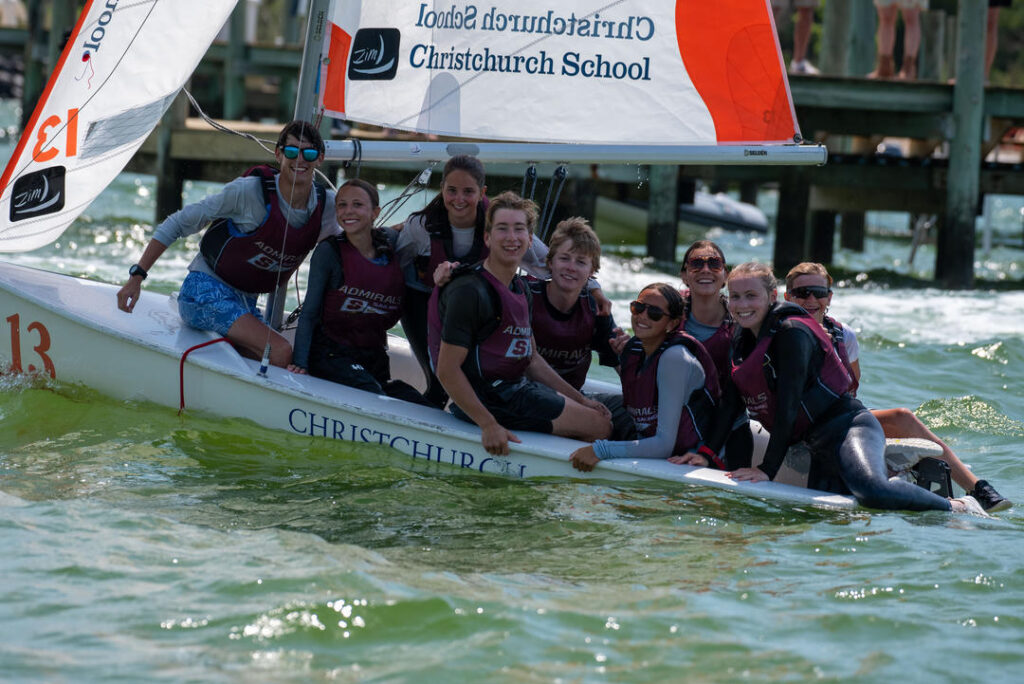
Some Scituate sailors having fun in the preseason
If there were one thing to emphasize about Duxbury in the spring, it would be wind. Duxbury is known for being very windy in the spring, so be prepared for lots of hiking and bailing when sailing there. Current is a significant
factor here, and sailors should know the tide schedule so that they can predict how current will affect their starts and mark roundings. The team’s fleet of 12 z420s is just one year old, and the sails have only been used for about a month. As with all z420s, they are faster and more responsive than c420s, and crews are able to sit farther forward in the boat. In the summer, wind conditions in Duxbury change drastically, with most days very light or moderate breeze.
The Charles River is perhaps the most fascinating place to sail in high school. Most high school sailors spend the majority of their sailing time in lakes or bays in suburban areas, lacking the distractions of a busy city venue. Sailors on the Charles River are exposed to an extreme variety of wind conditions. The wind generally blows from the west around 10-20 knots. However, some days provide more challenging conditions. The Charles river has its fair share of extremely light days and very windy days, there tend to be significant shifts every race. Northerlies and southerlies offer sailors especially shifty conditions because of city wind tunnels. In general, sailing on the Charles gives a sailor practice in both light and heavy wind while tuning them to react quickly to shifts and puffs. If you sail at Community
Boating, you could sail in either c420s or Cape Cod Mercuries. The latter boat is very different from any racing boat other programs use and is built more like a keelboat than a dinghy. Just up the river at MIT, sailors might sail in either an FJ or Firefly. Fireflies are similar to 420s, with the crew sitting facing the mast, but lacking jib cleats, just like in an like an FJ. They roll hard, and crews need to trim the jib slowly coming out of tacks to get maximum speed.
These are just a few of the many, many places that you as a high school sailor will race at. It is important to be open minded about rigging and tuning wherever you sail, and to get a feel for the conditions on the water. With much of high school sailing taking place either after school or at one-day weekend regattas, there is very little time to devote to this, so it is more important than ever to be efficient at understanding the conditions at unfamiliar venues and coming to conclusions about how this should affect your sailing even before you rig your boat. This will give you a leg up over less perceptive sailors, and therefore, an advantage on the race course.
Ken Legler is an icon in the sailing and coaching community. This editor humbly suggests that Ken is one of the most knowledgeable, dedicated people that has ever graced the sailing community. As a Tufts grad, I will admit that I may well not be objective, but I was a hockey player at Tufts, and still his influence reverberated around campus when I was there. Few have had greater dedication, vision, success, and willingness to counter the current than Ken, (carbon mast Larks!) and the few times I sailed Larks at 
at should this event be sailed in?
ON COLLEGE SAILING
PERSONAL STUFF
Adam Werblow will be entering his 28th season as the head coach of the 


In short, I love it! If I were to win the lottery tomorrow, I would be back with the Seahawks the next day (ok–maybe there would be a wild bender first, but I’d be back within days). I believe in small class sizes and an enriching environment for students to explore their intellectual selves. As The Public Honors College for the State of MD, St. Mary’s is set in an idyllic setting on the water. In this manner, St. Mary’s provides an academic utopia for motivated athletes that is really unique. The Chesapeake has beautiful long fall and spring seasons making it ideal place to train for College Sailing. Our central location amongst the most prestigious hosting venues means that the major national regattas are often in our backyard.
Race 18B, for the championship, saw Yale, Georgetown and CGA all in the lead pack off the line with BC looking slow on the wrong side of the course. Nikole Barnes showed the blistering speed she has exhibited all season and ran away with the bullet. Georgetown hung on to a 3 for the win and Yale turned in a 5 to round out the top 3.


Many women made clear that the Sperry Women’s Championship event and women’s events in general prove to be some of the most rewarding experiences of being on their teams. Hope Wilson, a graduating senior on the Dartmouth sailing team, had time to reflect on her years on the women’s team. Hope said “My favorite part about being on this team is definitely the people. We have such an awesome group of people who are always excited about getting better every day, so it is hard not to have a good time with all of them.” Hope later reflected on the laughs shared within the women’s team and the irreplaceable experience women’s sailing has been for her.

Sammy started her sailing career at age five in the “Starfish” program at Bahia Corinthian Yacht Club (BCYC) in Corona del Mar, CA. She raced her first regatta at seven and was soon Sabot racing throughout Southern California. Sammy graduated from Sabots to C420s and CFJs, club racing for BCYC and as a varsity member of the Corona del Mar High School Sailing Team, where she helped the Team win the 2016 Pacific Coast Championships. Sammy is a volunteer coach at BCYC, aspiring doctor, and rising junior at Corona del Mar High School. You can reach Sammy at 
Everyone defines sportsmanship a little bit differently. In an interview Dave Perry defined sportsmanship as saying, “It’s an attitude of respect for the game, the rules, the people you’re racing against and the officials. Respect means you go about your job of competing fairly within the rules and try your hardest to win, without doing anything that is unfair to others.” This definition of sportsmanship is spot on. In sailing we are always trying to win the race, but in doing so we must compete fairly. Not only does sportsmanship mean we compete fairly, but we show respect towards our, competitors, teammates, and race committee. Sportsmanship is the fundamentals of sailing that every sailors needs to follow and enforce.

Paul Elvstrom, a famous Olympic sailor once said, “You haven’t won the race, if in winning the race you have lost the respect of your competitors.” This famous quote on sportsmanship is the essence of sailing. Sailing is a sport where you only win when you respect all aspects of the sport. We ourselves must monitor and protect the integrity of sailing. Sportsmanship is the foundation of the rule book, with the key components being; take your penalty turn even if no one saw what happened, or the boat you foul doesn’t protest you, enforce the rules, be respectful to your competitors, teammates, and race committee, and be a role model. Lets keep sailings integrity, and remember the next time your on the water the key components of sportsmanship!
I would bet that you could take a good coach, put him or her in a new sport, and that coach would find some success. Think about the best coach you ever had, and visualize that person in another sport, and you might see just how that person could adapt and still be a difference-maker.


During the sailing journey, each youth works with a mental health counselor to create their own