Congratulations on landing your first summer coaching job. Life as a coach is different from as a sailor, more responsibility and more freedom. Making the most of your summer is all about managing your responsibilities so you can capitalize on your freedoms. Between sailors and members there are plenty of responsibilities and pitfalls to be avoided. Here are some tips and tricks to a smooth summer.
Names, Ages, Numbers

Always, always know at least one of the three things above about your class, preferably all three. This is your first year, chances are you are a Beginning Opti coach and get to spend the next 10 weeks with a group of screaming 7-9 year olds.
It will be the best summer job you have ever had.
Learn everyone’s name. Most of us are not inclined to picking up names readily. Everyone, meaning literally everyone not just junior sailors, but other staff, members, afterguard, coast guard, the guy at the gas pump, learn as many names as you can. People like it when you call them by their name and are much more inclined to help you when you are inevitably in need.
Sailors respond to names. It is hard to tell the kid in the orange life jacket to do something if you aren’t directly addressing him or her. They all know your name; you need to know theirs as well. Name games are typically one of the least favorite things about the beginning of a summer, but after associating someone’s name with a piece of fruit over and over for ten minutes it is hard to forget. If you are still hard pressed to remember, a failsafe is a piece of duct tape on the back of the lifejacket with a name written in permanent marker.
Know the age group. What entertains an 8 year old will bore an 11 year old and have a 15-year-old turn his or her iPod to deafening. Pay attention to them and they in turn will pay attention to you. If you see a group starting to fade in an activity, switch activities before it has the chance to completely break down. Most kids already think you are pretty cool; you are older than a sibling but younger than their parents. By knowing your audience, what movies they like, the TV shows they watch, the YouTube videos they obsess over, you are much more likely to gain much needed respect and attention.

Numbers. This one is self-explanatory but is important nonetheless. Always know how many are in your class and if you currently can see that many heads. Just basic safety measures and by the end of the summer, making that headcount will be second nature. Numbers also matter for programming. Which drills you can do, duration of each one, timeline of the class, are all directly affected by how many kids you have on that given day. If you have a roster of 18 and only 10 show up, your chalk talk, rigging demonstration and tacking drill just got shortened and that is now space you need to fill some other way.
Yacht Club Life: Adjusting
Most people coaching junior sailing have some experience in the program. There are always exceptions to this rule, if a sailor learned after junior sailing age for instance, or if it is your first time at a new yacht club. Regardless of whether you were born on the balcony of the yacht club or this is your first summer in junior sailing ever, there are some adjustments to be made. You are now an employee, not a member (even if you are one of those too) and everyone knows who you are and what you are doing or have done. Make good decisions.
Game Plan: Have One
Planning your day/week/session in detail will help you when you show up two minutes before the morning meeting on six hours of sleep and no coffee in sight. It happens. Planning will also keep your director happy, give your kids a clear path for learning and allow you to involve fun events. Your lesson plan doesn’t have to be a three page detailed document, but jotting down six hours of drills for a four hour time slot will allow you to change gears quickly.
Programming for your summer will help your weeks flow and provide focus for your lesson plans. Think about where you would like your class to be at the end of the summer and plan backwards from there. Spending the time to do this at the beginning of the summer will save hours of headache at the end when you are at a loss for what to do with your class.
Big Picture: Enjoy Yourself
The most important of any summer spent on the water is to remember to have fun. What made your years in junior sailing fun? At the same time, how can we construct lesson plans that are constructive and fun? This all pertains to the first point of knowing the group you’re coaching. Everyone gets burned out by the end of the season, its inevitable. Recognizing that coming on and adjusting accordingly so that you stay fresh is the key to finishing a summer strong.

Get to know your coworkers. Growing the trust and comfort level will help you survive the summer. Go to the movies, get dinner, race together, do something as a team, whatever it takes. Some of them will become life long friends; some will only be summer acquaintances, but spending large amounts of time with them is unavoidable.
You have the best summer job possible. Don’t forget that.
Blog
Coaches Locker Room: Building a Resume
Building a Resume
Whether this is your first coaching job or your last (or so you think), your resume is the first interaction you have with the program director, head instructor, or hiring manager. Building an effective resume is one of the most important parts of landing your dream job. In sailing, just as in any other industry, there are several key aspects of your resume that will increase your odds of getting an interview: formatting, content, relevancy and length.
Formatting: Be Organized
When reviewing applications for a position or positions, most resumes get a quick scan when they hit the desk of whoever is in charge of hiring. Increase your odds of getting a second read by keeping your resume organized and simple. Uniform fonts, wide margins and equal spacing are a start, paired with offset bullet points for important information and organization help create a simple effective document.

Uniform font also applies to color. Keep the whole document in a simple font such as Cambria or Times New Roman. Mixing in wingdings or Brittanic Bold is never a good idea; it is unprofessional and displeasing to the eye. Effective use of italics, bold and underlining can help draw attention to important information and guide the reader through the resume. Additionally, offset bullet points organize important information into concise, easily read sections.
Content: Short and Sweet
When it comes to resumes, length matters. You should never feel like you need to fill up space for the sake of making your resume longer. One to two pages are acceptable for the vast majority of the positions for which you will be applying. Potential employers want to see the following categories:
- Header with personal information
- Education
- Professional Experience (paid or unpaid)
- Achievements (race results, awards, etc.)
- Skills/Certifications
At the top of the document should be a simple header with your name, contact information (phone number, email address, physical address). If you plan on moving due to school or other circumstances, put a permanent address (such as your parents house) down as well.
Education should list your high school and college with dates of attending, location of the school, and what you studied (degree, major/minor). You can include time abroad, any job training you may have, certificates earned and GPA if over 3.0 (individual employer requirements may vary).
Professional Experience is a big section. This is where you list your previous jobs, internships or other relevant experience. When listing jobs, be straightforward with the position title and briefly describe what you did. It is best to avoid using big industry terms or over-inflating the importance of your position.
All program directors are looking for someone with adequate experience. Often times this is quantified through race results, awards, or achievements in sailing. If the job listing specifically asks for race results and you provide none, your resume is probably going to the bottom of the pile. Organize all your accomplishments in sailing (results, awards, etc.) into a section that is easy for the hiring manager/program director to read and understand.
The assumption is that when you are applying for a coaching position, you either have taken your Level 1 certification or you are planning on taking the course in the near future. It is a long course and while not outrageously difficult, it is a lot of information in a short time and you deserve recognition for that. List your certifications such as your Level 1, CPR/AED/First Aid, and so on.
Relevancy: To The Point
Keep your resume relevant. Many people have several different copies of their resume edited for slightly different positions. The content in your resume for a head coaching position will differ from other positions to which you will apply. This applies to the accomplishments and experience sections mainly.
Job history is important in that many hiring managers are looking for someone who has worked somewhere doing something previously. If you have only held a couple positions in your life, great, list those positions. If you have had many jobs in your life, list the ones that pertain to the position that you are applying for. Same with accomplishments, list what you think has helped you become the candidate you are today, or that demonstrates why you are a good candidate.
Length: Short and Sweet
A popular question is, how long should my resume be? The answer is between one and two pages. Your resume should never be shorter than a page or longer than two. Keep descriptions to the point and only list the experience and achievements that help your candidacy. Be direct and specific.
Putting It All Together
Your resume is the first interaction that your potential employer has with you. They don’t know anything about you besides what you put down on that page. Crafting a good resume is difficult and while these tips will get you on the right path, always consider consulting someone you know who has experience reviewing resumes. A well-written resume will open a lot of doors down the road. Be concise, make it relevant to the position, include your pertinent content and make it look good with proper formatting. You will be one step closer to landing the best summer job out there.
Do you feel ready for summer yet? Check back here for more tips and tricks to landing your dream coaching job, and as always you can email [email protected] with questions or if you’d like to see a particular article written.
Coaches Locker Room: Sailing Job Hunt Advice
By Airwaves writer Tyler Colvin.
So you want to coach sailing? Great, welcome to the best summer job you will ever have. Whether you are in high school and a junior sailing veteran, or a college athlete with minimal yacht club experience, there are several things to think about when applying to your first coaching job: location, job description and program size. Sail1Design happens to have the largest sailing/marine industry career center in the sailing world! Check it out.
Location: Where in the World?
If you are planning on applying to the club you grew up sailing at and know intimately, you can skip this section. Location of the club will impact your coaching game plan for the summer, stress levels and social life (important for your own sanity). Finding the best balance for your own personal preferences will help you become successful and get the most out of the best summer job ever.

Factors such as lake sailing versus ocean sailing, venues with lots of current or tidal change, and wind tendencies are all physical features of the club and sailing venue that will impact your ability to be an effective coach. If you grew up on a lake and go to a club on the ocean you suddenly have to deal with tides, large waves, kelp, increased traffic, the list goes on. Be comfortable in the setting that you are applying to, and if you aren’t comfortable, find a way to spend some time before the session starts adjusting to the conditions.
Off the water, location is just as important. Having fun outside the club is key to a good summer as well. Isolating yourself in Northern Maine at a club where the nearest town is several miles away is great if you are ready for that situation. However, if you still want to see your college friends, family, crew, whoever, it could be a difficult place to be for 10 weeks. Also if you are a race coach, the further you are from other clubs, the longer your regatta trips become.
Job Description: What Am I Ready For?
Read the job description. Read it again. If you have any questions, email or call the point of contact and inquire. No matter the boats you will be coaching in, age groups matter, as do sailing abilities. Know the age group and ability level you will be working with, if you are uncomfortable working with small children then a Beginner Optis Coach position may not be for you.
Time commitment in terms of length of program and weekly hours should also be outlined in the description. If you are applying to a club far from home, know that for 10 weeks this summer you will be away from friends and family. That sounds great for some, but can be a deterrent for others. Knowing the time commitment allows you to also plan your own life, racing, gym time, a second job, whatever it may be.
Program Size: Size Matters
The size and extent of the programs you are applying to can vary drastically. There is a huge difference between a summer camp with four sunfish and a 420 from the 70s, and a 300-sailor program with 36 club owned boats, 18 privately owned boats, and a coaching staff that rivals small college athletic departments. Not only are there differences from the obvious size and skill level, but also mentality and philosophy play a role.
Big competitive programs tend to also have big money and big personalities amongst parents. You will work with some incredible sailors and staff, make a huge number of good connections and have a large support group behind you. Conversely, you will deal with lots of, well, enthusiastic, parents. Small programs tend to be more relaxed and have a more fun learn-to-sail atmosphere. The trade off there is more responsibility if things go wrong, fewer people to help out, and you still might be one or two of those involved parents.
Ready, Set, GO…Get Certified
Some programs may require, most in fact will, a certification of some sorts. CPR/First Aid are standard, but the big one is your US Sailing Level 1 Certification. This multi-day course covers everything from drills, to basic boat handling and motorboat skills. Regardless of whether you think you need it or whether it’s required, get this certification. It is unbelievably helpful with programming and curriculum development as well as covering any situations that may arise. Beyond that there is the insurance, which covers you for a huge amount on top of the sailing program’s insurance.
Do you feel ready for summer yet? Check back here for more tips and tricks to landing your dream coaching job: http://sailingjobs.sail1design.com/
NEW, UPGRADED VIPER 640 CLASS WEBSITE LAUNCHED
December 8, 2014-FOR IMMEDIATE RELEASE
The Viper 640 Class Association has continually emphasized providing a contemporary website to support a modern growing class. From its founding the Class was launched with an interactive website that allowed all of our members and prospective members to access information, share stories, share boat tuning tips, and engage in friendly banter on the Class forums. Deservedly, the Class website (www.Viper640.org) has won various awards including One-Design Class Website of the Year. However, the Viper Class has not rested on its laurels. Web technology is continuously evolving and so is the Viper Class. The growth of the Class as an international organization with fleets in Europe and Australia in addition to the USA, Canada, and the Caribbean, has presented us with the opportunity to upgrade our website and build a global platform.
The Class Association retained Strawberry Marketing to develop a new website for the Class. The redesigned Viper640.ort website was launched on December 8, 2014. The new site combines a modern visual presentation of the Class, more user-friendly, intuitive navigation, and easier inputting of member-generated content. The Class is appreciative of the effort by David and Danielle Pitman and Oriana Humphryes from Strawberry Marketing for their brilliant creative and technical workmanship. The Class would also to thank Fletcher Boland, Chairman of the Viper 640 Web Committee and professional website designer, and immediate past Class President Peter for the many hours they put in on behalf of the Class. Finally, the Class would like to thank Rondar Raceboats and EFG International who made it financially possible to upgrade the site to such a high standard.
The new website has arrived in time for a very exciting 2015 sailing season around the world. The Viper season starts in January in Sydney Australia with the Australian National Sports Boat Championship, an EFG Viper 640 Pan-American Championship qualifier regatta. It includes the Florida winter series in Sarasota, the EFG Viper Pan-American Championships in March in Miami, Long Beach Race Week in California, the Euro Cup on Lake Garda, Italy, the Canadian Championships in Kingston Ontario, a series of championship regattas in the UK, and October’s Viper 640 North American Championships just outside New York City in Larchmont, New York.
The Class looks forward to seeing old and new class members in 2015, including David and Danielle Pitman who were so impressed by the content of the new website that they have gone and ordered a new Viper for themselves.
Staying Fit in the Off Season
By Airwaves writer Lydia Whiteford
With all of the regattas over and Thanksgiving break behind us, college sailors all across America are officially done with their fall seasons. For the moment, all we have to worry about is preparing for our final exams and picking out Christmas gifts. However, time moves quickly and the frigid spring season is just around the corner. For most of us the winter months are considered cherished time off, but it is important to remember that this is also prime time to get into tip top shape so we can be as prepared as possible for the kick-off in the spring.
For most schools, the first regatta of the season is the first weekend in March, but many schools start practicing as early as January or February. The spring season is often cold, and full of fronts that make it windier than the milder fall. If you’re not careful or prepared, it is easy to pull or otherwise damage rusty hiking muscles, and that could result in an injury that could ruin your whole season. Spring is also the time for team racing, which is fast-paced and labor intensive, so being in the best shape possible only adds an advantage for you over your opponents. These are my best tips for keeping active and preparing for the amped up season to come.

- Come up with a Regimen– The schedule in the winter is much more stable for many college sailors than it is when we are in season. During winter break, many people have up to a month off with no school to worry about, and in the interim between seasons the 3-4 hours a day that were previously occupied by practice are opened up. What this really means is we no longer have an excuse to neglect our gym memberships. I find it helpful to incorporate those now empty hours into a new routine, and keep a regimen that is easy to follow but variable enough that it won’t get too boring. I’ve found its really important to mix in as much cardio as possible, because lifting weights all winter will likely lead to weight gain that you might not want to have in your boat when the season actually starts. Here are some things that I like to do, which are slightly more crew specific because that’s what I know best.
Running (20–40 minute intervals)-I find this to be one of the best ways to get into shape because you can go at any pace you want, and nothing’s better for keeping all of your leg muscles conditioned.
Biking: (45-1 hour intervals)- This is my favorite alternative for running, because it focuses a lot of time on your quads and can strengthen them without weights.
Swimming: (30-45 minute intervals) – This is another excellent cardio option, because it gives every muscle an intense workout while being easy on your joints. This is especially good for crews, who often develop knee or back problems just from the way they handle the boat. Also, when you are swimming you can pretend that you are in the ocean and that it’s not the middle of winter.
Abs: (varying intervals) – The one thing I consider the most important in my ab workouts is remembering to alternate exercises. This is best achieved by creating a mini-regimen for yourself depending on the days. For example, one day maybe you do a plank, sit-up, side crunch circuit one day and then a totally different set of exercises the next day. The goal is to get in as many reps as you can, while also targeting as many different areas of your abdominals as you can.
- Find a Workout Partner: Everyone has experienced the struggle of knowing you need to go to the gym, but also knowing there’s a “Friends” marathon on TBS that you really can’t miss. The best cure for this is to find someone to workout with you, so that you have an obligation to go to the gym. Also, working out with a buddy makes it more fun! You can do exercises for pairs; take a class, run races, anything that makes you get off the couch. It’s always fun to meet and surpass goals, and having another person alongside you to do that means you always have someone to push you when you’re down and congratulate you when you hit a new peak.
- Stay Healthy: Winter break is a priceless amount of off time for college sailors. It is one of the only opportunities we have where we don’t have classes, practice, or regattas to worry about. As a result, it is important to take full advantage of this time to catch up on sleep, eat well, and relax so that your body can be at its healthiest when you return to school and to sailing. In the spring, air and water temperatures are frequently below freezing and if your body is ill prepared, it can spell sickness or injury very easily. So, the biggest piece of advice I have for college sailors during these precious weeks off is to confirm to them that it is okay to not think about sailing for a little while, if you need to focus purely on improving yourself first. We devote so much of ourselves to our sport that needing to take a little time off during the winter is only natural, and often it will make you a more refreshed and ready sailor come spring time if you intentionally use this time to pursue other interests and keep yourself healthy.
Hopefully, this article is helpful in reminding college sailors everywhere that staying in shape is critical for a good performance in the spring. Granted, many of the exercises I’ve recommended are crew specific, and maybe they’re even me specific. This is not a rigid list, and there are all sorts of useful types of exercise that you can do that I haven’t listed. The best resource for motivation are those around you who know what you need – teammates, coaches, and family members all make excellent work out partners and resources for new things to do when you feel like you’re in a rut. And, as always, the most important thing to remember is that any exercise is productive exercise!
DN Iceboat
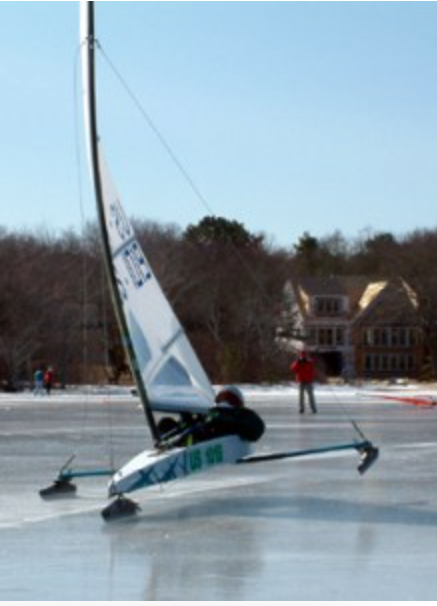
The DN name originates from Detroit News, where the DN was first designed and built in the winter of 1936-1937. It was built in a hobby shop at Detroit News to fulfill the demand for a simple and affordable ice yacht. Since then, the boat has evolved considerably, but has not strayed away from the original parameters. The wooden hull is 12 ft in length and sits atop of an 8 ft wide beam known as the runner plank. Unlike a stern-steerer, the DN has a tricycle configuration, meaning that it has two runners (the steel skates that the boat rides on) aft on the outboard ends of the plank, and one steering runner forward at the very bow. Many newer boats feature upgrades such as lengthened insert runners and an extremely flexible carbon-fiber mast. The mast is 16 ft tall, allowing for a mainsail area of 60 sq ft, which is plenty when you’re sailing at these insane speeds.
See Sail1Design’s full article and profile on the DN HERE
DN Class: